
Benjamin Song’s mother was a regular presence at the trial. She wore elegant pants suits and professed absolute confidence in her son’s innocence. At least publicly, the defendants’ loved ones seemed loath to blame Song, and instead floated various theories for what had happened that night. Maybe the police officer had shot first, and Song had fired in self-defense, or to protect another protester. Maybe he had aimed at the ground, but misfired. Only one parent quietly condemned the shooting to me. “I think it’s despicable,” they said. “It made what everyone else did terrorism.”
In the aftermath of the shooting, law-enforcement officers searched the defendants’ cars, apartments, and a brick home, affectionately nicknamed the Big Gay House, where some of them lived. They seized more guns, body armor, and a printing press. They took pictures of a hoodie that said “chinga la migra,” stickers that read “be gay do crime,” and a drawing of President Trump with a swastika. They looked into the Emma Goldman Book Club, an anarchist reading group that several of the defendants belonged to. They collected publications with titles such as “Organizing for Attack! Insurrectionary Anarchy,” “Visualize Industrial Collapse,” and a zine titled “The Satanic Death Cult Is Real,” which offers a feminist analysis of horror movies. Law enforcement pulled over Daniel Sanchez Estrada—Rueda’s husband, who was not at Prairieland that night—on the suspicion that he had removed a box of explosives from her home. The box turned out to be full of more zines and an old love letter. Sanchez Estrada was charged with conspiracy and hiding evidence; he, too, was found guilty.
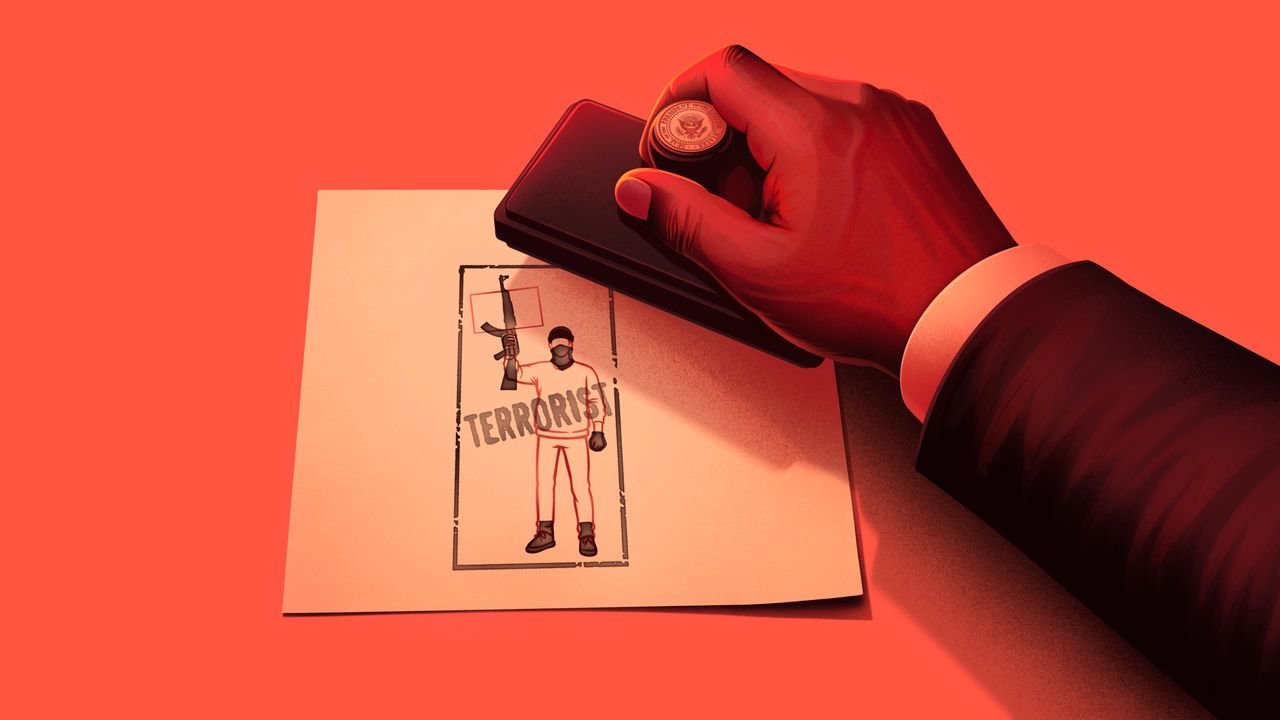
Although none of the publications were illegal—nor were the guns, the defense attorneys noted—the government argued that the evidence pointed to a shared ideology. In Assistant U.S. Attorney Shawn Smith’s closing statement, he said that the defendants should and could have known that Song would shoot a police officer, “because of Antifa.” Unlike other groups designated as terrorist threats, Antifa is more of a set of tactics and a political philosophy than a discernible group. Broadly speaking, it refers to a form of militant antifascism that embraces direct action—confrontations with right-wing protesters, say, or infrastructure sabotage. But the Trump Administration has embraced a more capacious definition. In the Presidential memorandum, Trump characterized the “common threads” of antifascism as “anti-Americanism, anti-capitalism, and anti-Christianity; support for the overthrow of the United States Government; extremism on migration, race, and gender; and hostility towards those who hold traditional American views on family, religion, and morality.”
Some coöperating witnesses, who pleaded guilty in exchange for lighter sentences, were asked by prosecutors to identify defendants who were aligned with Antifa. But when questioned by defense attorneys, they described their and their friends’ political beliefs using a range of labels: libertarian, socialist, communist, anarchist, and anti-authoritarian. The government attempted to reconcile the hodgepodge of leftist ideologies and micro-factions through the testimony of Kyle Shideler, a director and senior analyst at the Center for Security Policy, a far-right think tank. Shideler, who has put himself forward as an expert in radical Islam and “Black identity extremism,” is also focussed on Antifa. Shortly after Kirk’s assassination, he published a “roadmap for the Trump administration” detailing how to “dismantle far-left extremist networks”: targeting progressive nonprofits that may provide funding for leftist organizations and revoking visas for people who “demonstrate support” for anarchist or Marxist groups. According to the roadmap, environmental or abortion-rights groups are also potentially suspect, since they may be used “as a recruiting tool to activate individuals . . . and bring them further into a movement whose true objective is revolution.” Shideler is a regular guest on right-wing podcasts and cable-television programs, but this was his first time testifying as an expert in court. In his testimony, he purported to pinpoint various “hallmarks” of Antifa in the defendants’ behavior, including using Signal, wearing black bloc, and crowdfunding.
Later, I spoke with Tom Brzozowski, a former counsel for domestic terrorism at the Department of Justice’s National Security Division, who told me that the vague language around Antifa, both in this case and in federal filings, was troubling. “There’s no way to discern whether you know the activity that you’re engaged in might somehow be construed by the government as Antifa or Antifa-aligned,” he said. “The dude dressed in black mixing it up with an ICE officer physically—that’s a problem. You can’t assault ICE officers. But then you got the guy who’s at the same protest and was not assaulting anybody. Say they both went to the same training session that was put on two days before, about how to peacefully protest at ICE facilities and how to know your constitutional rights. And that training was funded by a philanthropic organization that’s interested in promoting civil liberties. That entire stream is now under active investigation—that’s ‘Antifa-aligned’ for you.”



