
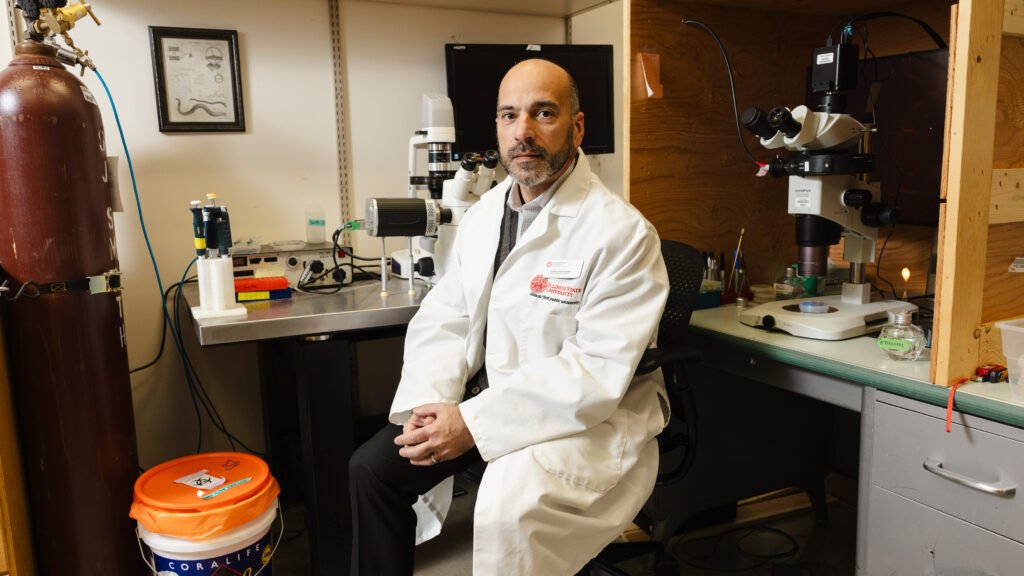
Andres Vidal-Gadea’s neuroscience research was going well. A molecular neuroethologist at Illinois State University, he studies the function of genes, sussing out ways to stop the progression of Duchenne muscular dystrophy. To do so, Vidal-Gadea would knock out genes in nematodes, then have those worms attempt to burrow in dirt or go for a swim to see happened to their muscles.
Vidal-Gadea was garnering reliable funding from the National Institutes of Health along with a steady stream of publications. But he increasingly was getting a critique from grant reviewers: It was time to move from nematodes into mice, to see if his observations held in animals more closely related to humans — a necessary step to move any insights into human trials. So, he searched for potential collaborators who had the right kinds of mice, and could do the experiments he needed.
Vidal-Gadea found those collaborators in the Netherlands, and in March 2025 they began writing grant proposals together. But shortly thereafter, he said, “this entire thing kind of fell through.”
Ten months ago, the NIH announced it would no longer allow American researchers to share their federal grants with research partners abroad. Vidal-Gadea is one of numerous scientists still grappling with fallout from that policy shift regarding so-called foreign subawards.
In a recent nationwide survey STAT conducted of nearly 1,000 NIH-supported scientists, 25% of respondents said their research had been impacted a great deal or a fair amount by the move away from foreign subawards, and 20% said they had been affected a little. Trump administration officials said they acted to increase accountability and transparency, but the funding halt has disrupted clinical trials, forced scientists to alter or abandon projects, and led to a year-long pause on applications while the agency transitions to a new funding mechanism for work done in collaboration with researchers outside the U.S.
The idea of foreign subawards was to push forward projects that would be difficult to do in the U.S. alone. They enabled scientists here to work with entities abroad to do things like track viral outbreaks, recruit patients for trials of new drugs, and gain access to cutting edge laboratory instruments, techniques, or tissues, while taking on the bulk of the administrative burden, including reporting back to the NIH on any problems or progress. Their use has been particularly widespread in global health, infectious disease research, and to support international clinical trial networks for rare cancers and genetic diseases.
Last May, to “maintain national security” and better track how its $47 billion biomedical funding budget is spent, the agency abruptly put an end to renewing or issuing new foreign subawards.
“The American people deserve transparency and accountability in how their tax dollars are spent,” an NIH spokesperson told STAT in an email. “This updated approach reflects a commitment to fiscal responsibility and strong oversight, while preserving the ability of recipients and investigators to conduct international scientific collaboration.”
TB study forced to drop research on patients
One of the survey respondents was Christopher Sassetti, a tuberculosis researcher at UMass Chan Medical School, who said he has not been able to resume foreign partnerships since his NIH subawards were banned last year.
In the U.S., tuberculosis is relatively rare, about 10,000 cases per year. But incidence of the disease — which is caused by airborne bacteria that replicate deep in the lungs — have been on the rise since 2021. Sassetti studies how different strains of the bacteria behave differently in human populations with diverse immune responses to infection to better understand how the bug evolves and spreads. The work has important implications for overcoming the rise of drug-resistant tuberculosis.
To pursue that work, Sassetti’s NIH grant paid for collecting blood samples from people in Lima, Peru — who carry a unique immune gene — and then infecting their cells with TB in the lab. Because of the subaward issue, his team has had to abandon that approach and work instead with genetically engineered cell lines. They don’t replicate the behavior of cells in the body as well since they are cancer cells that have been grown in labs for decades.
The project also included subawardees in South Africa who were doing a household contact study. When someone is diagnosed with tuberculosis, close contacts are monitored and blood samples taken, which allow researchers to see how the immune response looks early in disease and how that changes later on. Sassetti had to switch to doing an analysis of samples from infected macaques.
In both cases, Sassetti’s team was able to shift funding for the removed foreign subawards to domestic institutions to support the pivot. But, he said, it has meant losing the opportunity to work with large human populations of tuberculosis patients, which don’t exist in the U.S. The engineered cells and the non-human primate work “fulfills the aims of the grant, but I wouldn’t say are quite as scientifically compelling as a human cohort,” he said.
Sassetti, like Vidal-Gadea, had existing grants with foreign subawards when the NIH banned them last May. Scientists in that position were initially offered two options to negotiate their grants when they came up for renewal — either move their international collaborators’ portion of the work to the U.S. or wind it down and give back the funds to the NIH.
“We were forced to remove these things based on really a fluke of timing,” Sassetti said. “If our non-competing renewal would have been after the new system, potentially there would have been a mechanism to continue it. But because these were disallowed before there was a new system, they were just all removed … and that’s permanent. We were told at the time, they’re not coming back. This was a permanent maneuver.”
Like Sassetti, 28% of STAT survey respondents impacted by the foreign subaward policy shift said they moved the work of their international collaborators to U.S.-based institutions. Seven percent said they shut down non-clinical work outside the U.S. and returned funds to the NIH, 8% said they had to wind down, pause, or alter the scope of a clinical trial with sites outside the U.S., and 12% reported having a grant application rejected because it included a foreign subaward. STAT partnered with the MassINC Polling Group to conduct the survey of 989 NIH-funded scientists between Jan. 28 and Feb. 18, 2026.
Last June, after intense pushback on the policy’s potential to imperil hundreds of ongoing clinical trials, the NIH created another path for research involving human subjects. It allowed scientists to convert any foreign components into a supplement which functions as a separate award linked to the main grant. This foreign supplement model has helped to provide continuity of support while the agency finalized a new funding mechanism for international collaborations.
But even when researchers were able to successfully convert existing subawards to the supplement model, it often took many months, due in part to mass firings at NIH last year and the continued departure of many of the agency’s grantmaking officials and staff. Those delays forced some scientists to halt the enrollment of patients in studies and lay off research support staff, according to written responses to one of STAT’s survey questions.
One malaria researcher at a public university in the Midwest, who asked for anonymity for fear of retribution by the federal government, told STAT in an interview that his team was only able to continue an ongoing study of children with the disease in Africa because of an injection of bridge funding from his university and a philanthropic foundation.
“That was absolutely essential for us to keep our teams together for those eight or nine months,” he said. “We were lucky. But I know of lots of cases where people haven’t found non-NIH support and have had to pause or let people go.”
In other cases, the foreign subaward issue isn’t the main source of disruption, but it compounds other funding interruptions initiated by the Trump administration.
Take FlyBase — an online database of the Drosophila melanogaster (otherwise known as the fruit fly) genome, which for more than 30 years has been an essential resource for researchers studying everything from cancer genes to neurodegeneration to the fundamental mechanisms of inheritance. About 75% of known human disease-causing genes have a fly counterpart, making the model organism a useful tool for studying human biology.
Scientists all over the world use FlyBase every day — to look up gene expression patterns, search through its collection of 87,000 Drosophila papers, or contact other labs to get genetically unique strains of flies or reagents to run new experiments. All of that was offered free to the research community thanks to federal grants that supported scientists and staff at Harvard University, Indiana University Bloomington, the University of New Mexico, and the University of Cambridge in the U.K. who maintained the online repository.
Last summer, after an NIH grant supporting work by those four institutions became a casualty of the White House’s freeze on funding to Harvard, eight Flybase employees were laid off. Following legal action by Harvard, the grant was restored last month. But due to the ban on subawards, support for the University of Cambridge team — which updates the repository with new genetic and phenotypic information as it is generated — was removed. In order to prevent FlyBase from becoming frozen in time, the consortium is now asking the wider fly research community to chip in annual contributions to keep the Cambridge group curating, an annual cost of around $500,000, project leader Norbert Perrimon told STAT in an email. The eight terminated Harvard FlyBase staffers have not been rehired, as they found other positions while the grant was frozen.

The NIH released the outlines of its subaward replacement system in a brief announcement in September. The official funding notice, which was posted in January, provides a more detailed look at how the new mechanism, dubbed a PF5, will work, but has still left researchers with questions.
Under the PF5 system, the NIH will issue primary awards to U.S.-based researchers and separate, linked awards to foreign partners. The linked foreign awards will have unique grant numbers and draw their funds directly from the Department of Health and Human Services payment management system. Each separate grantee organization will be responsible for reporting back to the NIH and ensuring the terms and conditions of the grant are met.
“Under the previous subaward model, particularly with foreign subawards, NIH could not clearly track how much taxpayer money was being spent through foreign subrecipients,” an agency spokesperson told STAT. “The PF5 structure strengthens accountability and oversight by providing NIH with a clearer, more direct line of sight into where federal funds are going and how they are being used.”
While that will make it easier for HHS to monitor and control the flow of NIH funds, scientists told STAT it makes management of the grant unwieldy. “From my point of view, from somebody that’s had a lot of these foreign subawards, it really removes my ability, from year to year, to adjust the budget or hold the foreign site scientifically accountable because the money no longer comes through me,” Sassetti said. “Presumably, now there’s somebody at the NIH in charge of that who doesn’t really have any sophisticated idea what the site should be doing and how it integrates with what the rest of the program is doing. It’s definitely a negative from our point of view.”
The PF5 mechanism is designed to support any project proposing international collaborations, the NIH spokesperson said. That includes R01 and R21 grants — which are typically awarded to scientists who run labs to support experiments and staff for five and two years, respectively — as well as a variety of training grants and R24 grants, which support research infrastructure projects like biospecimen repositories and long-running observational cohort studies.
NIH Director Jay Bhattacharya has asserted that one of his top priorities is reducing administrative overhead and simplifying peer review by streamlining the grant application process. But the new PF5 mechanism creates more paperwork for researchers seeking NIH support for international collaborations and for peer reviewers evaluating their proposals. Going forward, applications will require separate sections for each foreign component of a project, pushing the page limit from 12 to 24 pages. International partners who haven’t received NIH awards previously will also need to register with the agency, a process that researchers told STAT may take up to six weeks.
“To write it up and review it will be quite complicated and cumbersome under this new structure,” the malaria researcher said. “It’s looking like it will end up being a huge amount of extra work for a worse scientific presentation that will be harder to evaluate.”
Still, he and others are glad to see that a new structure is finally in place. Since last May, scientists hoping to continue working with foreign partners on new grants or launch first-time collaborations abroad have had no means for seeking NIH support. Applications under the PF5 mechanism can be submitted starting April 25. Delays to research caused by the 12-month pause was a top concern among other impacts mentioned by STAT survey respondents who were affected by changes to foreign subaward policies, brought up by 24 scientists in open-ended answers.
For Vidal-Gadea, the inability to collaborate across borders has not only slowed the progress of his lab, it has also been heartbreaking given his career path. Vidal-Gadea is the product of a global scientific community — the Illinois State biologist first became enamored with science in his native Uruguay, where he saw the meritocracy of academia as a path to working his way up in the world. He was introduced to Duchenne, the disease he now studies, in Canada, taking care of patients as a way to put himself through college. He pursued neuroscience in order to help those patients during his Ph.D. studies in the U.S., and during a stint in the U.K. as a postdoctoral researcher.
Despite having roots across the globe he could fall back on, he has no intention of leaving. Last week, after 23 years in the U.S., Vidal Gadea received his citizenship. The security of being a full-fledged citizen has lifted a weight off his shoulders.
“I feel energized to become more involved in politics and become more involved in advocacy and in fixing what we need to. There is plenty to fix, in the way that as scientists, we don’t do a great job of sharing with our communities our role, our place in society, and the service that we’re here to provide,” he said.
Fixing the scientific ecosystem has never been more critical, he said. Turmoil and funding disruptions at the NIH over the past year required Vidal-Gadea to spend double the amount of time writing grants than he is used to. Uncertainty about funding has also made it difficult to recruit graduate students, which risks slowing his research down even further.
“It’s clear we have a monumental task ahead,” he said. “But Duchenne muscular dystrophy is a monumental task as well, and we have not shied away from it.”
How the survey was done
STAT and MassINC Polling Group surveyed 989 researchers from 45 states, Washington, D.C., and Puerto Rico between Jan. 28 and Feb. 18. The survey was emailed to about 41,000 NIH-funded scientists, relying on a public database of grant recipients in 2022. Only the 97% of respondents who said they had active grants in 2025 were asked questions about specific grant impacts. The results were weighted based on each researcher’s total NIH funding and their region of the country, and the margin of error for questions asked of the full sample is 3.3 percentage points.
STAT’s coverage of the federal government’s impact on the biomedical workforce is supported by a grant from the Dana Foundation and the Boston Foundation. Our financial supporters are not involved in any decisions about our journalism.



