
This is an edition of The Atlantic Daily, a newsletter that guides you through the biggest stories of the day, helps you discover new ideas, and recommends the best in culture. Sign up for it here.
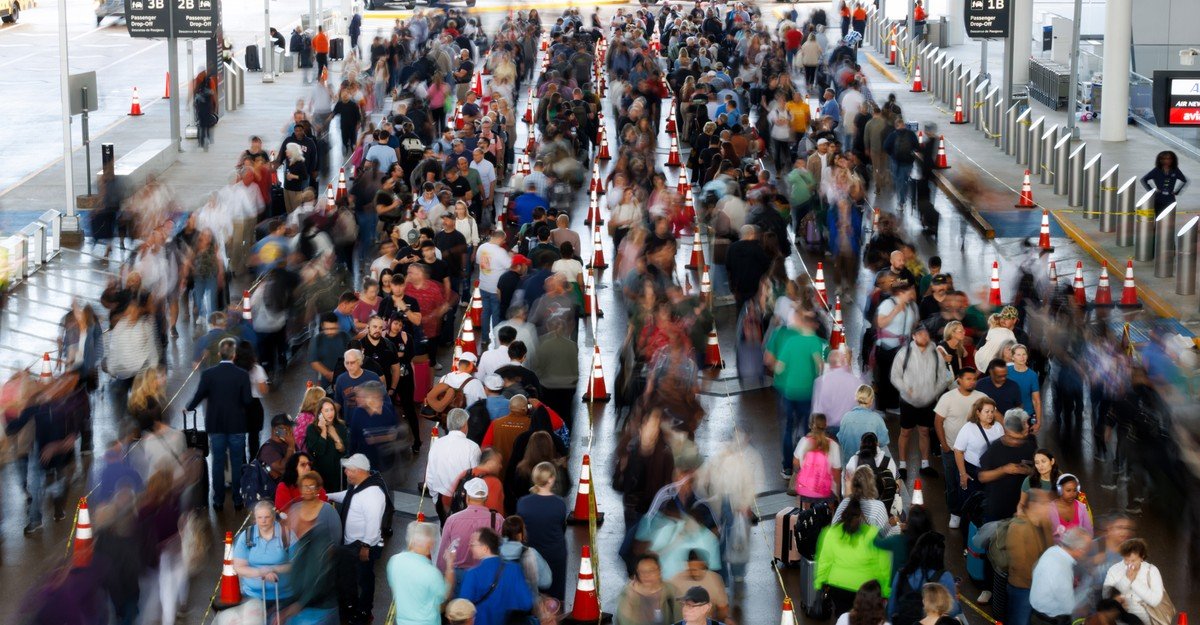
Walk into any American airport today, and you might end up in a security line that extends past the baggage claim. You might hear a muffled voice announcing over the intercom that your flight has—once again—been delayed. And you might have to pay even more for this experience.
Airfare has spiked since the start of the war in Iran, as airlines cope with rising jet-fuel prices and the new risks of flying in and around the Middle East. Business Insider found that the average price of a flight from one end of the United States to the other rose from $167 in February to $414 in mid-March. Outside the country, ticket prices for major routes connecting Europe and Asia have surged, per data from Alton Aviation Consultancy: The Hong Kong–London route is 560 percent more expensive than it was last month, and the Bangkok-Frankfurt route is up 505 percent. (Flights between the two continents would ordinarily pass through the Middle East.) And tickets are likely to stay expensive for some time.
Americans are already seeing prices rise at airports and at the pump—the average cost of gas in the U.S. has gone from $2.98 a gallon to $3.98 a gallon over the past month—but the breadth of the war’s economic consequences is just starting to become clear. The energy shock could have broad implications for the prices of all kinds of consumer goods, including clothing, food, and computers (also: party balloons). What’s happening to plane tickets is a preview of what might come next for other industries.
“Airfares are certainly the canary in the coal mine,” my colleague Annie Lowrey, who writes about economic policy, told me. “No other major consumer good or service I can think of is as sensitive to energy costs.” Jet fuel makes up roughly 30 percent of the cost of an airline ticket, and much of that increase is getting passed on to customers. When Iran effectively closed the Strait of Hormuz earlier this month, it pinched off the world’s oil supply, and prices shot up. The average price of jet fuel spiked more than 58 percent during the first week of the war and has increased more than 10 percent each week since. Airlines began feeling that strain right away, which soon started to bear on tickets—dynamic-pricing systems allowed companies to change what they charge for each seat in real time.
Airlines have always had razor-thin margins. Fuel is the industry’s largest operating cost and can represent about 25 percent of a company’s total yearly spending. American Airlines recently said that it will be forced to spend an additional $400 million this quarter. “If oil prices stay where they are today, that’s 11 billion [dollars] of expense for us,” United Airlines CEO Scott Kirby said this week. He also suggested that, for the company to break even, it would need to raise ticket prices another 20 percent. That direct correlation—as fuel prices go up, so does airfare—helps explain why the Iran war’s effects on plane tickets have been so immediate. A similar dynamic is at play in the trucking industry: When the cost of diesel goes up, so do the rates for ground-shipping contracts.
The other big-picture issue affecting airfare has to do with flight capacity. More than 52,000 flights to and from the Middle East have been canceled since the start of the war. Flights that haven’t been canceled might have to take longer paths around the Middle East, using up more fuel and putting more pressure on airlines to compensate elsewhere, Martin Dresner, a supply-chain professor at the University of Maryland, told me.
The Iran war could also raise the prices of semiconductors (reliant on helium, much of which comes from the Middle East), clothing (many synthetic fibers, including polyester, are made from oil), and aluminum-based products, as well as any consumer goods that travel via air freight. Fuel surcharges account for roughly 19 percent of the cost of a package delivery in the United States, and as shipping and transport costs go up, so could the price of groceries, Annie said. Businesses that sell nonperishable goods such as computers and clothing would likely react by selling off inventory and then, eventually, increasing sticker prices.
Many of those effects won’t be felt immediately. Take urea, a nitrogen-based fertilizer that’s integral to modern farming. Much of its global supply comes from the Middle East, and urea prices have increased by 50 percent since the war began. Although farmers may take a direct hit on those prices, consumers may not actually experience a price shift for a while, thanks to the nature of the agricultural supply chain. Reduced urea leads to reduced crop yields, which leads to fewer and more expensive food products—a far more indirect relationship than that of jet fuel and airfare.
Were the strait to fully open right now, some of those potential issues would never materialize, and the global oil supply would start to recover. But even if the war were to end today, “we’re looking at months ’til production is fully restored, at least,” Jason Miller, a supply-chain professor at Michigan State University, told me. Airlines will see elevated costs until the oil supply stabilizes—which is likely why United Airlines’ CEO has been telling people to book their tickets for summer travel as soon as possible, before prices go even higher. Ultimately, this economic squeeze could last longer than the war that created it.
Related:
Here are three new stories from The Atlantic:
Today’s News
- President Trump signed an executive order to pay TSA workers, bypassing Congress after lawmakers failed to agree on a broader Department of Homeland Security funding bill. This comes after House GOP leaders rejected a measure the Senate adopted early this morning to reopen DHS without funding immigration enforcement.
- The FBI said that hackers targeted Director Kash Patel’s personal email, after an Iranian-government-linked group claimed responsibility and posted alleged stolen materials online. The agency said that most of the data appear to be old and that they do not involve government information, and that it is working to investigate the situation.
- Secretary of State Marco Rubio said that the U.S. military campaign in Iran is “on or ahead of schedule” and could end in weeks, although he acknowledged that “we have some work to do.” Meanwhile, Israel’s defense minister said that Israeli strikes on Iran will “intensify and expand” because Tehran has ignored warnings “to stop firing missiles at Israel’s civilian population.”
Dispatches
Explore all of our newsletters here.
Evening Read
The Very Powerful Men Who Think Introspection Is Dumb
By Thomas Chatterton Williams
America’s tech oligarchs are pathologically unreflective. From their perspective, looking inward is a waste of time better spent moving fast and breaking things, or hoovering up money and consolidating power.
That thesis received further confirmation earlier this month when the venture capitalist Marc Andreessen said that he engages in “zero” introspection—or at least “as little as possible.” Andreessen, a billionaire AI evangelist, was speaking to the podcaster David Senra, who enthusiastically approved. Senra explained that he had learned introspection was useless by reading 410 biographies of entrepreneurs. “Sam Walton didn’t wake up thinking about his internal self,” Senra said, referring to the Walmart magnate. “He just woke up like, I like building Walmart; I’m gonna keep building more Walmarts, and just kept doing it over and over again.”
Read the full article.
More From The Atlantic
Culture Break

Explore. Most people have a smartphone. But many want to use it less, Julie Beck writes.
Watch. Hoppers (out now in theaters) offers a surprising take on the typical talking-animal story, David Sims argues.
Play our daily crossword.
Rafaela Jinich contributed to this newsletter.
When you buy a book using a link in this newsletter, we receive a commission. Thank you for supporting The Atlantic.



