
Light filters through blue tissue paper in the art room. Its walls are decorated with construction paper fish, their scales sparkling with glitter.
Down the hall, infants snooze in a room full of cribs, while outside, children swing from the jungle gym and race around the playground. Across the complex, there’s a shelf stocked with non-perishables, next to a rack lined with onesies, sweaters and T-shirts.
Through another passage is a hallway lined with backpack hooks, each labeled with a different child’s name. Through another door is a chapel with steep ceilings and a stained glass window — the “dove of hope” overlooking residences across the courtyard.
When Ava Moreno enters the stairwell to her office, she pauses at a black-and-white photo taken in 1972, showing a long line of men spilling over the porch of a Tampa Heights house — the original building of Metropolitan Ministries, when 13 local churches first came together to address poverty in the community.
Now the nonprofit’s sprawling campus holds a day care and nursery, an after-school program, a food pantry and boutique, a community garden, a counseling office, job training, and countless other services. Across the street is the Patricia J. Sullivan School, an elementary school run as a partnership between Metro and the county school district. Employees said they’re regularly inspired by the far-reaching work of their programs and their colleagues.
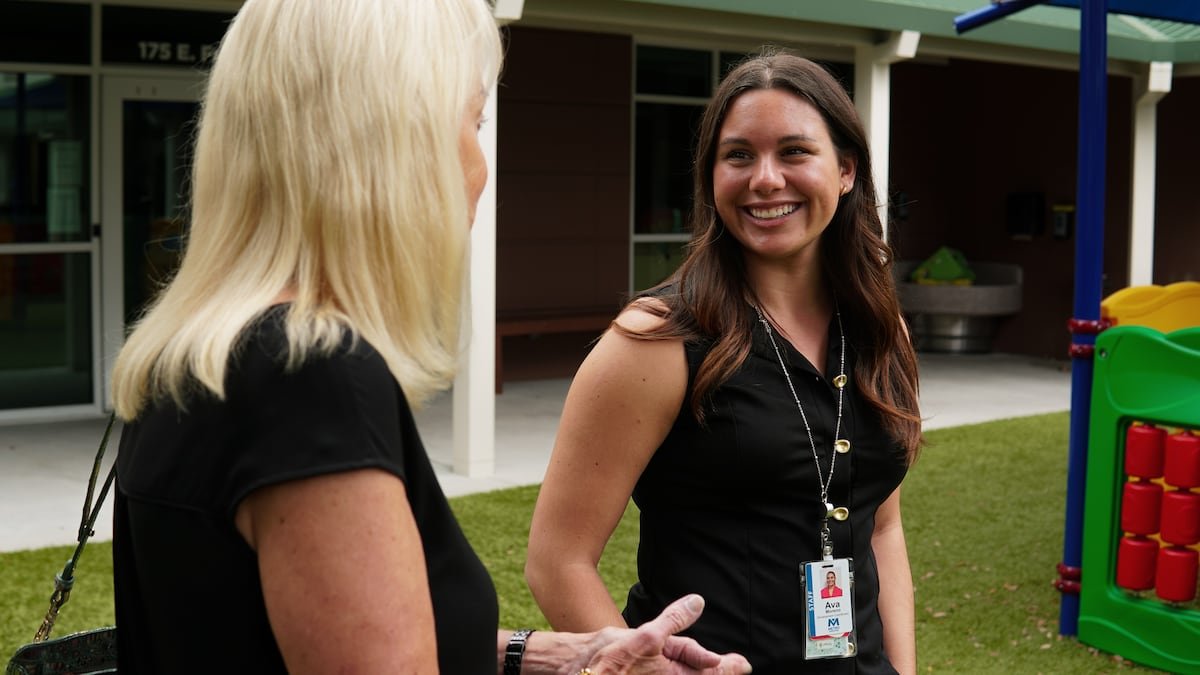
“I can walk around campus and be like, ‘Oh my gosh, what a great reminder of all of the things that we get to do here and that we get to serve our community with,’” said Moreno, who learned about the nonprofit through a class project while still a student at the University of South Florida. She’s now been with Metropolitan Ministries for eight months.
Employees said the nonprofit stands out as a place that cares deeply for its clients as well as its staff.
Dorcas Smith, senior director of community case management services, described the culture as one of help, support and collaboration. Employees come to the cafeteria for hot meals. Some bring their children to the day care on-site.
“I’ve never worked in a place where, if our employees have hardships, they can experience the same type of service and grace that our clients do,” said Smith.
Employees pointed to the workplace’s “sanctuary model,” an organizational framework developed by Philadelphia clinicians in the 1980s that aims to create communities that are trauma-informed and focused on healing.
The model influences how leadership and employees treat each other, as well as how they interact with clients. Among other practices in the day-to-day, every staff meeting at Metro starts with employees sharing how they’re feeling — “You can choose any word outside of ‘good’ or ‘bad,’” said Moreno.
Attached to their name badges, each employee carries a card containing reminders of the nonprofit’s commitments to democracy, emotional intelligence, social responsibility and other principles. They also each carry a card with their personal self-care plans to turn to in times of stress — with activities like prayer, taking a walk or listening to music. It’s about making sure everyone’s personal and professional needs are met, Moreno said.
Telva Rivera, senior director of Hillsborough Residential Programs, was drawn to Metro after hearing about its use of the model at a conference. With a background in social work and early childhood development, she relocated from New York during the pandemic and started working in intake for the residential program — processing applications for the shelter and getting residents settled.
Now, she oversees the program. Families often come in for help with housing, and in the process are also connected with education opportunities, child care and a host of other wraparound services.
“I get to see the entire gamut of support that’s provided,” Rivera said. “I get to see the front to the end of clients and see them grow, learn.”
This is what’s most rewarding, Rivera said. Everyone here has “a calling for the work.”
The nonprofit is committed to helping employees grow. Rivera said she was able to complete an internship in the counseling center while working toward her Florida licensure in social work. Teams go on regular retreats each year, and there are frequent training opportunities across departments.
All of this has fostered a longevity that’s hard to come by in the nonprofit space, said Smith, who manages three different programs helping clients address housing and financial instability.
“One of the things that really caught my attention when I first came on board was the number of people who have been working for this company eight years, nine years, 10 years,” Smith said. “That’s not really common when you go most places, especially with the kind of fatigue that happens when you’re serving.”
Smith worked in child welfare agencies for 30 years and had started volunteering with Metro more than a decade ago, when she brought a group of teenagers from her church to man a holiday tent. She’s now been here three years and hopes to continue being part of the organization’s growth and expansion.
“This is one of the places where the mission is so evident,” Smith said. “It’s not just how they serve our clients, but how they serve the staff, too.”
Metropolitan Ministries
Location: Tampa
Employees: 348
Website: https://metromin.org/
Company comments: “I have the opportunity to serve an underserved population in the area that I grew up in. Metro provides the resources to myself and the team that allow us to serve clients in the most dignifying way. The commitment to serving others is obvious from the top down within the organization.”
“I work with a really great team that truly inspires me. We are like a family always ready to jump in and help out wherever needed no matter what our job title and responsibilities are.”



