
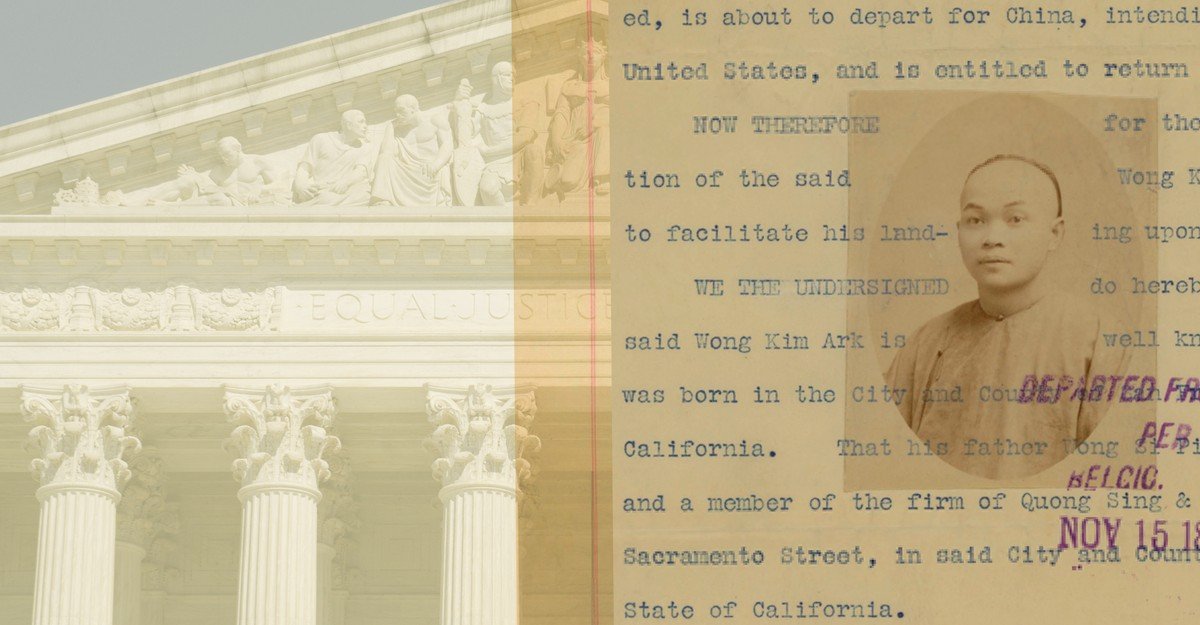
Ever since the Supreme Court recognized birthright citizenship in 1898, generations of Americans have accepted that the United States Constitution encodes an absolute rule that if someone is born on U.S. soil, they are a citizen, end of story. But fringe elements of American society have repeatedly tried to attack this fundamental rule. During World War II, one group—the Native Sons of the Golden West—pursued such an attack all the way to the Supreme Court. Later this week, the Court will once again confront such a challenge, when it hears arguments in Trump v. Barbara.
This time around, it is not an exclusionist group of citizens who are asking the Court to walk back the absolute rule of birthright citizenship; instead, it is the presidential administration currently in office. The administration’s arguments are much the same as those made by the Native Sons during World War II, as is the damage that accepting them would inflict.
The Supreme Court first dissected the citizenship clause of the Fourteenth Amendment, which recognizes the citizenship of all persons “born or naturalized in the United States, and subject to the jurisdiction thereof,” in the 1898 case of United States v. Wong Kim Ark. There, the Court held that the Fourteenth Amendment, “in clear words and in manifest intent, includes the children born within the territory of the United States of all other persons, of whatever race or color, domiciled within the United States.” Relying on centuries of English law that influenced the U.S. Constitution, the Court explained that so long as someone is domiciled on American soil—even if they are a citizen or subject of another country, and even if their allegiance to America is fleeting—then such persons are “within the allegiance and the protection, and consequently subject to the jurisdiction, of the United States,” thereby rendering their United States–born children citizens.
Applying that standard in Wong Kim Ark, the Supreme Court upheld the birthright citizenship of a man born in San Francisco to Chinese-immigrant parents who were, as the Court said, “subjects of the Emperor of China” and who had returned to China. Today, the Trump administration defends the president’s executive order doing away with absolute birthright citizenship by arguing that the rule should not apply in the case of individuals born to parents who are either only temporarily in the United States or living in this country as undocumented immigrants. Although the administration purports not to ask the Supreme Court to overrule Wong Kim Ark, the particulars of its argument tell a different story. The administration states without any reservations that anyone born to parents who owe “allegiance to anybody else,” including another foreign power, does not qualify for citizenship under the Fourteenth Amendment. That sweeping position directly contravenes Wong Kim Ark and would require the Supreme Court to overrule it in order to embrace the government’s proposed citizenship rule.
The most significant challenge to Wong Kim Ark until now began in the spring of 1942 and coincided with orders issued by General John L. DeWitt, the head of the Western Defense Command, that compelled the removal and mass incarceration of the Japanese American population on the West Coast. At their annual convention that May, the Native Sons endorsed the following strategy:
First to prosecute, then to carry through to the Supreme Court of the United States, if necessary, a suit challenging the United States citizenship of the Japanese; and second to draft and sponsor an amendment to the Constitution of the United States which shall have for its object the exclusion of all persons of Japanese ancestry from American citizenship.
Days later, with financial backing from the organization, Native Sons Grand Secretary John T. Regan filed a lawsuit in federal court against Cameron King, San Francisco’s voting registrar. Ostensibly, the suit sought to strike some 2,600 Japanese Americans born in the United States from the voting rolls. But Regan’s complaint asked the court to direct King “to strike the names of all Japanese from the register of voters on the ground that they are enemy aliens, citizens of Japan, and therefore ineligible to citizenship and the right to vote.”
The Native Sons were represented by former California Attorney General Ulysses S. Webb, who from the beginning made clear that the lawsuit sought to overturn Wong Kim Ark. At a hearing before District Judge Adolphus Frederic St. Sure, Webb called Wong Kim Ark “one of the most injurious and unfortunate decisions ever rendered” by the Supreme Court. Webb boasted that the Native Sons’ lawsuit presented “an opportunity” for the Supreme Court to “correct itself.”
Webb acknowledged that the purpose of the Fourteenth Amendment was “to citizenize and then to enfranchise the Negro” in the wake of the Civil War. But, he told the court, the lawsuit concerned “the right of citizenship of all peoples and all races who do not fall under the characterization or description of white people.” The Fourteenth Amendment, he argued, gave citizenship exclusively to people born in the United States whose parents were also eligible for citizenship. Given that federal law with rare exceptions limited naturalization “to white persons, persons of African nativity or descent, and descendants of races indigenous to the Western hemisphere,” this was a sweeping argument. (Only in 1952 did federal law finally permit Asian immigrants to naturalize.) Webb therefore contended that under this interpretation, native-born Japanese Americans were not citizens under the Fourteenth Amendment.
Webb bolstered his argument with a lengthy speech in which he asserted that the United States had been “settled by the white race” and that the Constitution’s opening words referencing “We, the people” exclusively “comprehended the white people.” Turning to Wong Kim Ark, Webb dismissively described the holding as resting on the idea that for no good reason, the United States was bound by the common law of England, which had somehow “crept” its way into American law.
Judge St. Sure, who two months later would preside over Fred Korematsu’s trial and convict him of violating General DeWitt’s exclusion orders, made quick work of the case, dismissing it in July 1942 and citing Wong Kim Ark as binding precedent. He also emphasized that the decision had been reaffirmed by the Supreme Court, including in a 1934 case called Morrison v. California, which involved an individual born on U.S. soil to Japanese-immigrant parents.
Not to be discouraged, the Native Sons appealed to the federal Ninth Circuit, advancing many of the same arguments but also going even further. Saying the quiet part out loud, their brief asserted, “Because of racial characteristics of the Japanese, assimilation with Caucasians is as impossible as it is undesirable.” The brief also claimed that “dishonesty, deceit, and hypocrisy are racial characteristics” of persons of Japanese ancestry. Finally, it argued, “a Japanese born in the United States is still a Japanese.”
Exclusionist organizations regularly advanced this argument before and during the war, often pointing to the fact that until 1924, Japan treated all people born to Japanese nationals anywhere in the world as Japanese citizens under the doctrine of jus sanguinis, Latin for “right of blood.” (This was in contrast to the common law rule of jus soli, or “right of the soil,” recognized in Wong Kim Ark.) This dual citizenship—or so the argument went—meant that such people were not fully “subject to the jurisdiction” of the United States as contemplated by the Fourteenth Amendment, because they owed loyalty to another sovereign. (Notably, during World War II, Italian law still treated foreign-born children of Italians this way, but the Native Sons never challenged the citizenship of Italian Americans.)
In February 1943, the Ninth Circuit judges heard arguments in Regan v. King on the very same day that they heard arguments in three other cases involving the civil rights of Japanese American citizens, all of which would make their way to the Supreme Court: United States v. Hirabayashi, United States v. Yasui, and United States v. Korematsu. In the end, the Regan case was the only one of the four in which Japanese American interests prevailed. In Hirabayashi, Yasui, and Korematsu, the Supreme Court upheld General DeWitt’s curfew, registration, and removal orders that led to mass incarceration directed at persons of Japanese ancestry on the West Coast—decisions that today are considered among the worst ever handed down by the Court.
But for the Ninth Circuit judges, all of whom sat to hear Regan v. King, it was an easy case. Wong Kim Ark was the settled law of the land, and no one seriously questioned birthright citizenship’s place as sacrosanct under the Fourteenth Amendment. After Webb presented his argument, the judges, in an almost unprecedented act, stopped the proceedings before even bothering to hear from the other side. Then, after a few moments of hushed discussion, Judge Curtis Wilbur announced from the bench, “It is not necessary for the court to hear further argument. The decision of the lower court is sustained.”
Beyond the courts, moreover, even as the government unconstitutionally discriminated against and locked up people of Japanese ancestry under President Franklin D. Roosevelt’s infamous Executive Order 9066, senior government officials never questioned the birthright citizenship of Japanese Americans born on United States soil. For example, immediately following the Japanese attack on Pearl Harbor, Attorney General Francis Biddle noted “the legal difficulties presently involved in attempting to intern or evacuate the thousands of American born persons of Japanese race, who are, of course, American citizens.” And in 1943, in the process of reopening the United States military to “loyal American citizens” of Japanese descent, who would go on to answer the call with extraordinary sacrifice and heroism, Roosevelt and the War Department affirmed that native-born Japanese Americans enjoyed birthright citizenship. (As Roosevelt declared at the time, “Every loyal American citizen should be given the opportunity to serve this country.”) Even General DeWitt, one of the strongest advocates for mass incarceration of Japanese Americans, recognized their citizenship, saying: “An American citizen, after all, is an American citizen.” This explains why, as an amicus brief in Trump v. Barbara written by the law professor Eric L. Muller notes, the government formally recognized children born in the incarceration camps as citizens under the Fourteenth Amendment—even those born to “enemy aliens,” individuals who had renounced their citizenship, or people brought involuntarily to the United States from Peru as barter for prisoner exchanges with Japan who had no legal ties to this country.
It is hardly surprising, then, that when the Native Sons asked the Supreme Court to hear their case, the Court declined, doing so without comment on May 17, 1943, bringing Regan v. King to an end.
But the Native Sons were not done. As a last-ditch effort, they proposed an amendment to the Constitution that read, “All persons born of citizens or naturalized in the United States and subjected to the jurisdiction thereof, are citizens of the United States and of the states in which they reside.” Here, too, their efforts failed.
Had the Native Sons prevailed in Regan v. King, the outcome would have stripped citizenship from tens of thousands of Japanese Americans born on U.S. soil—as well as countless others who could trace their lineage to ancestors who had immigrated and were not eligible for citizenship themselves. Today, the Trump administration, like the Native Sons before it, contends that “the phrase ‘subject to the jurisdiction thereof ’” in the Fourteenth Amendment “harks back to, and should be read in tandem with, the phrase ‘not subject to any foreign power,’” which the administration equates with “not owing allegiance to anybody else.” The government’s rule would sweep within its reach not only those categories of people it targets but also, on its broadest reading, potentially the child of every noncitizen immigrant and dual citizen. It would also encompass many, if not all, of the Japanese Americans whose rights were under attack in Regan v. King.
This alone is reason to pause at the breadth of the Trump administration’s position. A Native Sons victory during World War II would have stripped citizenship from a group that included the most decorated soldiers in U.S. military history, the Japanese American members of the 442nd Regimental Combat Team and its 100th Infantry Battalion during World War II. It also would have stripped citizenship from, to name but a few, Gordon Hirabayashi, Fred Korematsu, and Minoru Yasui, all future recipients of the Presidential Medal of Freedom; Tommy Kono, the future two-time U.S. Olympic gold medalist in weight lifting; the celebrated artist Ruth Asawa; the actor George Takei; the two-time Cabinet member Norman Mineta; the scientist Harvey Itano, whose cutting-edge discoveries helped lay the foundation for modern hematopathology; and Mitsuye Endo, who sacrificed her freedom during World War II and remained imprisoned at the Topaz War Relocation Center to keep alive her habeas corpus case that challenged the constitutionality of the camps. The United States surely stands to lose many other great Americans who would be similarly honored by future generations if the Supreme Court walks back Wong Kim Ark this time around.



