
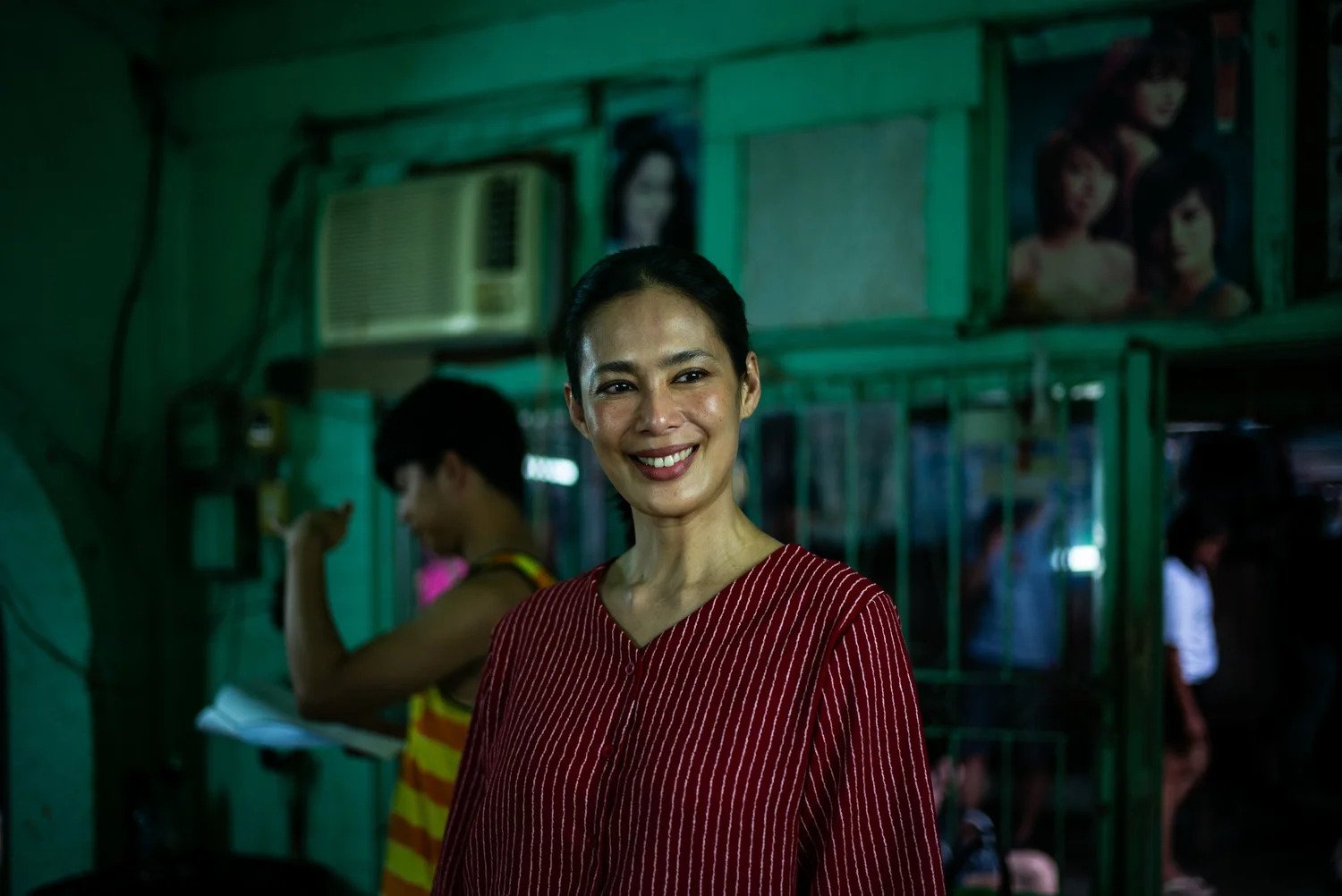
Filipina maid themed films are a recurring presence in East Asian cinema, particularly in Singapore and Hong Kong. From Kelvin Tong’s “The Maid” (2005) to Anthony Chen’s Ilo Ilo (2013), they’re often the kind of material that lead to commercial and critical successes for the filmmakers and the actresses involved. “April” is the latest in what is practically a subgenre. It’s written and directed by Taiwanese director Freddy Tang (“Port of Lies”) and stars Angel Aquino, who is among the Philippines’ most accomplished thespians.
April (Angel Aquino) is a Pinay caregiver in Taiwan. She is the breadwinner of a family of four: her laid back husband, Joseph (Paolo O’ Hara) and her two precocious kids, Luisa (Gabby Padilla) and Diwa (Benedix Ramos). Her mother, Maria (Madeleine Nicolas), might be in her last days. April needs to go back to her coastal town to be by her side, but she’s charged with taking care of Ah Gong (Xiao-Xiong Zhang), a wheelchair bound patriarch who is suffering from dementia.
Ah Gong’s son and daughter, Ah Cheng (Kaiser Chuang) and Yun (Tzu-Yu Yu) provide a compromise: April can visit her mom, but she’ll have to take Ah Gong with her. Meanwhile, their estranged brother, Qi-Wen Lin (Kuwan-Ting Liu), is fresh out of jail, and returns to a changed landscape and a newfound responsibility.
Labor export policy is a miserable norm in the Philippines, a semi-feudal, semi-colonial country without a solid industrial base, where people and resources are set up for extraction. It’s a byproduct of a government that is corrupt and unwilling to provide; robbing and killing them when it’s not selling them to the highest bidder. Filipinos often choose to be migrant workers to escape that. Most don’t have that choice and are pressured by poverty and deprivation. At least they’re able to provide for their families, even as they’re forced to leave them.
That said, one can look at this type of movie and sense a common view of a nation and its people as being nothing more than maids in an East Asian household. Servants, in other words. Of course, this has racial implications.
Now, filmmakers do get stuck between a rock and a cold hard place when dealing with social reality. How should they even address it in ways that would make their viewers care? Should they lean into the issues or the viewers’ biases? Can they truly go about it without sticking to the stereotypes? And what if they’re trying to do this as a comedy?
Freddy Tang powers through all of these by being ready for the job. He had tackled the topic before in his widely praised 2023 TV series, “Port of Lies”, a deep dive into the plight of migrant workers in Taiwan as a crime procedural/legal drama. This means he’s well-acquainted enough with the subject matter to be aware of its dimensionalities. In other words, the migrant worker would likely not be a mere archetype with respect to an East Asian protagonist. He’ll also know how to make that story interesting.
April is imperfect: doting, impatient, overbearing and out of touch. She’s been away for years yet acts like she should always be the authority in the house. She is caring, but she knows what she wants and doesn’t want. If she disagrees with something, she’ll go ahead and say it, feelings and relationships be damned. But she’s not a tyrant. It may take some time for her to absorb the passions and the sorrows of her husband and her kids, but when she does, she understands and immediately lends a helping hand. You can feel that she’s the bedrock of the family by simply showing up. She doesn’t need to raise her voice.
They couldn’t have found a better actress for this than Angel Aquino. Not only does she carry the film, she pulls it all together with a dense & layered performance that is teeming with gravitas and restraint. She also speaks Hakka (Taiwanese dialect), exuding devotion and commitment. It all goes back to her character because it’s so well-acted that you feel her presence and remember it, even in scenes when she’s not around.
This despite plot choices that were in danger of undercutting her presence in the story. A parallel arc does run alongside hers and it’s almost 50/50. It’s that of prodigal son, Qi-Wen Lin, who is at the very first shot. Fortunately, it’s a compelling watch, with a rich and solemn portrayal by Kuwan-Ting Liu that humanizes a beaten down scammer and a man child who has disappointed his family and that the system disappointed, and is now being pestered by a buncha crooks. Romance is on the horizon, which brings in Esther Huang in a stellar turn as Xiu-Mei Zhang, a tough as nails provincial girl who carries their relationship. She even drives a truck.
We get a lot of screen time with April away from Ah Gong, as if her story matters in and of itself. Lesser minds would have made this a goofy fish out of water stuff, a comedy of errors, with Ah Gong reacting to Filipino things. However, this movie makes the daring choice of keeping him largely silent and receding into the background. He gets his moment eventually, and when it hits, Xiao-Xiong Zhang knocks it out of the park in a quiet, heart wrenching sequence that he sells entirely with his face and tears. Screen veteran Lui Manansala plays a spiritist in that same sequence, adding a curious wrinkle to the proceedings. Let’s just say that Ah Gong is not the only one that April brought along for the ride….
Screenplay manages to tie things up quite nicely. In coordination with Hsiu-Hsiung Lai’s crisp and clear editing, not only does it gracefully juggle these various plotlines, but multiple tonalities, twists and genres as well, sometimes in the same scene. For instance, a Mexican standoff pirouettes into a friendly chat about pork knuckle noodles.
A fine stable of actors round up the cast on both the Philippine and Taiwanese side, enriching the mirth and the pathos with the quirks and modulations that they bring to the table.
A compelling look at migrant workers and families, “April” depicts the Filipina maid not as a judgement of a people, but as an actual human being, regardless of nationality.



