
It’s not easy being Fedir Shandor, the Ukrainian ambassador to Hungary. His host country is holding elections next month, and the prime minister, Viktor Orbán, has made his whole campaign about Ukraine. Specifically, Orbán is asking voters to believe that Hungary risks becoming a Ukrainian colony, and that he’s the only person standing in the way of Volodymyr Zelensky drafting them into the fight against Russia.
That might sound far-fetched, but Hungary occupies an awkward position as the most reliable Russian ally inside Europe. Its election is making things weirder, and more sinister: Orbán’s government has tried to paint the main domestic opposition party as a Ukrainian front, accusing Kyiv of carrying out a hostile operation designed to depose Hungary’s leader.
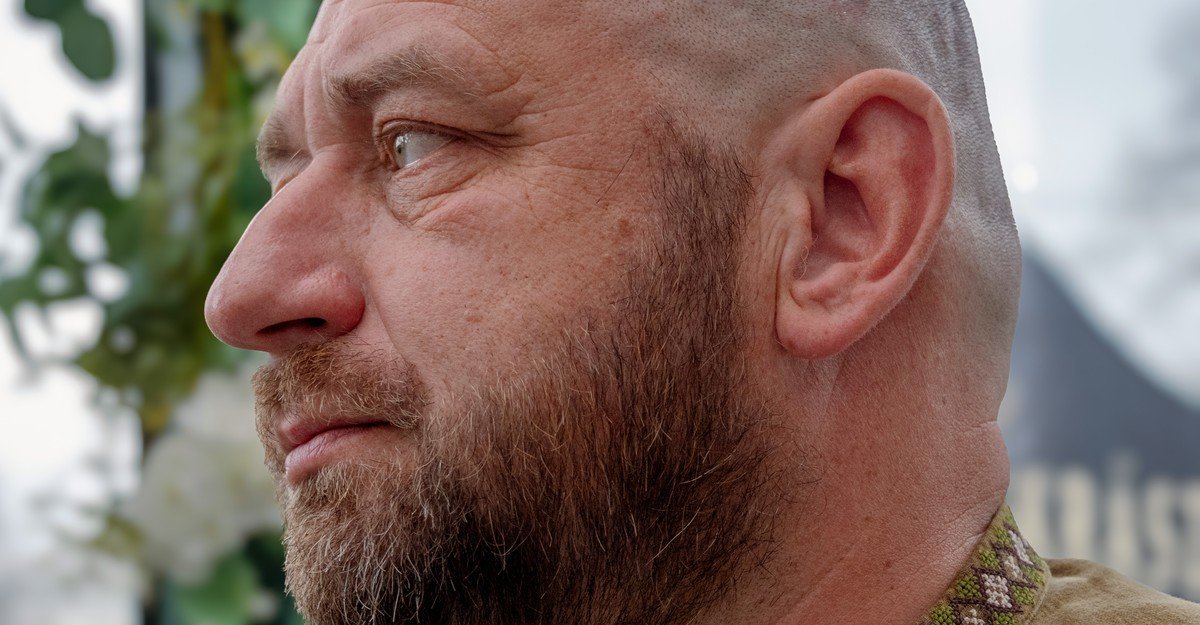
So when the ambassador agreed to meet with me over the weekend, at a pastry shop on the outskirts of Budapest, I expected him to disguise himself in some way, or perhaps to talk in hushed tones and skirt sensitive topics. I was not prepared for the tank of a man who came careening into the shop’s sunroom—waving his arms, ripping off his hat, and speaking about 12 decibels louder than anyone else. His bearing is that of a bouncer, except for the traditional Ukrainian embroidered shirt.
“Do you feel safe here?” I asked Shandor when we sat down. He is a favorite boogeyman of pro-government media, and he has been summoned to the foreign ministry for so many dressings-down that he says he has earned a place in the Guinness World Records. “Yes!” he replied immediately. “It’s no problem, no problem.” The reason for the absence of a problem is simple. “I am a sergeant,” he explained.
When you’ve actually gone to battle, as Shandor has, information warfare isn’t so daunting. Just outside the window from where we were speaking, Zelensky glowered from an Orbán campaign poster styled like a “Wanted” notice. “Yeah, it’s my president, very popular,” the ambassador said, slouching in his chair with his hands clasped over his stomach. “Maybe next election, he’ll be the president in Hungary.”
He sat upright and elbowed me. “It’s a joke,” he said.
Shandor’s mother is Ukrainian, and his father is Hungarian. The two nations, separated by an 85-mile border, have a shared history in the Transcarpathia region.
Shandor, who is 50, was head of the sociology faculty at Uzhhorod National University, in western Ukraine, when Russia invaded his country and tried to decapitate his government in early 2022. He went to a recruiting center and signed up to fight, helping repel Russian forces from the city of Sloviansk, and then from Kharkiv. The decision came naturally, he said. “It’s my country; it’s my family.” Because of the coronavirus pandemic, he had experience teaching virtually, so he continued to give lectures from the front line. When the commander of his company was killed, he took over.
He fought for about two years, then was named ambassador to Hungary in 2024. “One word,” he replied when I asked what his diplomatic responsibilities were. “I am a bridge.” He insisted that this bridge hadn’t buckled under the weight of Orbán’s election campaign. Some of his most fruitful contacts, the ambassador told me, are local mayors. He promotes sister-city relationships between the two countries, celebrates ethnic Hungarians living in Ukraine, and mobilizes humanitarian efforts that bring resources to his battered homeland.
Shandor pointed to Hungarian volunteers helping finance the reconstruction of Ukrainian kindergartens destroyed by Russian bombs and missiles. It’s a pittance compared with the 90 billion–euro loan from the European Union that Orbán has blocked, part of a larger dispute over oil flows interrupted by damage to a pipeline that runs through Ukraine. But the aid matters, both materially and symbolically. To hear the ambassador tell it, the animosity exhibited by Hungary’s government doesn’t reflect its society’s sentiments.
Even within the government, not everything is as it seems. Shandor estimated that 70 percent of his contacts are still intact, even in the midst of an election campaign focused almost entirely on demonizing his government. The election campaign, he said, is a “stupid period.”
Of course, sometimes the situation is more serious than stupid. Earlier this month, Hungarian counterterrorism authorities detained a group of Ukrainians carrying about $82 million in cash and gold in armored vehicles from Austria to Ukraine. The government in Budapest alleged money laundering—a charge bolstering its claims that Ukrainians are engaged in funny business beyond their borders. Ukrainian officials said the convoy was a routine transfer by road because the war had rendered airspace too dangerous. Shandor told me the Ukrainians were blindfolded, and that one was given an injection of a muscle relaxant designed to elicit information. The ambassador called it a “truth vaccine.” To demonstrate how he defused the situation, he held up his phone to one ear and then grabbed my photographer’s phone, holding it up to his other ear, explaining how he acted as a go-between by speaking Hungarian on one line and Ukrainian on the other.
He had a simple explanation for the episode. “Election,” he said. “Every week there’s a new idea. Classic Russian methods.”
Shandor doesn’t think Russian-style dirty tricks will work in Hungary. He described an independent streak, accentuated by Hungary’s distinctive language, that makes the country more resilient to Russian influence than Ukraine or other places that once lay behind the Iron Curtain, such as Serbia and Slovakia. “Music, poets, gastronomy,” he said. Pride in Hungary’s singular culture, he suggested, inoculates the country against foreign propaganda.
I wasn’t so sure. Western officials told me the Kremlin has endorsed plans to use social media as part of a campaign to boost Orbán and undermine his opponent, Péter Magyar, a onetime ruling-party insider who has managed to pierce the prime minister’s air of invincibility after Orbán’s 16 years in power; most polls show Magyar ahead. The independent investigative outlet VSquare reported earlier this month that a delegation from Russia’s GRU military-intelligence agency had been dispatched to the Russian embassy in Budapest, and The Washington Post revealed a Russian proposal to stage an assassination attempt against Orbán to rally the country behind him.
With the election two weeks away, Shandor predicted that efforts to destabilize the country will intensify, perhaps even involving physical violence to cleave the country in two. He summarized the strategy: “Physical contact, destroy the society, two parts.”
The conversation was getting serious, and despite the ambassador’s martial appearance, he is compulsively lighthearted. So he started talking about sex. Earlier this year, Magyar warned his followers that his opponents were preparing a smear campaign against him that included a video of an intimate encounter, which he said was consensual. Ultimately, only a still image featuring a hotel bed circulated. But Shandor seemed to delight in the episode, saying it played in Magyar’s favor.
“Hungary is a sexual nation,” he said. “It’s a beautiful, sexual nation.” He began clapping his hands in what I took to be a show of approval for Magyar’s appearance. “Young leader, easy on the eyes, not impotent.”
After our meeting, he was preparing to travel to Debrecen, Hungary’s second-largest city, to deliver a lecture to the Ukrainian community there. During his vacation, when he’s able to leave Budapest, he returns to the front line in Ukraine to deliver aid. “It’s normal,” he said.
Perhaps, after his time in Budapest, it almost seems that way to him.
Simon Shuster contributed reporting.



