
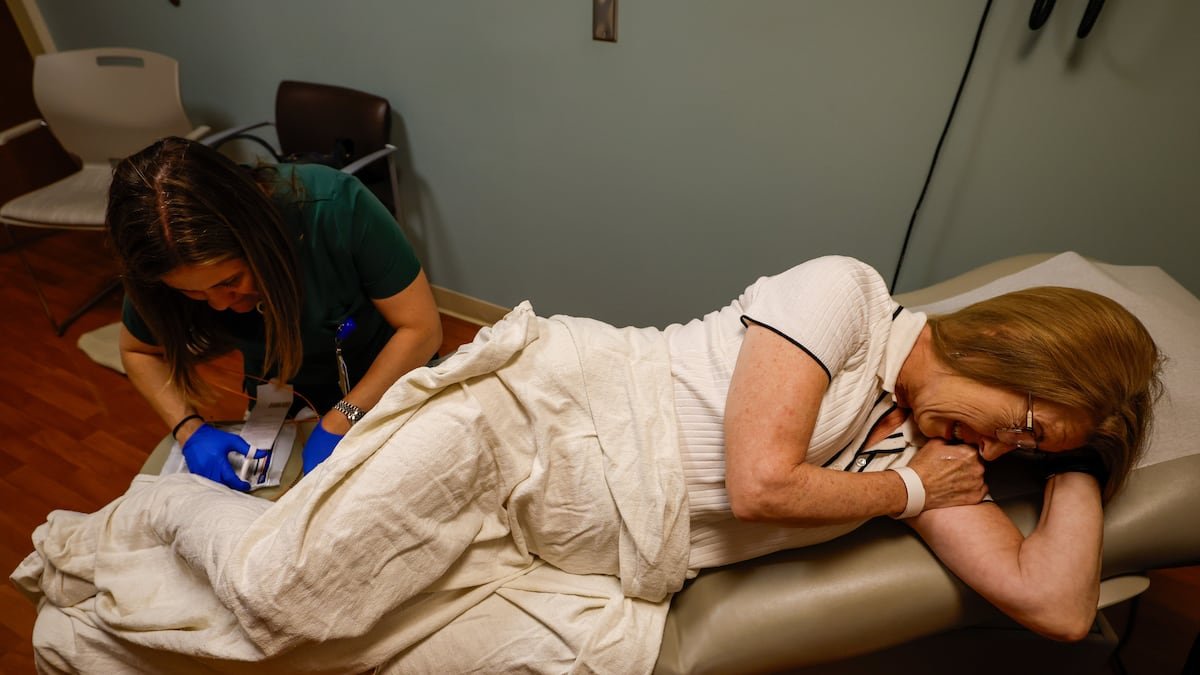
She was married for nearly 30 years when she learned about her husband’s infidelities and went to the local health clinic to get tested for sexually transmitted infections.
Up to that point in 2017, Eileen McGill Fox had viewed her life as relatively normal. She worked in the school system, was a mother to four grown children and was a few years from retirement. She envisioned her future traveling overseas and filling her free time with volunteer work.
The unfaithfulness had come as a shock, so when she learned she was negative for syphilis, gonorrhea and HIV, Fox was grateful for the small relief. But a year later, during her annual pap smear exam, Fox learned she wasn’t in the clear. Doctors found she was positive for Human Papilloma Virus, a common STI that isn’t screened for on standard STI panels. Next to the result, the words “high risk” were highlighted.
“And I was like ‘high risk for what?’” Fox recalled. She was diagnosed with vulvar cancer two months later, in February 2019. A cervical cancer diagnosis quickly followed. Then, in 2023, Fox was diagnosed with anal cancer, too.
It’s been seven years, and Fox is still undergoing treatments. Her diseases, doctors say, were preventable.
Very few vaccines have been proven to stop cancers, but the HPV vaccine is by far one of the most effective. More than 80% of sexually active people will come into contact with a strain of HPV in their lifetime. For many, the virus goes undetected and clears up on its own. But for around 40,000 others in the U.S. each year, the virus lingers — and cancers develop as a result.
Though many people associate HPV with cervical cancer — most early studies focused on people with that disease — the virus affects both men and women. HPV has been linked to six different types of cancer, including anal and penile cancers. Head and neck cancer, which occurs at the base of the tonsils and back of the neck, is eclipsing cervical cancer as the most common type related to HPV.
Once a person has an HPV-related cancer, research shows, they’re at increased risk of developing another.
As her personal life was spiraling, Fox’s health declined, too. She traveled from the Midwest, where she’d been living, back to her hometown of Boston, and underwent a hysterectomy. The procedure addressed her cervical cancer, but Fox is still undergoing treatment for vulvar and anal cancer today.
Prior to her diagnosis, Fox hadn’t thought much about HPV. Her children were school-aged when the vaccine became available in 2006. She trusted her family physician, who had recommended it for her kids, but she had reservations. The vaccine was new and her children were young. By vaccinating them against an STI, she didn’t want to inadvertently encourage sexual behavior.
If she had known then what she knows now, Fox said, she wouldn’t have hesitated. Now, she’s a patient advocate who shares her story to ensure others know the risks of HPV and know how to prevent it through vaccination.

Current standards recommend the vaccine for everybody ages 9 to 26. The target age group is 11- and 12-year-olds, with those ages 13 to 26 known as “catch-up vaccinations.” In 2018, the U.S. Food and Drug Administration expanded recommendations to make the vaccine accessible to people ages 27 to 45, too, but that age group should first consult with a doctor to determine necessity and risk.
Every 10 years, the United States puts out a set of health goals, which includes target vaccination rates, said Susan Vadaparampil, a researcher at Tampa’s Moffitt Cancer Center who studies vaccine uptake.
By 2030, the goal is to have 80% of adolescents vaccinated against HPV. Currently, in the U.S., the rate sits at 63%. But in Florida, where vaccination rates have dropped amid loosening restrictions under the state surgeon general and a growing distrust from parents, only 59% of teens are up-to-date with the HPV vaccine. Physicians and researchers from Moffitt have advocated in Tallahassee for policy that encourages HPV vaccine uptake.
In Florida, boys are consistently vaccinated at a lower rate than girls, state data shows. That, said Vadaparampil, could be a hangover effect from when the vaccine was first introduced. It wasn’t recommended for boys until 2011, five years after it had been on the market, and parents might still think of the vaccine as gendered.
Geography also affects vaccine uptake: Those in rural areas tend to be vaccinated at a lower rate. And regardless of location, vaccine uptake is largely impacted by whether or not it’s recommended by a family doctor, Vadaparampil said. But data shows not all physicians are in the practice of routinely recommending the vaccine during visits.
“If you were in a room full of parents 20-plus years ago and you said, ‘There’s a vaccine that could prevent up to six different types of cancer in your child,’ people would probably be lining up,” said Vadaparampil. “But obviously it hasn’t translated as we had hoped.”
Fox, now a patient at Moffitt, moved to Tampa in 2023. She was craving sunshine, and having her brother nearby meant she’d have someone to help her after treatments, which she undergoes every 60 to 90 days.
Procedures are painful, she said. In addition to the hysterectomy, which left an 11-inch scar across her abdomen, she’s had the majority of her labia removed. She’s had to undergo laser treatments, removing the top layers of her vulva. To treat anal cancer, doctors regularly burn away pre-cancerous areas of her anal canal.
Using the bathroom can be messy — and it’s a physical reminder of her disease.
She has close friends and family that support her, and she’s joined a group for survivors of cervical cancer. She finds purpose in her from the advocacy work. Still, Fox said, she’s found that stigma keeps people from talking openly about HPV and the cancers that stem from it. She’s tired of sugarcoating it.
“When I tell people I have anal cancer, I’m like, ‘It is what it is,’” Fox said. “Let’s talk about vulvas and anuses and cervixes. Let’s remove the stigma and the shadow language for dealing with it.”
More than reducing stigma, Fox wants to spread the word about the HPV vaccine. She hopes to spare people the chemo, the incisions, the surgical burns.
“If it can happen to a married woman of 30 years, then it can happen to anybody,” Fox said. “I’m a mother of four, living a life of work and community service, then I find myself on the receiving end of this vicious, vicious virus.”



