
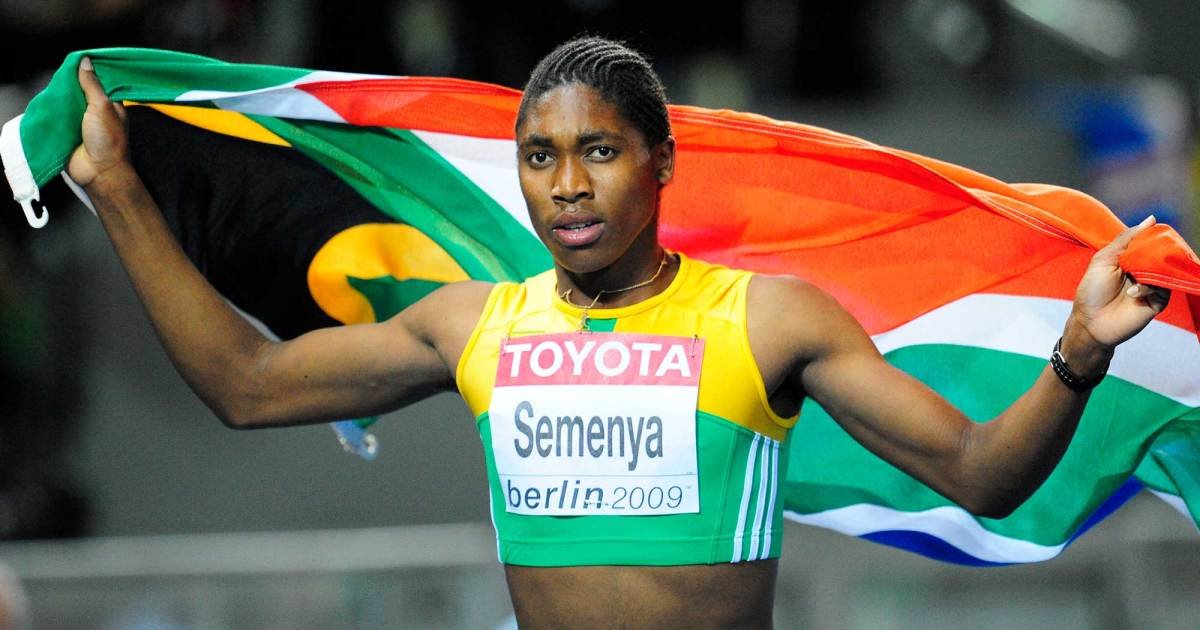
South African runner Caster Semenya, shown here after a 2009 race, has blasted the IOC for its new gender testing policy.
On March 26, the International Olympic Committee announced that all athletes competing in women’s sports will be required to undergo genetic eligibility testing. Claiming to be concerned with “fairness” and “the protection of the female category,” the IOC aims to ban transgender women from future Olympic games by screening for the SRY gene, which is usually found on the Y chromosome. The 2028 Summer Olympics in Los Angeles will be the first games with this policy in effect.
For queer historian and writer Michael Waters, the IOC’s announcement elicited a feeling of déjà vu: The institution has employed similar gender verification rules before—only to abandon them amid public backlash. In his 2024 book, The Other Olympians: Fascism, Queerness, and the Making of Modern Sports, Waters traces the history of trans athletes in the early 20th century, showing how a World War II–era moral panic around gender expression directly informs today’s anti-trans attacks.
I spoke with Waters about his book, the history of sex testing in international sports, and how the IOC’s latest policy marks a return to a discriminatory model of gender surveillance that draws from a dark eugenic past.
This interview has been lightly condensed and edited.
Let’s start with the basics: What is the IOC’s new policy on sex testing, and how does it differ from previous approaches?
The IOC’s new policy is resurrecting a policy of genetic testing that actually had been active for a few decades in the 20th century. In the 1960s, when the IOC first introduced genetic testing, it used these things called Barr body tests, which essentially were measuring the presence of XX chromosomes. Anyone without two X chromosomes would have been kicked out of women’s sports.
“These tests that the IOC and a lot of sports federations are now presenting as new, non-invasive, cutting-edge technology—they have literally used these before and found that they were, on one hand, inaccurate in creating these false positives, and on the other hand, just in violation of people’s human rights.”
There actually were some high-profile cases of cis women athletes who had a multiplicity of chromosomes—who did not just have XX—who were pushed out of sports because they failed this gene test. There’s this Polish sprinter named Ewa Kłobukowska in 1967 who had played in elite track and field competition before, and then when the Track and Field Federation implemented the first version of chromosome testing, she failed for vaguely explained reasons. An official said that she had “one chromosome too many,” and then she was banned from sports entirely. After that moment, the IOC stopped releasing and trying to publicize the banning of certain women from sports, but many more probably were kicked out because of failed tests that we just don’t know about.
The version of genetic testing that the IOC implemented in the late 1960s, and that continued on until the end of the 1990s, accrued so much backlash and criticism—from scientists, from athletes, from politicians, and actually the whole government of Norway banned this sort of genetic testing for sports practice—that around 2000 the IOC just got rid of genetic testing policies wholesale.
In the early 2000s, the IOC started to move toward creating some path to participation for trans women athletes. There were a lot of restrictions around how trans women could compete; the earliest rules required people to have gone through some sort of surgery-based medical care. And eventually, in 2021, the IOC kind of just stopped implementing any requirements overall and created this framework that would allow individual sports federations to make their own policies around which women can compete in women’s sports.
So what’s happening here is after this brief period of the IOC saying, “We’re going to leave it up to the individual athletic federations,” now they’re stepping back in and saying, “Okay, here is our policy.” While they’re framing it as this new thing that has risen out of discussion with stakeholders, really this is a direct resurrection of the policy that they had in the ’90s that was widely derided and abandoned.
Did anything in particular happen socially or culturally in the late 1990s that caused the IOC to abandon universal sex testing?
In the early decades, it was the Barr body test that measured XX chromosomes, and eventually, the IOC did actually switch to SRY tests around the mid-’90s. In 1996 at the Atlanta Olympics, there were eight women who originally failed the SRY test, who after further review were all reinstated. So these tests that the IOC and a lot of sports federations are now presenting as new, non-invasive, cutting-edge technology—they have literally used these before and found that they were, on one hand, inaccurate in creating these false positives, and on the other hand, just in violation of people’s human rights.
There are a lot of people assigned female at birth who might have a Y chromosome, or some traces of Y chromosomal DNA, and could actually test positive during the SRY test. Instead of dealing with the complexities of the human body—not to mention gender itself—this is just resurrecting an old-school approach. I think it’s notable that even the scientist who discovered the SRY gene has vocally been talking about why the application of this test in sports doesn’t make sense and is discriminatory.
So we’ve talked about the 1960s to our present day, but your book looks at the history of trans athletes going all the way back to the 1930s. Your research shows how the 1936 Berlin Olympics was a turning point, when the Track and Field Federation—now called World Athletics—implemented the first sex testing policy for women athletes. What happened in 1936, and what was going on in the years leading up to that moment?
It’s important to realize that in the early 20th century, women’s sports were a source of moral and gender panic. The founder of the Olympics, Baron Pierre de Coubertin, hated women’s sports—he didn’t think women should compete at all—and the early Olympics had very few sports available to women because of this.
“There was a belief that competitions like track and field would be both detrimental to women’s health, and in some cases even a masculinizing force on them. Butch women were looked upon as suspicious and cast as having an unfair advantage over more ‘petite’ feminine women.”
Actually, the only sports available to women were those like tennis—which at the time were very closely associated with a white, rich, European elite—because so much fearmongering around gender was so racialized. There was a belief that competitions like track and field would be both detrimental to women’s health, and in some cases even a masculinizing force on them. Butch women were looked upon as suspicious and cast as having an unfair advantage over more “petite” feminine women. And so before we’re even talking about gender diverse athletes and intersex athletes and trans women, there’s just this whole panic around cis women athletes and which kinds of cis women are winning in sports competitions.
In late 1935/early 1936, there are a few different things going on. The Nazis are hosting the Berlin Olympics and are applying really significant pressure on the IOC to limit which kinds of athletes can compete. This is mostly racialized—there’s all this discussion around whether or not the Germans would allow Jewish athletes to compete. In the German case, they were banning athletes of color and exacting their eugenics logic onto sports. The Nazis also were really skeptical of butch women and queer women.
Then, two athletes—both of whom had retired but had played in women’s sports—kind of one after another announced that they were transitioning gender and would begin living as men. Their names were Zdeněk Koubek and Mark Weston. Koubek is Czech; Weston is British. Sports officials saw the idea that an athlete could transition gender as a threat to the binary categories they had built. And so there was this high-profile Nazi sports doctor [Wilhelm Knoll] who pushed for sex testing policies after reading about the cases of these athletes transitioning. And again, neither of these two were trying to compete in women’s sports. They were living as men.
But the news of these transitions became wrapped up in the historical panic around butch women in sports and became a reason for the global right, the Nazis in particular, to push forward the first sex-testing policies, which ultimately only the Track and Field Federation passed in August 1936 at the Berlin Olympics.
The other important moment is that in 1936 at the Berlin Olympics, there’s an American sprinter named Helen Stephens who wins a gold medal for the US. And almost immediately after she wins, there are newspaper stories that come out that essentially accuse her of being a man in disguise. And so Helen Stephens is stereotyped as being pretty butch—she has kind of a deep voice, big arms, big legs. And the fact of her being this butch woman who had won this track and field event was treated by certain sports commentators as proof that she was unfairly masculine. So there was a whole news cycle in August 1936 about whether or not Helen Stephens was actually a man. It’s really reminiscent of what happened in 2024 with the Algerian boxer Imane Khelif. There was a storyline circulating that this woman who had won gold was not feminine enough, and was therefore a threat to sports. Her story and success became proof of the need for these medical exams in women’s sports.
Why did this Nazi-era approach to sex testing expand from the Track and Field Federation to become broader IOC policy in the 1960s?
The IOC sex testing stuff in the ’60s was really influenced by Cold War tensions. USSR women kept beating American women in sports, and there was all this fearmongering about the perceived butchness of the Soviet athletes and the possibility that the Soviets were sending men in disguise. Those underlying Cold War tensions really expedited the adoption of sex testing across the whole IOC in 1968.
It’s interesting to me that right now the focus is on trans women, but the early cases that your book looks at are trans men, yet the fear that’s undergirding both is the same: This idea of an invasion in the field of women’s sports. Why do you think that’s a consistent throughline? Are the Olympics sex testing men’s sports at all?
No, they’ve never sex-tested men’s sports.
And why do you think that is?
“I think women’s sports always really activated the global right because of what sports success says about women’s independence.”
From the early days of the Olympics there is this deep-seated paranoia about women’s sports and what sports mean for the place of women in society. There have been so many junctures of discomfort with women’s athletics, and specifically what a successful woman athlete means for gender politics and for women’s economic role and physical role and sexual reproductive role. It’s not surprising then that often the actors pushing sex testing policies—kind of at every juncture of the 20th century, up until today—are right-wing actors who themselves also are deeply concerned with pushing forward a conservative idea of gender. I think women’s sports always really activated the global right because of what sports success says about women’s independence.
In the case of the US, we see women’s sports as the starting point of a much larger push to disenfranchise and strip rights away from trans women. A lot of states start by banning trans women and girls from sports, and then go further and take away basic health care rights. The Nazis also focused a lot on women’s sports because of the historical fact that women’s sports had been a site of deep gender anxieties since the Olympics started.
I think what’s interesting about the history of sex testing in the Olympics—and the history of gender medicine more broadly—is that we see people at different points trying to take scientific discoveries and graft them onto a social understanding of sex and gender. Do you have thoughts on how these different scientific frameworks—from hormone testing to chromosome testing—have been used at different points to perform gender surveillance? What do these shifting methods reveal about the broader project of enforcing the gender binary?
I think the history of sex testing is a story of sports officials constantly coming up against the reality that sex is not a binary, and that you actually just can’t neatly cleave people into two categories, even against their will. And what you see throughout the 20th century up until today is that there are all these different scientific levers that officials try to pull.
“Maybe there was a moment in the early 2000s when the Olympics was willing to grapple with the fact that people are complicated and the body is complicated. What we’re seeing is the IOC completely abandoning that potential.”
The first sex tests were just a strip test, where women athletes would have to present doctor’s notes affirming that a doctor had looked at their genitalia and decided that they were in fact women, which was quickly proven to be both not a way to measure sex and also deeply humiliating and discriminatory. So then they embrace chromosome tests, which, similarly, not everyone neatly falls into an XX-XY structure. And so in the early 2000s, you see this shift towards hormones instead as a proxy for sex. But there’s no neat cut off between hormones associated with different genders.
Through all of these efforts, what you see is the fact that sports officials—and really we as a people—just have no clear way of measuring sex in a binary way, because it is simply just not binary. I think maybe there was a moment in the early 2000s when the Olympics was willing to grapple with the fact that people are complicated and the body is complicated, and maybe reconcile with the fact that being inclusive is going to be a process. What we’re seeing is the IOC completely abandoning that potential.
Fundamentally, the issue of trans women and intersex women’s access to sports is a human rights issue. Sports officials historically have used the guise of science as a way to justify often vehemently anti-trans policies. I think that we can and should respond by mentioning some science—and also mentioning the fact that there really is very little evidence around a lot of these scientific claims that the IOC is making—but I think more importantly we should be framing this as a human rights issue. Science does not absolve this issue either way. Really this is about whether states have a right to determine people’s gender for them.
What do you think happens next? And is there anything we can learn from history that could inform resistance to these policies moving forward?
These policies are an outgrowth of a global anti-trans panic, and I think they are becoming part of a right-wing feedback loop where what is happening in certain countries, like the US, is then informing global Olympic policies. You actually see this with the Supreme Court case that bans trans women and girls from sports in America. You saw the Olympics being cited as justification for banning trans women; the Supreme Court justices on the right noted that the Olympics has been moving in this direction and therefore are kind of using what happens on a global level as evidence for their own crackdowns on trans people, particularly trans women.
“This is all a manufactured moral panic, and institutions are just kind of slowly giving into it.”
In the same way, the IOC, I’m sure, is passing this policy in part because the next host of the Olympics is the US, which has banned trans women from competing in its borders. What is happening in the US and the global right is directly impacting what’s happening with the IOC. All of this ignoring the fact that there’s no reason that we’re doing any of this in the first place. This is all a manufactured moral panic, and institutions are just kind of slowly giving into it.
That is the dark read of the situation. On the flip side, these policies are fundamentally arising out of culture and politics, and there’s no reason that they should exist on their own. I think that’s why we saw in the ’90s the IOC abandoned chromosome testing: because there was a groundswell of people who pointed out, rightfully, that it’s a really discriminatory policy that violates women’s human rights in a lot of cases.
I do think ultimately it’s going to take something similar. We have to push for a cultural shift that takes into account bodily diversity and champions trans women’s rights. I also think we’re going to see plenty of different lawsuits being filed by intersex women athletes who are denied the chance to play in the Olympics now. National governments like France also have privacy laws that would really restrict and perhaps just not allow a body like the IOC to require genetic testing. So if more countries pass legislation like that, that would conflict with the IOC policy, and perhaps they would roll it back. But I think fundamentally what we need is cultural change.



