
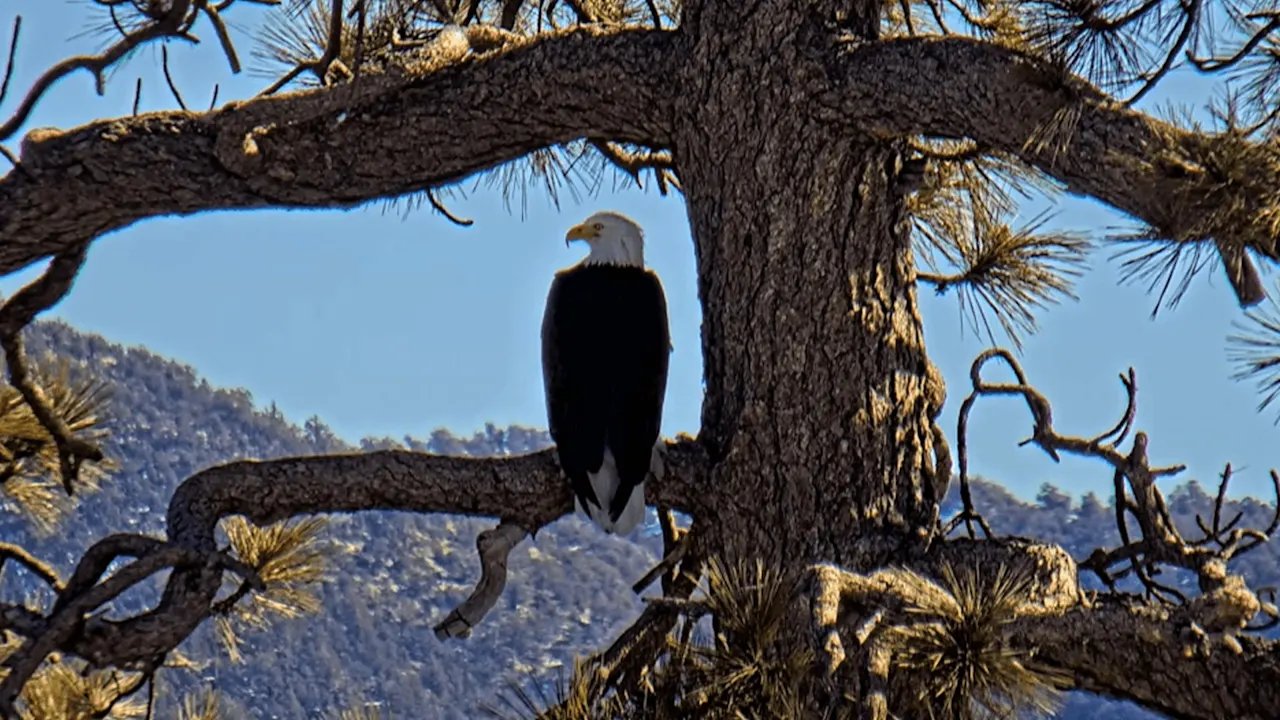
Jackie, the world-famous Big Bear bald eagle, has been melting hearts and educating the public about her species since 2015, thanks to a web camera run by the California nonprofit Friends of Big Bear Valley (FOBBV).
A little more than 10 years later, her admirers have the chance to give back.
FOBBV and the San Bernardino Mountains Land Trust (SBMLT) have teamed up to raise money to purchase the property with the goal of preserving the open space. These 62 acres, located on the north shore of Big Bear Lake, are vital not only for Jackie but also for her mate Shadow and their offspring.
Developer RCK Properties wants to put 50 custom homes and 55 boat slips instead, in a project dubbed Moon Camp. In order to prevent this, $10 million must be raised in six months, with a July 31 deadline.
Adding another layer of complexity, Sandy Steers, the former executive director of FOBBV, a director of the land trust, and a driving force behind the purchase deal, passed away shortly after finalizing the agreement.
Fast Company sat down with Jenny Voisard, media and website manager at FOBBV, and Peter Jorris, president of the land trust. The pair discussed how this purchase would benefit the environment, the current state of their fundraising efforts, and the history of Bald Eagles in Big Bear.
The fight to preserve Moon Camp
The land trust was formed in 1995 when residents banded together to stop another development. FOBBV was formed under similar circumstances in 2001, to fight against the development of the Moon Camp property.
Steers was at the forefront of this movement, becoming the organization’s executive director. The almost 25-year-old battle has been complex, with many highs and lows, ranging from lawsuits to denied green-light approvals.
Although the land trust and FOBBV are different organizations, the two often have similar goals. SBMLT has been wanting to preserve the Moon Camp property even before FOBBV existed.
In 1997, the organization sat down with the Forest Service. It asked, as recalled by Jorris, “If money was no obstacle, if the Forest Service had unlimited resources and every landowner was a willing seller of their property, what would the Forest Service want to add to its ownership in the overall forest?”
“That became our master plan,” he added. “And so Moon Camp became one of those very early on.”
Since FOBBV is a nonprofit and SBMLT is a land trust, it makes sense that the two would partner to save the Moon Camp property.
“A land trust is an organization that finds ways to purchase land for various reasons to keep it in open space, as opposed to seeing it go into some form of development,” Jorris explained. “In our particular case, we operate within a national forest, and it just so happens that the San Bernardino National Forest was created way back in 1891. Much of the land within its boundaries was already in private ownership.”
The Moon Camp property sits just one mile away from Jackie and Shadow’s nest. The shoreline property is an important fishing and perching ground for the eagles. If the development happened, the eagles’ routine would be disrupted.
“The disturbance will probably cause them to leave the area,” Voisard mused.
Beyond the eagles, there are other potential negative environmental impacts. The Ash Gray Indian Paintbrush, a rare plant present on the property, is only found in the San Bernardino Mountains. Flying squirrels also make their homes in the area.
Further, the development would increase traffic on a one-lane highway, which could be problematic in the case of wildfires evacuations.
The $10 million price tag may seem steep, but it’s the current market value of the property. Neither SBMLT nor FOBBV want to cause RCK Properties financial harm.
“We’re not obstructionists. So we want it to be fair for them,” Voisard explained.
Stephen Foulkes, vice president of RCK Properties, declined to speak on the record with Fast Company, but did confirm the purchase agreement.
Both the land trust and FOBBV want to preserve the forest, and the flora and fauna that call it home. It’s also important to honor the work that Steers poured into this project, even in her final days.
It is hard to overstate how important this is for the organizations.
“It means everything,” Voisard says. “This was everything that she fought for. Sandy Steers put Big Bear Valley on her shoulders, all of the nature and wildlife, and wanted to protect it. And so we’re going to make sure it is.”
A fundraising update and future fundraising plans
During the first phase of fundraising, an official website was created to eliminate confusion. The revenue generated came from small donations.
The eagle web cameras are so popular that they have attracted 2.5 million followers across FOBBV’s social media platforms, and was even featured on popular national programs like NBC’s Today show.
So it is not surprising that over $900,000 was raised in the first two weeks. As of publication, that number has increased to just under $1.6 million, which is roughly 16% of the funding goal.
The second phase of fundraising hopes to attract larger corporate or even celebrity donors. Both organizations have several leads but welcome more.
A brief history of the Big Bear eagles and Sandy Steers
Steers, a biologist and former NASA employee, moved to the valley around 2000. She quickly became involved in protecting the natural wonders around her, including working with the Forest Service to monitor bald eagles.
Prior to 2009, bald eagles used Big Bear Valley as their winter escape. Around that time an eagle couple, Ricky and Lucy, decided to make the valley their full-time home.
Jackie was hatched in the 2011-2012 season while Steers watched from afar with her binoculars.
“Sandy loved Jackie so much and was so connected to Jackie. She would stand out in the freezing cold and weather and just stare at her for hours with a spotting scope,” Voisard says. “When I think of Jackie, I think of Sandy.”
The genesis of the idea for the web cams came because Steers wanted to see inside the eagle’s nest and was determined to make this happen.
“She organized and worked really hard to not only raise the funds for it, but to understand how to build a system and design a system that would be safe for wildlife and humans,” Voisard stated. “It’s in the middle of the mountains, 145 feet up a tree, and so it’s very extensive and expensive and required a lot of permitting.”
All her hard work paid off. The first camera was live in 2015 with a second in 2021. Viewers were able to see Jackie fall in love with Mr. B, her first mate. They were also able to witness Shadow wooing her away from him, which is not normal eagle behavior. Eagles typically mate for life, but Shadow had some smooth moves.
Jackie and Shadow have successfully raised several chicks and are still going strong.
This season, Jackie and Shadow laid two eggs, which were sadly eaten by ravens. Thankfully two more came about a month later.
Now the world gets to wait and see the fate of these potential chicks. Their fans can get an inside look into the nest and help save their habitat to ensure the safety of future generations as well.



