
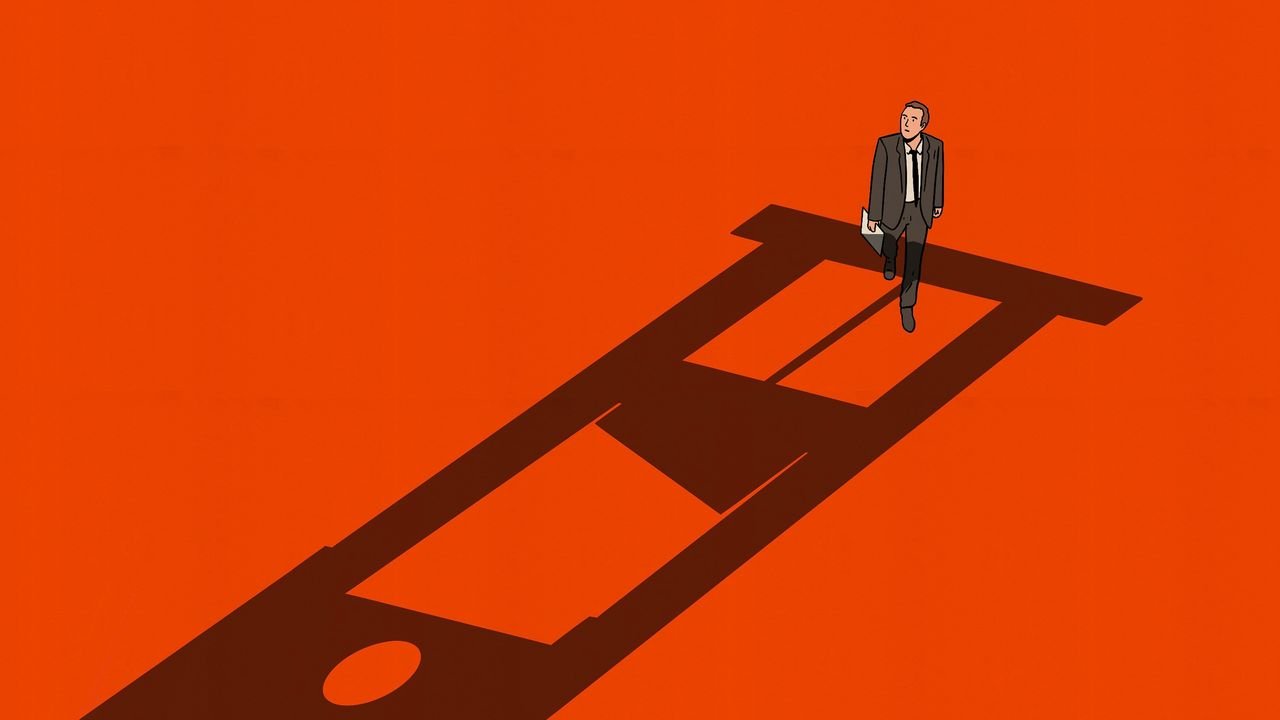
Since France abolished capital punishment, in 1981, it has been nearly impossible to see a guillotine. In Paris, the Museum of the Prefecture of Police possesses just a guillotine blade, while the closest thing on view at the Carnavalet Museum is a two-foot-tall model guillotine and a pair of dangly brass guillotine earrings. In the Eleventh Arrondissement, where the Rue de la Roquette meets the Rue de la Croix Faubin, you can just make out five rectangular indentations in the pavement—flagstones that supported a guillotine that stood outside the Roquette prison during the second half of the nineteenth century. (It was used to execute dozens of people, including the anarchist Auguste Vaillant, who lobbed a bomb onto the parliament floor, and Émile Henry, who blew up a café to avenge Vaillant’s execution.) The apparatus is a phantom now, but it was once a concrete, almost corporeal presence, known familiarly as the Widow, the National Razor, the Cigar Cutter, or, simply, the Machine.
Originally, the guillotine was called the louisette, after its inventor, the surgeon Antoine Louis. He conceived of the device in the late seventeen-eighties, likely drawing inspiration from the English gibbet, the Scottish maiden, and the Italian mannaia, and had it built by a harpsichord manufacturer named Tobias Schmidt. Louis and Schmidt were acting on the advice of Joseph-Ignace Guillotin, a physician who firmly opposed the death penalty but, as long as it was in effect, wanted to render it more humane and efficient.
Before the Revolution, methods of capital punishment varied according to class: nobles were beheaded by a brisk swing of the sword, while other criminals faced an array of punishments, from hanging to drowning, depending on the offense. Guillotin urged the Assemblée Nationale to democratize its approach, so that “offenses of the same kind will be punished by the same kind of penalty, regardless of the rank and status of the guilty.” To that end, he proposed the creation of a new apparatus. “The knife falls, the head is severed in the blink of an eye, the man is no more,” he famously explained. “He barely feels a quick breath of fresh air on the back of his neck.”
The first public execution by guillotine took place in 1792. Despite Guillotin’s ideals, executions were messy and sometimes shambolic affairs, swarmed by bloodthirsty crowds and heckling tricoteuses. One such affair claimed an extra life when the executioner’s son ascended the scaffold to brandish a head, lost his footing, and fell to his death. The machine came with its own macabre accessories: a splatter shield and a wicker basket, placed at the foot of the platform to catch the rolling head.
Executioning was a hereditary métier, monopolized in Paris by the Sanson clan for nearly two centuries. In 1847, Henri-Clément Sanson, who preferred gambling to guillotining, pawned off the family apparatus. The Deibler family eventually took over, launching a new trend: waggish criminals started tattooing the words “ma tête à Deibler” (“my head for Deibler”) on the backs of their necks. The guillotine was conspicuous, until it wasn’t. In 1939, hundreds of people mobbed the Place Louis Barthou to witness the execution of the serial killer Eugen Weidmann. Someone had stashed a film camera in an apartment high above the plaza, capturing a scene of rowdy onlookers feasting on sausage sandwiches and uncorking bottles of wine as—after a series of delays—the blade dropped on Weidmann’s nape. The spectacle was sufficiently embarrassing that the Prime Minister decreed within a week that executions would theretofore be hidden behind prison doors. Yet gruesome traces of the practice endure: Anatole Deibler chronicled his work in a series of gray linen notebooks, excerpts from which were published in 2000 as a book called “Guillotinés.” Readers will encounter mugshots of the condemned, Deibler’s hand-drawn notations (a red cross with a black circle represented a completed execution), and, without warning, a series of photographs of severed heads.



