
Adults experiencing a mental health or drug-related crisis will soon have a new health care option in Newark where they can get medication, professional and peer support, and a comfortable place to rest for up to 24 hours.
New Jersey health care officials and leaders at Rutgers University gathered Tuesday on the University Hospital campus in Newark to cut a symbolic ribbon on the state’s first crisis receiving stabilization center, a final link in the crisis response system the state launched four years ago with the 988 hotline. The system also includes a statewide network of mobile emergency behavioral response teams, which rolled out last year.
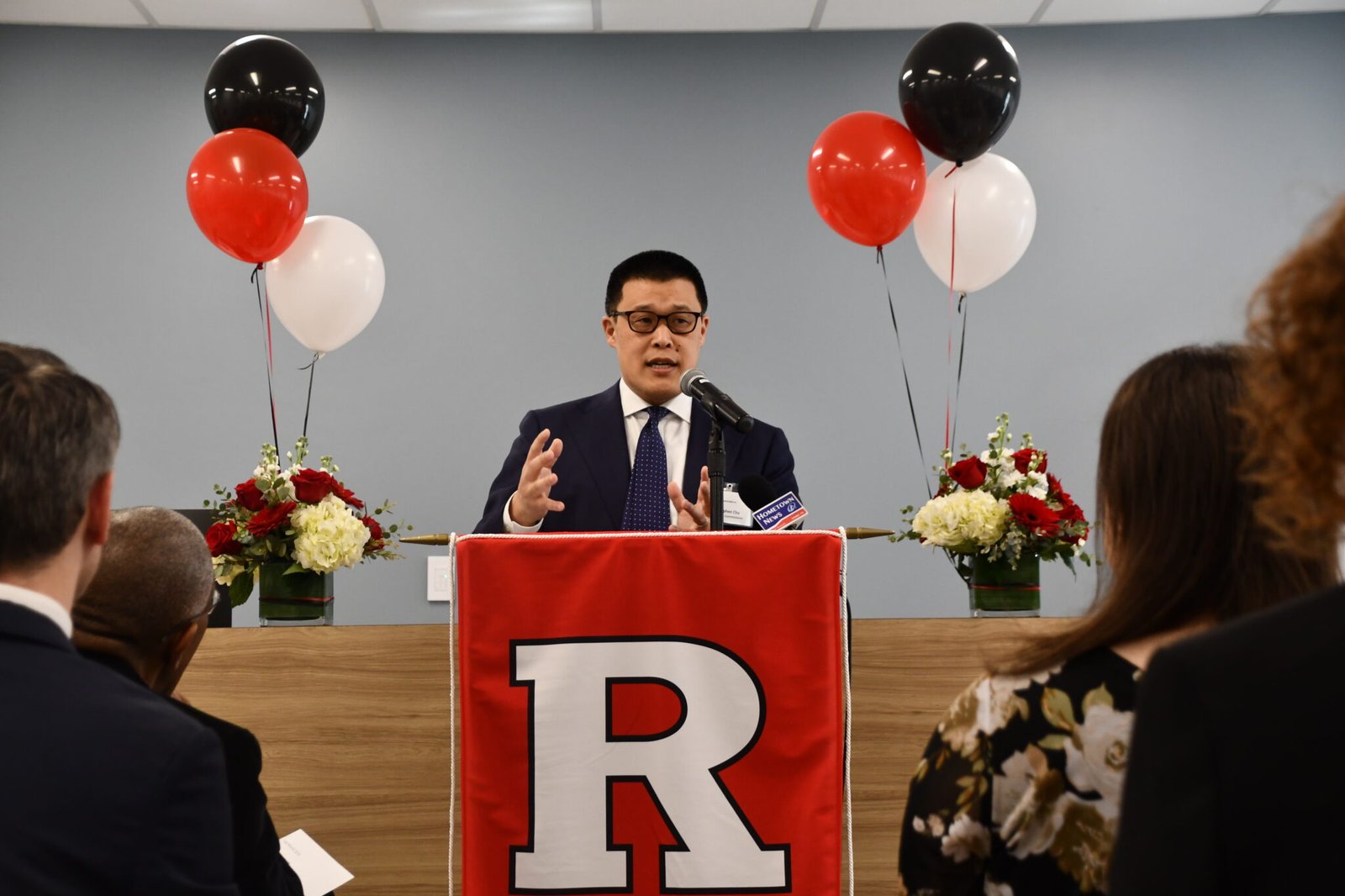
State Department of Human Services Commissioner Stephen Cha, whose agency oversees the crisis response system, said the new center “represents a core need.”
“People need somewhere to call. People need someone to respond, but also people need somewhere to go, and that’s what this place is here,” Cha said.
With federal changes coming to Medicaid, NJ pursues ways to keep people enrolled
The crisis stabilization center — the first of five the state is slated to open in the coming months — will welcome patients later this month inside the existing University Behavioral Health Care’s building on South Orange Avenue. That facility oversees behavioral health research, provides clinical services to some of the most vulnerable patients in the state, and trains Rutgers University’s medical students, some of whom do rotations next door at University Hospital, the state’s public hospital.
The center, which will be open 24 hours every day, is designed to be a less stressful alternative to a hospital emergency room and features private clinical rooms and comfortable lounge chairs. It is open to all, regardless of anyone’s ability to pay.
“We believe this is going to revolutionize the way people in crisis are going to be treated,” University Behavioral Health Care President and CEO Frank Ghinassi said.
More than 700 people died by suicide in New Jersey last year, an increase from 2024, according to state data. More than 13% of adults here said they were depressed in 2025, according to America’s Health Rankings, a national survey.
Gov. Mikie Sherrill’s $60.7 billion budget proposal includes $28.8 million for the 988 hotline and crisis response system, which has been built over the years using a mix of state and federal pandemic relief money. The hotline is expected to log 170,000 calls this year, according to budget documents.
Other crisis stabilization centers are planned for Morris, Bergen, Monmouth, and Camden counties once funding becomes available. The state has invested $37 million since 2024 to retrofit facilities and contract with the provider groups like University Behavioral Health Care that will operate the centers, Human Services offiials said in an analysis of the current state budget.
Multiple other states have created similar short-term stabilization centers as part of their 988 crisis-response system, said Deputy Human Services Commissioner Valerie Mielke, who oversees the system.
Mielke said these facilities can save taxpayer money by reducing the burden on more costly options, like emergency rooms and correctional facilities.
“By providing a community-based alternative, these centers can help reduce unnecessary ER visits and hospitalizations while ensuring people get the right level of care when they need it most,” she said in a statement.
A proposal to generate more predictable funding for New Jersey’s crisis response programs by adding a 40-cent fee to every phone line remains up for debate in the New Jersey Legislature. The bill, sponsored by Sen. Joe Vitale (D-Middlesex) and Sen. Vin Gopal (D-Monmouth), is aimed at raising $67 million annually. At least a dozen states have passed similar laws to fund these programs.
“We need to make sure that we fully fund this program, with a predictable source of revenue, so that we’re not going hat in hand to the Legislature every year having the food fight with everyone else who has important programs,” Vitale said in Newark on Tuesday.
Lawmakers have until July 1 to craft and adopt a spending plan based on Sherrill’s proposal.
New Jersey launched the 988 hotline in July 2022 in response to a federal law that required states to replace traditional 11-digit help lines with a single three-digit number that would be universal nationwide and be easier for people in crisis to remember. The state contracts with a handful of mental health organizations that train and staff the hotline, where services can be available in 240 languages, according to state officials. Texting is also an option for English and Spanish speakers.
According to the Department of Human Services, calls to 988 averaged just under 3,800 a month when the program started in 2022 and have since grown to more than 8,600 monthly this year. As of 2026, 85% of those are answered by one of the in-state call centers, while the remainder are picked up by national operators who can also connect them with services in New Jersey.
In April 2025, the department added mobile response teams that hotline counselors could dispatch to help people in non-life-threatening emergencies. These two-person teams include a mental health professional and a trained peer specialist, who are linked by phone or video to a clinical expert. They work to de-escalate the situation, connect the family with other services, and follow up as needed.
The crisis stabilization center in Newark will give 988 operators and mobile teams another option when someone needs care. Instead of referring someone to the emergency room, they can connect them with the University Behavioral Health Care program, where patients can get medication, emotional support, connections to other services, and a safe place to rest.
“We see individuals who need this service every day, every night” at University Hospital’s emergency room nearby, hospital president and CEO Carole Johnson said. But linking a patient in crisis with care can take time, she said, and options are limited.
We believe this is going to revolutionize the way people in crisis are going to be treated.
– University Behavioral Health Care President and CEO Frank Ghinassi
“Nothing breaks our heart more than losing that chain, losing that opportunity to get someone on their path to recovery, and too often, that’s what happens, because we don’t have the continuum that gets you from crisis to stabilization to a place in the community where you can get care and you can continue to thrive. So we’re so thrilled to see this happen,” Johnson said.
The Newark stabilization center is also set up to accept people who come in on their own or are brought there by law enforcement, who in the past transported individuals in crisis to the emergency room. Once inside, people can meet with a nurse practitioner and a mental health professional — at the same time, to avoid forcing them to repeat their story — in a private room, hospital officials said.
If the person is a danger to themselves or has urgent medical problems, they will be directed to University Hospital’s emergency room, across several parking lots on the same campus. If not, University Behavioral Health Care said they can receive medication on site for addiction disorders, mental health diagnoses, or non-urgent medical needs, like to adjust their blood-sugar level or deter an infection.
Individuals can then spend up to 24 hours lounging in the light blue recliners in an open room with big windows, overseen by an advance practice nurse, a mental health professional, and peer specialist. This team can help people connect with additional services, renew outdated prescriptions, and schedule follow-up care as needed.
Rutgers President William Tate IV, who earned a master’s in psychiatric epidemiology, praised the new crisis center for enabling clinicians to follow proven steps of treatment, which first involve stabilizing a patient, then providing the best standard of treatment, before customizing that care over time.
“You can’t get to standardization and customization without stabilization,” Tate said, predicting it would keep people out of both emergency rooms and city jails. “I’m just pumped to be here and be part of it.”
GET THE MORNING HEADLINES.



