
This story was originally published by Chalkbeat. Sign up for their newsletters at ckbe.at/newsletters.
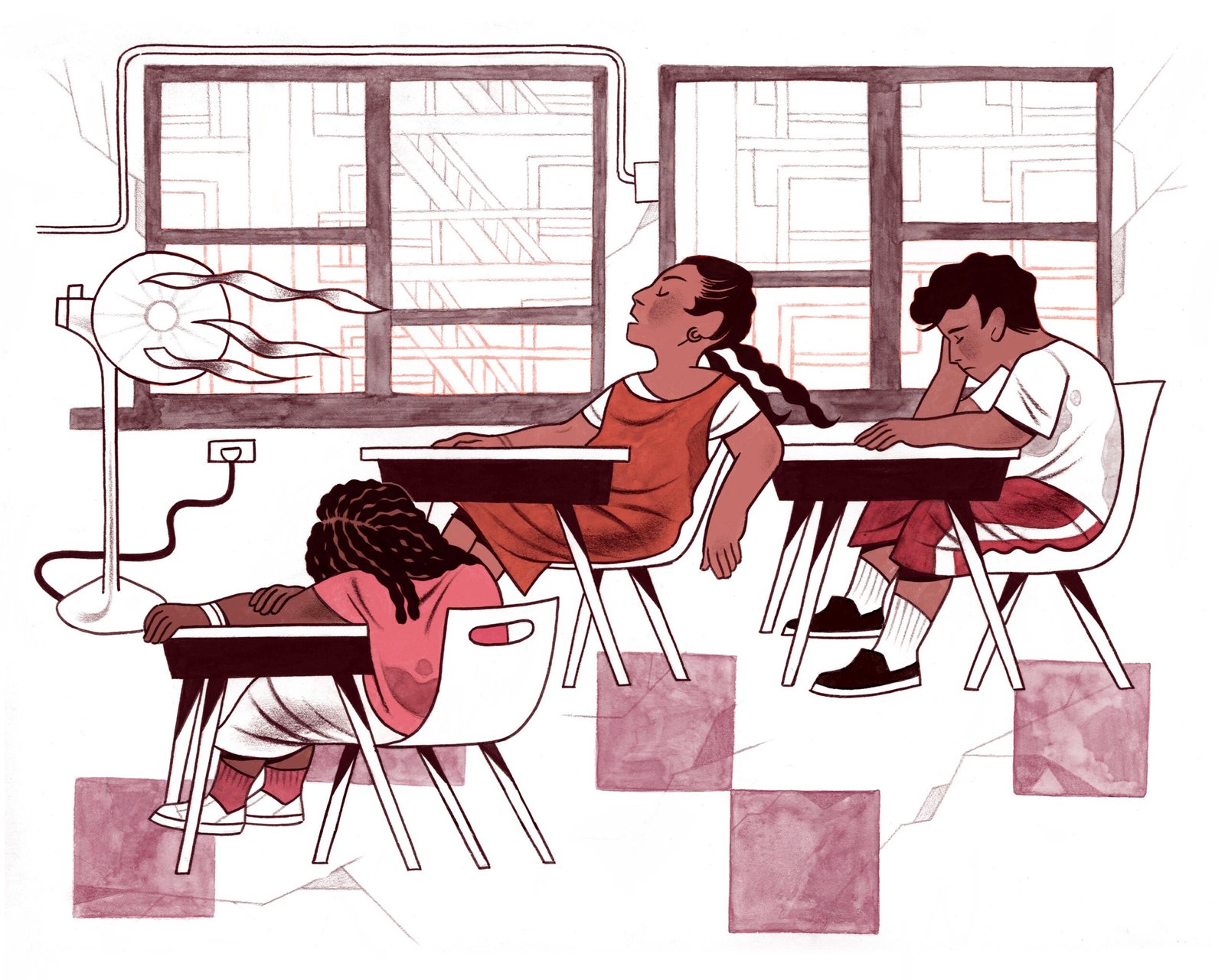
Gabrielly Ferreira remembers what it was like to spend kindergarten through eighth grade at Ann Street School in Newark’s East Ward, a building dating back to 1892. The floors were sinking, the paint was peeling off the walls, and sharing a small fan with her classmates during the hotter months distracted her from learning.
Then, in ninth grade, Ferreira went to Science Park High School in the Central Ward and saw a well-maintained school for the first time.
“It was much nicer. It was much cleaner. I guess it was much more open. I felt like even the hallways felt bigger,” said Ferreira, now 16 and a junior.
“It’s a really big change to go from a building like Ann Street to Science Park.”
 Credit: (Yunuen Bonaparte for Chalkbeat)
Ferreira’s experience is not uncommon in the East Ward, where school buildings are, on average, more than a century old and in need of repair. Some are too hot in the summer, too cold in the winter, with poor ventilation, broken water fountains, and peeling paint.
Newark isn’t alone: Philadelphia, Chicago, Memphis, and many other urban districts are also grappling with crumbling schools. What’s different about New Jersey is that the state is legally responsible for building and delivering new schools to 31 high-poverty districts, including Newark.
Parents, students, teachers, and advocates have pushed for new schools for years. When Superintendent Roger León took control in 2018, he promised to fix them and open new ones.
But the problems persist. And nowhere are the issues more apparent than in Newark’s East Ward, the city’s most densely populated area, where more than half of schools are also overcrowded, according to a Chalkbeat analysis.
While other parts of Newark have received new schools in recent years, a confluence of factors on the state, local, and neighborhood levels have slowed change in the East Ward. The state’s Schools Development Authority, the agency responsible for funding and constructing schools known as the SDA, has a multibillion dollar backlog of new school projects. The East Ward also lacks open space and has a history of heavy industry that makes large patches of the area unsuitable for new schools.
There is at least one school coming to the East Ward soon, according to the district, and small-scale renovation projects are ongoing. But the funding gaps and the complexity of new construction mean many of Newark’s most vulnerable students will be stuck in aging, crowded schools for the foreseeable future.
Paul Brubaker, the district’s communications director, did not respond to questions about the district’s efforts to fix the East Ward’s old schools and the needs that remain.
 Credit: (Yunuen Bonaparte for Chalkbeat)
While Gov. Mikie Sherrill’s proposed budget does not add new money to the SDA, Maggie Garbarino, Sherrill’s deputy press secretary, said her administration will follow an existing funding schedule established in 2023 that will add $350 million for school construction projects that have already been started and an additional $50 million for emergency repairs in high-poverty districts this budget cycle.
For advocates like Nikki Baker who’ve spent years pressing state leaders for more money for new schools, the frustration runs deep. An organizer with the Healthy Schools Now coalition, Baker says the cycles of “delayed and deferred” funding have left districts like Newark behind.
Research has shown that poor building conditions and other environmental factors can hurt student attendance and academic performance.
“A clean, healthy environment; to be able to breathe easy, to have a nice new school, access to clean drinking water, the feeling of that,” Baker said, “that does everything for students’ mental and physical health.”
Newark’s East Ward students must cope with old schools
The East Ward, which encompasses parts of Newark’s Ironbound, is home to thousands of Spanish- and Portuguese-speaking immigrant families. It’s an industrial part of the city, and in the southern part of the East Ward, young people are the most at risk of disconnecting from school.
Emma Villa, a sophomore at East Side High School, said warmer days are brutal inside the school due to no air conditioning. On hot days, most teachers open the windows to let fresh air in, while others have fans.
“In the summer, it’s so hot, you just see sweat on everybody’s faces, it’s just disgusting. It’s like a sauna in there,” Villa, 15, said.
 Credit: (Yunuen Bonaparte for Chalkbeat)
The East Ward is home to eight elementary schools and two high schools, with some dating as far back as 1848 — before the Civil War. The SDA has rebuilt two elementary schools in the ward: Oliver Street School in 2016, the first building rebuilt in the East Ward in over 100 years, and South Street School in 2018.
Seven others have not been rebuilt. Those untouched buildings are 139 years old on average, according to a Chalkbeat analysis, and the aging facilities are driving up maintenance costs.
The entire city school district is also over capacity by more than 2,000 students, according to a state report. In the East Ward, schools like Wilson Avenue, East Side, Lafayette Street, and Ann Street are significantly overutilized, with some enrolling approximately double the number of students as their buildings were designed for, according to a Chalkbeat analysis of state building capacity data.
East Side sophomore Jason Argueta, 15, feels the impact. He knows his school is run-down, despite school leaders trying to fix things like repainting the walls this year. Still, he said, “You can see the floors cracking, the walls cracking.”
Students also say getting to class during the school day can be tricky.
 Credit: (Michelle Perez for Chalkbeat)
The hallways are so congested at East Side that Argueta said he needs to find alternate routes to get to class on time. “I find shortcuts to class, but then [other students] find the same shortcut and it gets crowded again,” Argueta said.
Friends Selena Inahuazo and Ariel Muñoz, both sophomores at East Side, said broken water fountains and questionable old pipes mean they have to bring their own water bottles.
“I don’t drink water there. I try not to,” said Muñoz, 16. “It just tastes different.”
Classrooms also get cold in the winter, and some bathrooms have holes along the walls. Recently, East Side junior Jailyn Leon said, a cockroach crawled out of one of them.
Newark resorts to fixing its own problems as state funding lags
Some money has trickled into Newark from the state in recent years.
In February, León said the district is working to update “every classroom, every office, and every school” after the SDA gave Newark $6.3 million for urgent repairs and annual maintenance work at two high schools. Over the last five fiscal years, the SDA has invested $44 million in Newark school repairs. But that’s a drop in the bucket of what León estimates is a more than $2 billion need to fully update and repair school buildings in the city.
The SDA has identified 31 Newark schools that need to be replaced, up from the 13 aging school buildings flagged in previous plans. But there is no clear timeline or funds available for that work to start soon. The SDA has received funding through bonds, direct appropriations, and on a “pay-as-you-go” basis from the state legislature, with no long-term plans to fund the agency.
In the meantime, the cost for maintenance and temporary fixes keeps rising.
Yearly upkeep at East Side, built in 1911, is budgeted at $963,361 this school year, roughly $45,000 more than last year, according to the district’s maintenance plan. For Ann Street School, maintenance was budgeted at $439,518, roughly $20,000 more than the previous year.
 Credit: (Yunuen Bonaparte for Chalkbeat)
But as state funding stalls, Newark’s East Ward schools are getting older, prompting the district to take matters into its own hands. Newark has started to open new schools in existing buildings, a solution that solves one problem but raises new costs and challenges.
The district recently announced plans to open a new elementary school in the East Ward to ease overcrowding. But past efforts to convert existing properties into schools have locked the district into long-term lease agreements, decades of payments, and unforeseen construction delays.
That’s a pattern the district has resorted to because it doesn’t have the legal authority to build new schools in Newark. The state Supreme Court in 1998 ordered New Jersey to cover 100% of school construction costs because Newark and 30 other high-poverty districts lack the tax base to cover their needs. To assure equitable learning opportunities for students in those school districts, the state said it would take on the costs and oversee the construction process.
Nearly 30 years later, districts like Newark are stuck footing the bill for new schools and the complications.
For example, the district opened the East Ward’s first trade school, the Newark School of Architecture and Interior Design, in the old Saint James Hospital building. But that project was completed three years behind schedule in September after renovations began in 2022. It will cost the district more than $300 million over 30 years under its lease agreement with the property owner.
A better solution, according to East Ward Councilman Michael Silva: Build a new high school.
“We need to move forward and start building more schools adequate for the amount of students that we have here, and bringing us up to par with a lot of the schools that are in other cities throughout the state,“ Silva said.
But with no long-term plans to fund the SDA, and an estimated $7 billion in construction projects in high-poverty districts that have yet to be funded, state leaders are scrambling for other solutions.
Senate Majority Leader M. Teresa Ruiz, who represents Newark, agrees that there is a critical need to figure out how to build new schools. She introduced a bill in February that, if approved, would place a question on the November ballot to authorize $10.5 billion in new state bonds for school construction projects in districts across the state.
The last time the state went to bond for school construction funding was during Ruiz’s first budget cycle, roughly 18 years ago.
“That is a disservice to every single student, family, and community and district in the state of New Jersey,” said Ruiz during February’s Senate Judiciary Committee hearing.
“We’ve added some funding to the budget on an annual basis. It hasn’t been significant enough,” Ruiz added.
But even if the bond is approved, building a new school in the East Ward is challenging.
 Credit: (Yunuen Bonaparte for Chalkbeat)
Twenty years ago, the SDA acquired a plot of land on the corner of Ferry and St. Charles streets as the site for a new high school. The SDA at the time tried to combine the site with other properties to create a large enough area to build on, but funding shortfalls prevented the agency from acquiring the remaining land and including the project in its capital plans, leaving the promise for a new high school in the East Ward unfilled for decades
The price tag on land for areas like Newark’s East Ward will be significant, Ruiz said, a challenge she hopes Sherrill’s administration will take on.
Land in the East Ward is also scarce. Building a new school requires “almost an entire block,” said Brendan Da Silva, a Newark-based real estate agent. Elementary schools like Hawkins Street and Lafayette are just under 70,000 square feet, while East Side is just over 300,000 square feet.
Ruiz and Da Silva suggested building schools on top of existing buildings could be a solution for the East Ward.
That might be the best solution as the Ironbound section of the East Ward alone contains dozens of vacant properties the state has labeled as having actual or suspected contamination, with more scattered across Newark, Da Silva said.
 Credit: (Yunuen Bonaparte for Chalkbeat)
East Ward residents want better conditions in the area
In the meantime, East Ward community members have grown frustrated. They say neighborhood kids are already dealing with health issues outside of school because of the industrial environment.
Francis Nuñez, the director of advocacy and organizing at the Ironbound Community Corporation, a parent and East Ward resident, said she chose to send her daughter to a West Ward school instead because of overcrowding, large class sizes, and previous water quality concerns in the East Ward.
Nuñez, who graduated from Lafayette Street School in 2006, said she has seen new luxury housing developments pop up in her neighborhood despite the community sounding the alarm on the need to remediate land for new schools.
“I also feel like it’s a little bit of an insult to the community to know that most buildings need updates in order to be able to function as needed, and our elementary schools, especially, are struggling to do that,” said Nunez.
Extreme heat and water quality issues in schools also reflect broader environmental concerns in the East Ward, said JV Valladolid, an environmental justice organizer with Ironbound Community Corporation.
Heavy trucking, industrial pollution, and ongoing construction on new housing projects manifest in “not just asthma, but diabetes, cardiovascular issues, reproductive health issues, cancer rates, learning disabilities, absenteeism, and bad smells in the neighborhood,” said JV.
“That means that you don’t go outside for recess, you close your window, or you feel unwell generally.”
The community is “struggling to fight for the very basic necessity of clean air, a safe space to cool down, and quality schools,” JV said.
Jailyn, the junior at East Side, is one of the residents fighting for that.
 Credit: (Yunuen Bonaparte for Chalkbeat)
As part of the Youth Power Action Coalition, a student-led advocacy group in Newark, Jailyn and her peers are pushing the district to give teens a bigger role in helping to improve schools by establishing a student advisory group to conduct annual building condition reviews along with staff and creating a system where students can report facility concerns.
In February, the district rejected their proposals, but Jailyn still encourages students to “use their voice” to tell school board members what they deal with in school.
After years of watching promises go unfulfilled, “sometimes you feel left out because other schools in the district are brand new,” Jailyn said. “But why is it they’re brand new, and just like the old, oldest buildings are not being renewed?”
This story is part of the NJ 2025 Reporting Fellowship, which collaborates with 15 local and community news organizations, the Center for Cooperative Media at Montclair State University, and NJ Spotlight News. The stories in this collaboration focus on immigration, education, healthcare, the economy, and the environment, highlighting the perspectives of diverse communities in New Jersey.
Jessie Gómez is a reporter for Chalkbeat Newark, covering public education in the city. Contact Jessie at jgomez@chalkbeat.org.
Chalkbeat is a nonprofit news site covering educational change in public schools.



