
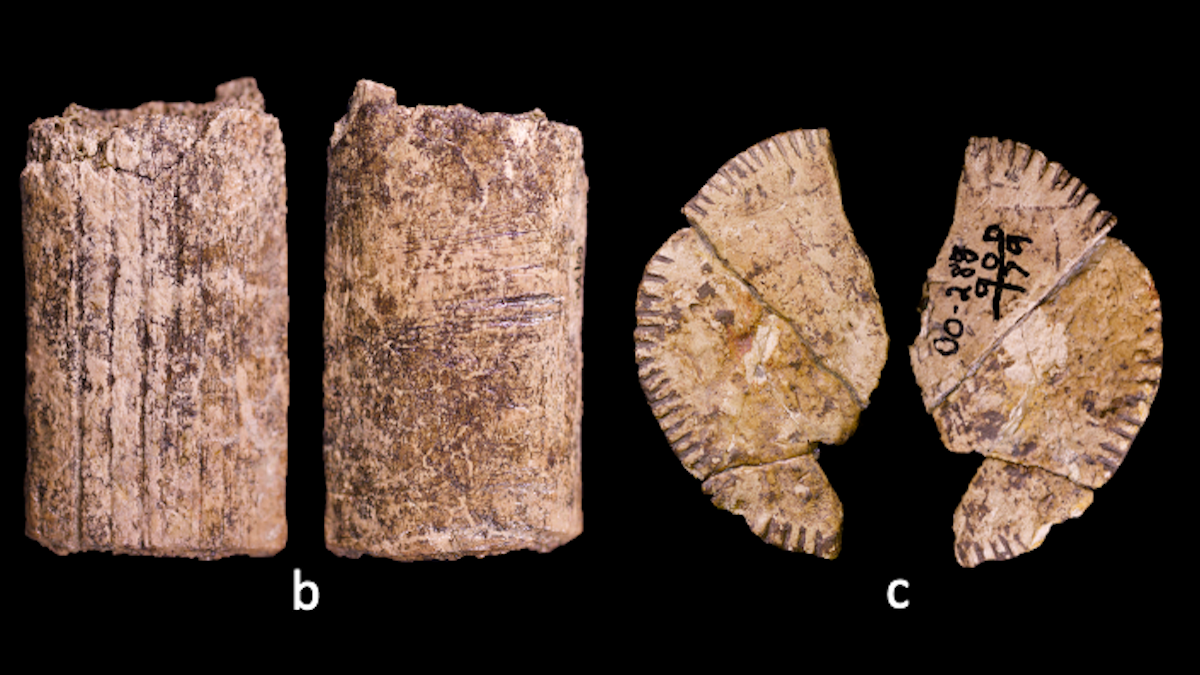
A new study may have identified the oldest known dice, dating back more than 12,000 years.
The record-breaking game pieces were used by Native American hunter-gatherers near the end of the last ice age, which makes them thousands of years older than previously known artifacts that could be considered dice.
They didn’t look like the classic cubes decorated with dots that tell your thimble to go directly to jail – instead, they were two-sided objects with different markings on each face. The principle is the same though: They could be thrown to generate a randomized binary option in a game of chance, like flipping a coin.
“Historians have traditionally treated dice and probability as Old World innovations,” says anthropologist Robert Madden, a PhD student at Colorado State University and author of the new study.
“What the archaeological record shows is that ancient Native American groups were deliberately making objects designed to produce random outcomes, and using those outcomes in structured games, thousands of years earlier than previously recognized.”
These ancient objects weren’t newly discovered, but their function as potential dice is. Madden developed a test: By analyzing Native American artifacts already known to be dice, he identified four features that they all had in common.
Then he compared other artifacts thought to potentially be game pieces to see whether they had any or all of these same features. Those that had all four features were deemed “diagnostic” prehistoric Native American dice, while those that only met some of the criteria were “probable” dice.
To be classed as dice, the objects needed to be two-sided objects made of wood or bone; each side had to be clearly different, usually with paints, pigments, or markings; they had flat or slightly curved surfaces; and they were the right size and shape for players to hold several of them in their hand at once and throw them down on a surface.
“In most cases, these objects had already been excavated and published,” says Madden. “What was missing wasn’t the evidence, it was a clear, continent-wide standard for recognizing what we were looking at.”
Of the artifacts Madden analyzed, he identified 565 that fit all four criteria for being dice. A further 94 objects were deemed probable dice, sporting some of the features. These artifacts came from 57 different archeological sites across North America, spanning thousands of years of history.
The oldest date back to the Folsom culture, between around 12,200 and 12,800 years ago, which yielded more than a dozen diagnostic dice. However, one probable die could go back to the Clovis people, and might be as old as 13,000 years.
Outside the Americas, the next-oldest examples of objects that functioned as dice are only about 5,500 years old, and were found in Asia and the Middle East. So if the North American collection is in fact an early form of dice as we know them, then it pushes back the time frame not just for this type of game, but for a certain kind of mathematical thinking.

“This finding is all the more significant because historians of mathematics frequently identify the invention of dice and games of chance as a crucial early step in humanity’s evolving discovery and understanding of randomness and the probabilistic nature of the Universe,” Madden writes in the published article.
Related: A Roman-Era Stone Baffled Experts. AI May Have Solved The Mystery.
Of course, there’s always the chance that the artifacts aren’t ancient dice – Madden admits that it’s possible the objects may have been used for other purposes, such as divination. But the evidence for these other purposes isn’t as strong as it is for gaming, the study suggests.
“The results of this effort suggest that dice, games of chance, and gambling have been a persistent feature of Native American culture – one that served a critical role in social integration – for at least the last 12,000 years and continues into the present,” Madden writes.
The research was published in the journal American Antiquity.



