
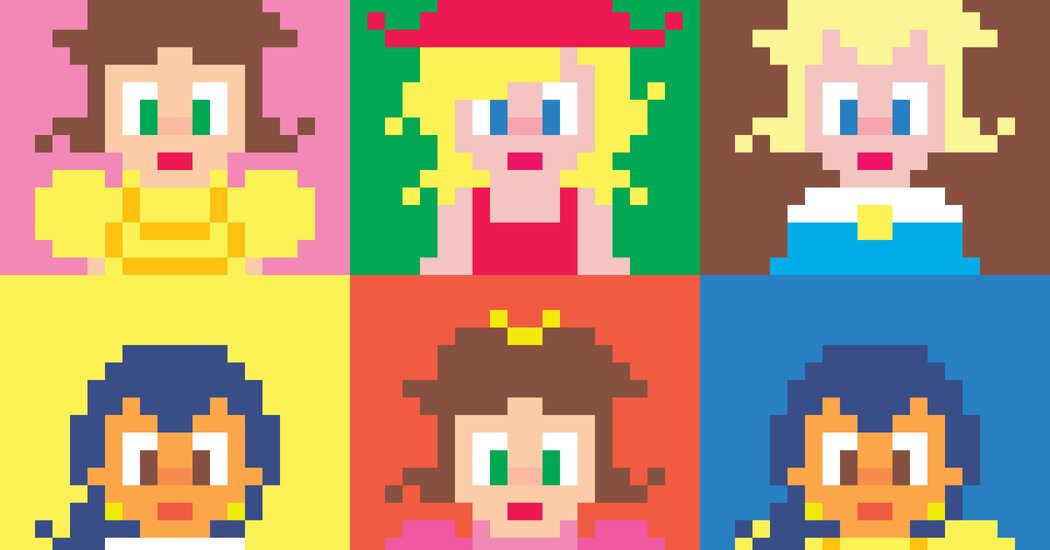
The First ‘Lady’
While later Nintendo games in the 1980s would feature stone-cold heroines like Samus, a bounty hunter in space, the series started in 1981 with basics. The Mario character was named Jumpman because he jumped to dodge obstacles. And his girlfriend was simply Lady, who was kidnapped by the titular ape of the Donkey Kong arcade game.
This was the beginning of the damsel-in-distress trope in video games.Starting in 1982, the character became known as Pauline in new releases of the arcade cabinet and its 1986 transfer to the Nintendo Entertainment System.
“Help Mario scale the construction site to rescue his girlfriend, Pauline,” the manual for that version of the game says. “You can gain points by picking up things dropped by Pauline (parasol and purse).”
In 2017, Pauline gained more individuality and left behind her damsel-in-distress past. Nintendo reintroduced Pauline as the singing mayor of New Donk City, a creative take on Manhattan that became a standout of Super Mario Odyssey on the Nintendo Switch. Her redesign was a significant departure: Instead of the billowy dresses of her princess counterparts, she opted for a red pantsuit for city business and a slinky dress when singing at celebrations. A teenage version of the character also appears in the recent game Donkey Kong Bananza, now as a partner to the large gorilla instead of its hostage.
The Toadstool Princess
The Super Mario Bros. games of the 1980s and ’90s continued to use the kidnapping of women to propel the player’s journey, but the character of Pauline was largely forgotten and replaced with Princess Toadstool, also known as Peach, the only person powerful enough to undo an evil curse on the Mushroom Kingdom.
There was a bait-and-switch element. The castle levels promised the possibility that Mario could rescue her, only to encounter one of her panicked mushroom courtiers saying that “our princess is in another castle.”
Princess Peach still had opportunities to shine, however, especially in the franchise’s many party games like Super Mario Kart, in which she was the only playable female character. Her first solo adventure came in 2005, where she flipped the script and needed to rescue a kidnapped Mario using skills powered by her own mood swings. But it wasn’t until 2024 that she went on her next major adventure, saving creatures from a wicked sorceress in Princess Peach: Showtime!
The Sidelined Princess
Four years after Peach’s introduction in 1985, a second princess, Daisy, appeared. In the 1989 Game Boy release of Super Mario Land, she was the ruler of a faraway kingdom, though in actuality she was little more than a stand-in for Princess Peach — 16 gray pixels with few discerning features. And when she appeared a year later in a golf game, she was demoted to caddy, hanging on the arm of Luigi and looking virtually identical to Peach on the title screen.
Daisy became one of the first members of a growing cast of supporting characters, mainly appearing in games like Mario Party and Mario Tennis. Her design settled into the slightly tanned, brunette princess in the orange dress that players know today. She also developed a tomboy personality and an intense competitive streak in soccer games like Mario Strikers Charged, which helped distinguish her from the pink femininity of Princess Peach.
Always a partner and never a protagonist, Daisy was finally made playable in the mainline series in 2023, when she appeared in Super Mario Wonder on the Nintendo Switch. The game director Shiro Mouri said at the time that Daisy was included to resolve a disagreement between Mouri’s daughters. “They would always fight over who gets to play Peach,” he explained.
Lady of the Shooting Stars
Until “The Super Mario Galaxy Movie,” Rosalina was the only woman in the franchise who hadn’t been kidnapped.
“She was never a damsel,” Stang noted before the film’s release, “and I would be shocked if the movie returned to that original formula.”
However, early designs for Rosalina pointed to a much more traditional story. Concept art showed the princess in a bouffant hairdo and flowing dress similar to that of Disney’s Cinderella. Through revisions, her platinum blond hair became a defining feature loaded with personality.
“Her long bangs represent her outward strength and inner sorrow and loneliness,” read one design note from Nintendo developers, who originally conceived of Rosalina as one of Peach’s relatives.
The tragic back story that defined Rosalina was written overnight by the Super Mario Galaxy director, Yoshiaki Koizumi, who found himself advocating more narrative in games, which Shigeru Miyamoto, the series creator, allowed despite his belief that Mario games don’t require much plot.
“For a long time, it really felt like telling a story in a Mario game was something that wasn’t allowed,” Koizumi said in a 2007 interview with Wired. “But I felt in this case that the Lumas and Rosalina really needed a story to explain what they were doing out there and to give the players a deeper understanding of their presence.”
Still, many players have wanted more from the back story.
In September, ahead of the movie’s title reveal, Nintendo announced that it would release an improved version of Super Mario Galaxy that included two extra chapters of Rosalina’s storybook; moreover, it would sell physical copies of the book for almost $25 each.
And despite not being involved in the sequel, the original voice actor for Rosalina, Mercedes Rose, said she had seen an uptick in messages from fans who described the character as motherly and powerful. She recalled getting direction from Nintendo staff that Rosalina was something like the mother of the universe.
“Her voice is very calming and projects otherworldliness while still being so grounded in reality,” she said, explaining that recording took just a day. “I honestly did my mom voice. I have three kids. I did my own thing.”
Produced by Gabriel Gianordoli and Rumsey Taylor.



