
Mpox is a disease endemic in central and west African regions1. The disease is caused by two different clades of monkeypox virus (MPXV), I and II, which are further subdivided into subclades Ia and Ib, and IIa and IIb2,3. Historically, clade I MPXV circulation was observed in Democratic Republic of the Congo (DRC), the Republic of the Congo (RoC), Central African Republic, South Sudan, Gabon and Cameroon, whereas clade II circulation was observed in Sierra Leone, Liberia, Ivory Coast, Ghana, Benin, Cameroon and Nigeria4,5. Cameroon has historically been the only country in which circulation of both clade I and clade II MPXV has been observed6.
Clade IIb emerged in early May 2022 causing a global epidemic of mpox1. The clade IIb outbreak was characterized by rapid expansion of the disease in nonendemic countries, especially in Europe and North America, driven by sexual transmission among men who have sex with men4.
In August 2024, because of the rapidly rising number of mpox cases caused by clade Ia and Ib in the DRC and neighboring countries3,7, Africa CDC listed mpox as a Public Health Emergency of Continental Security. Subsequently, the World Health Organization declared mpox a Public Health Emergency of International Concern for the second time since 20228,9.
Currently West Africa, in particular Sierra Leone, is facing a major mpox clade IIb outbreak of a new clade IIb lineage A.2.2.1 virus derived from Nigerian A.2.2 viruses10,11. Similar to what has been observed for clade Ib, transmission by heterosexual contact appears to be one of the drivers of this epidemic12,13,14,15.
RoC has experienced a dramatic increase in mpox cases over the past two years16. Historically, only clade Ia has caused outbreaks in RoC, primarily in the northern part of the country. However, several introductions of clade Ib in the RoC capital Brazzaville were identified 2024 and 2025, with a clear epidemiological and phylodynamic link to Kinshasa, DRC17. Clade Ia and Ib now display characteristics of sustained human-to-human transmission based on their apobec3 signatures in the genome. Here we report the introduction of clade IIb mpox in RoC, highlighting the continuous evolving epidemiology of MPXV.
The case was a 43-year-old man from Pointe-Noire, which is the second largest city and the economic capital of RoC. The patient reported a recent travel history to France and Ivory Coast and was identified when visiting a private outpatient clinic on the morning of 22 March 2025 with complaints of fever, asthenia and a skin rash in the genital area. The physician initially suspected syphilis. After close physical examination of the patient, he noticed the presence of disseminated skin lesions on different parts of the body with vesicles (fewer than 15) and pustules on the limbs, trunk, back and buttocks. Diagnostic tests for syphilis, HIV, hepatitis B and hepatitis C were negative. Based on the clinical description, the case was referred as suspected mpox as part of the passive surveillance of the RoC Directorate of Epidemiology and Disease Control of the Ministry of Health and Population under the framework of the Center des Opérations des Urgences de Santé Publique. Skin lesion and blood samples were collected and transferred to the National Public Health Laboratory in Brazzaville for molecular diagnostics. The patient was isolated at home, given paracetamol and primalan for 5 days, and cyteal for treatment of the skin infection. He made a full recovery after 19 days. No transmission of the MPXV to family members or healthcare workers was observed. The home isolation set-up primarily comprised of voluntary isolation in housing separate from family members, with patient follow-up every 3 days until lesion resolution. Healthcare workers who examined the patient and his direct contacts were told to contact the mpox disease control team in case of any observation of symptoms including myalgia, fever and skin lesions. No mpox symptoms were reported for any of the healthcare workers or direct contacts.
The initial diagnostic result for the suspected mpox case on GeneXpert was MPXV clade II positive. A cycle threshold (Ct) value of 22 was obtained for the skin lesion sample and 34.8 for the blood sample, and nonvariola positive (generic assay to detect all nonvariola orthopox viruses including MPXV clades I and II) with a Ct value of 21.7 for the skin lesion sample and 32.5 for the blood sample. In the second analysis using the RADI Fast MPXV detection kit, the result was positive for clade II with a Ct value of 17 for the skin lesion sample and 33 for the blood sample.
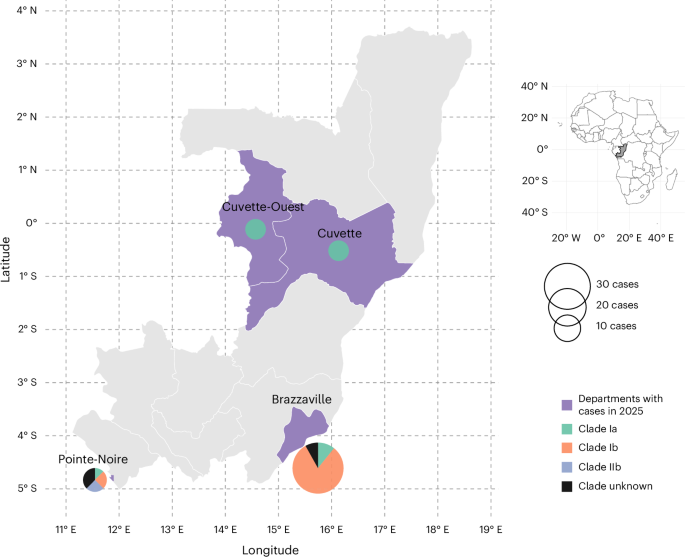
In addition to the above-described case, an additional 56 mpox cases were identified from January 2025 to August 2025 in RoC. Samples were obtained from 7 of the 12 administrative departments of RoC namely, Brazzaville, Pointe-Noire, Likouala, Cuvette, Kouilou, Plateaux and Niari. During this time 16 cases of clade Ia, 32 cases of Ib and two introductions of clade IIb were identified. Epidemiological data suggest that during this period in 2025 several lineages of clade Ia, as well as Ib were co-circulating in the major administrative (Brazzaville) and economic (Pointe-Noire) hubs in RoC (Fig. 1).
Slice size in the pie charts represents the number of mpox cases, and the colors indicate the number of cases per subclade. There were 37 cases in Brazzaville (4 clade Ia, 30 clade Ib and 3 unknowns); 5 cases in Cuvette-Ouest all clade Ia; 8 cases in Pointe-Noire (1 clade Ia, 2 clade Ib, 2 clade IIb and 3 unknowns); and 6 cases in Cuvette, all clade Ia. Basemap data from Natural Earth (https://www.naturalearthdata.com/).
Whole-genome sequences were obtained from the MPXV-positive specimen, with a genome length of 197,200 base pairs. Phylogenetic analysis identified this sequence as MPXV clade IIb, lineage A.2.2 (Fig. 2a). The Congolese sequence clustered with recent lineage A.2.2 sequences from Togo, the USA and Australia, forming a clade that branches into the new G.1 cluster, which is composed mostly of sequences from Sierra Leone (Fig. 2b). We next used a Bayesian Markov chain Monte Carlo (MCMC) approach to more rigorously assess the evolutionary dynamics of these sequences. Based on the best-fit model (Supplementary Table 1), the sequences showed an estimate for the mean rate of evolution of 5.12 × 10⁻⁵ (95% highest posterior density (HPD), 6.47 × 10⁻⁶ to 8.41 × 10⁻⁵) substitutions per site per year, comparable with the rate of evolution of clade IIb lineage A.2 (5.53 × 10⁻⁵ (95% HPD 3.39 × 10⁻⁵ to 7.46 × 10⁻⁵)18. The time to the most recent common ancestor between the RoC sequence and its closest non-RoC relatives was estimated at mid-2023 (mean 2023.5), with a 95% HPD interval of 2021.44 to 2024.63 (Fig. 2c). These estimates indicate that the lineage leading to the RoC strain originated between approximately August 2024 and March 2025, consistent with a recent cross-border importation event rather than sustained local circulation.
a, Phylogeny including 53 contemporary MPXV genomes of clade Ia and Ib, and clade IIb obtained from surveillance in RoC depicted as red circles in the phylogenetic tree. A complete list of MPXV genomes obtained from the surveillance in RoC is listed in Supplementary Table 2. b, Close-up tree of clade IIb, lineage A.2. The colors of the circles represent the origin of the MPXV genome, with clade IIb obtained from surveillance in RoC depicted as red circle in the phylogenetic tree. The tree was visualized in FigTree (http://tree.bio.ed.ac.uk/software/figtree/). Scale bar: nucleotide substitutions per site. c. Maximum clade credibility phylogeny of MPXV of a subcluster of clade IIb A.2.2 with time shown on the x axis. The Bayesian tree was constructed using a strict clock and exponential model.
Since 2022, molecular diagnostics for MPXV has been established in RoC allowing for the implementation of a passive mpox surveillance system in the country. In 2023, next-generation sequencing capacity was added, and the passive surveillance system allows for molecular diagnostics of mpox suspect cases, clade and lineage-defining quantitative real-time polymerase chain reaction (qRT-PCR) assays and the ability to perform molecular epidemiological studies using genomic MPXV data.
Our mpox surveillance successfully identified the co-circulation of multiple clade Ia lineages in RoC in 2025, the introduction of clade Ib from the DRC on two independent occasions in 2024 and now the introduction of clade IIb. Data generated on the detection of A.2.2 MPXV clade IIb were directly shared with the RoC Directorate of Epidemiology and Disease Control of the Ministry of Health and Population under the framework of the Centre des Opérations des Urgences de Santé Publique. This resulted in the implementation of mpox control measures in Pointe-Noire including strengthening of local laboratory diagnostics using GeneXpert platforms to increase decentralized MPXV diagnostic testing; enhanced molecular epidemiology surveillance by next-generation sequencing; outreach to hospitals, healthcare settings and healthcare workers to increase awareness on mpox and to improve mpox clinical management; and hospital and healthcare hygiene practices with a focus on nosocomial transmission prevention.
Phylogenetic analysis placed clade IIb MPXV into lineage A.2.2. MPXV clade IIb has been circulating cryptically for nearly a decade in Nigeria. The ongoing circulation of clade IIb in Nigeria, including distinct sub-lineages such as A.2.2, have resulted in recent regional outbreaks in Sierra Leone, as well as travel-related cases outside Africa, including in Germany, the USA and Australia. The rapid spread in West Africa, introduction into Central Africa and travel-related cases outside Africa resemble the rapid spread of the 2022 global mpox outbreak because the A.2 lineage also originates from Nigeria, has spread throughout West Africa and has been detected in Australia, Europe and the USA. Because only a single A.2.2 MPXV clade IIb genome has been detected and sequenced from RoC to date, our inference of MPXV introduction must be interpreted with caution. Sparse sampling and limited genomic surveillance in RoC hinder the reconstruction of transmission chains and phylogeographic origin. Although the RoC strain (hMpxV/Congo/BZV-LNSP-CG051/2025) clusters in clade IIb lineage A.2.2 alongside genomes from the USA and Australia, this placement alone cannot reliably indicate the direction or source of the introduction. The wide 95% HPD interval for the ancestral node (2021.44 to 2024.63) further underscores the uncertainty surrounding the timing and geographic pathway of importation. Expanded sequencing and continuous surveillance are therefore essential to clarify the evolutionary trajectory and transmission dynamics of MPXV in Central Africa.
Nevertheless, the clustering of our sequence with MPXV sequences from West Africa, the USA, Germany and Australia all collected in 2025, and given the known travel history of this case to France and Ivory Coast, suggests that the patient infected with clade IIb MPXV likely contracted the infection while traveling in West Africa or Europe. The rapid rise of clade IIb lineage A.2.2 highlights the vulnerability of the region for undetected circulation of MPXV. It also underscores major gaps in regional preparedness, in particular the availability of diagnostics and the ability to conduct molecular epidemiology.
This study has some limitations. Our patient could not provide comprehensive contact-tracing information to health workers, showing the complexity of tracking imported cases, and this does not allow us to completely reconstruct the exposure and transmission history. In addition, very limited genomic information is available from West Africa, or the new A.2.2 lineage altogether, further hampering efforts to determine the origin of exposure as well as the degree of ongoing circulation in sub-Saharan Africa.
This work presents epidemiological and phylogenetic characteristics of a laboratory-confirmed mpox case with MPXV clade IIb, lineage A.2.2 in RoC. The detection of clade IIb in this region highlights the growing complexity of MPXV epidemiology in a historically endemic region. In 2025, cases of clade Ia, Ib and now clade IIb have been detected in RoC. Current genetic and epidemiological data from RoC suggest that each of these MPXV clades and sub-lineages harbors distinct human-to-human characteristics based on APOBEC3 signatures and epidemiological characteristics16,17,19.
MPXV evolution is driven by a variety of mechanisms and underlies the relatively rapid genotypic and phenotypic change observed during consecutive mpox outbreaks of the past decade. These mechanisms include acquiring mutations (for example, the APOBEC3 mutations), gene duplication and recombination. The co-circulation of clade Ia, Ib and clade IIb in the human population of a relatively confined geographic area dramatically increases the risk for recombination events between viruses of these different clades, potentially resulting new phenotypes20.
The co-circulation of clade Ia, Ib and clade IIb in the human population highlights the increasing complexity of MPXV epidemiology and the need for a regionally coordinated response21. This response should be targeted at region-specific needs, including expanding access to decentralized diagnostics, enhancing the (molecular) epidemiological capacity and a dramatic increase in vaccine access. Implementation of isolation and contact-tracing strategies, as well as community outreach should be a key component of targeted mpox control9. Lastly, our ability to detect emerging and re-emerging pathogens is directly related to the accessibility to healthcare and diagnostic infrastructure. Large parts of RoC are relatively remote, and emphasis on increased surveillance in border regions between RoC, DRC and Central African Republic is needed.



