
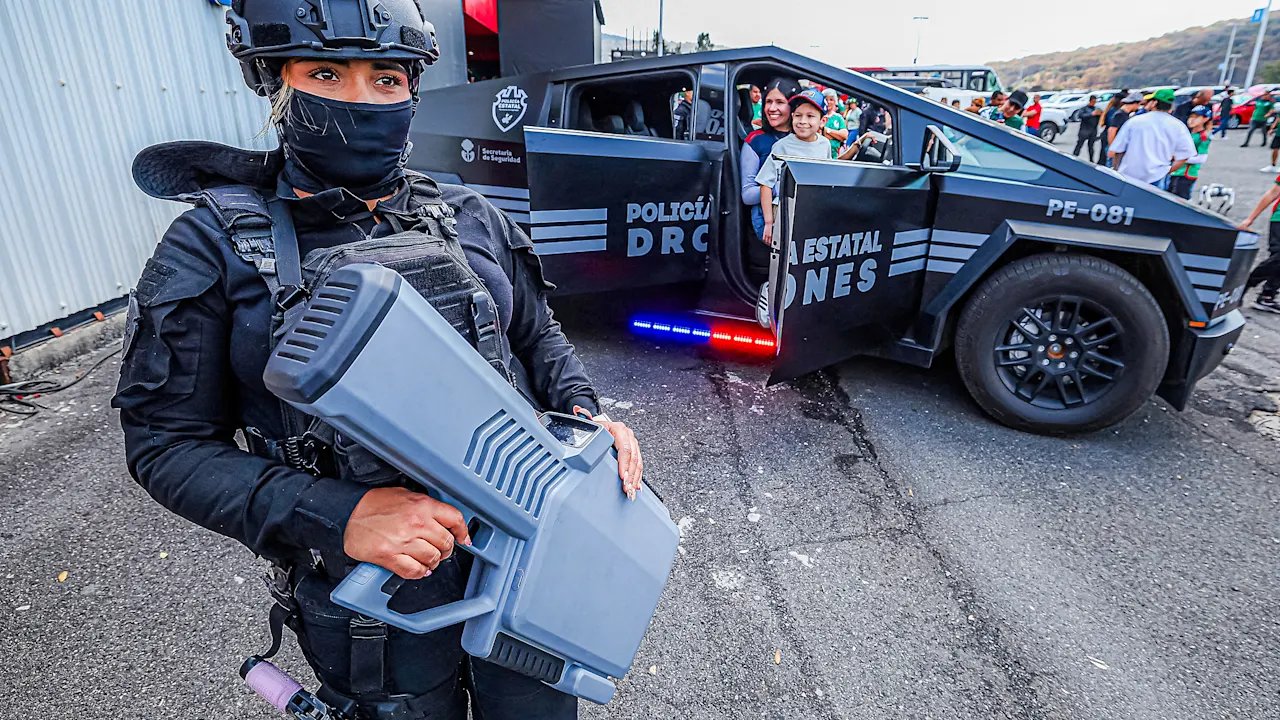
As the threat of drone attacks grows, the federal government is turning this summer into a proving ground for U.S. efforts to shore up aerial defenses at events like the World Cup. It may also serve as a launchpad for defense tech firms hoping to sell systems designed to intercept unmanned aerial vehicles.
“Out of the World Cup, you’ll see the baseline for what law enforcement and critical infrastructure sites will then buy at scale,” says Jon Gruen, CEO of Fortem Technologies, which signed a multimillion-dollar deal to provide artificial intelligence systems, radar, and drone interdiction technology to U.S. cities hosting the tournament. “You’re going to see how it worked, and see how it all fits together.”
A run of mega-events over the next few years, including this summer’s World Cup, expected to draw roughly 5 million international visitors for matches and fan zone parties, the nation’s 250th birthday, and the 2028 Olympics, has elevated drone defense as a national priority. It has also raised alarms among civil liberties groups about expanding law enforcement surveillance capabilities.
Drones are increasingly being used for asymmetric warfare, says Michael Robbins, President and Chief Executive Officer of the Association for Uncrewed Vehicle Systems International. One of the most notable examples is the Ukrainian Spiderweb attack, which secretly positioned remote-operated drones to devastate part of Russia’s bomber fleet.
“What’s different about the World Cup is the scale,” says Robbins. “It’s 11 Super Bowls at once.”
Robbins has been engaged in drone defense since 2018, when a high-profile drone intrusion at Gatwick Airport in the United Kingdom shut down airspace for two days and caused significant economic damage. In the United States, the federal government was slower to respond; for years, only a small number of federal officials were trained to take down drones.
“We don’t have the training, we don’t have the equipment, and we don’t have the number of personnel that are skilled in mitigation technology and the use of mitigation technology, particularly the application of that technology in really highly dense radio frequency environments or urban environments,” says G.B. Jones, chief safety and security officer for the FIFA World Cup 2026, in November.
That is now changing quickly. In December, the Safer Skies Act was signed into law, authorizing state and local authorities to disable dangerous drones and directing the FBI and other agencies to train them. The FBI’s Hazardous Devices School in Huntsville, Alabama, now runs a three-week training program for law enforcement focused on drone mitigation.
The Federal Emergency Management Agency has also announced $500 million in special grants for drone defense, known as Counter-Unmanned Aircraft Systems programs, with half of the funding fast-tracked to help World Cup host cities invest in new technology. The Department of Homeland Security will spend an additional $115 million on drone defenses for the tournament. In January, officials from host cities and federal agencies gathered in Colorado Springs to run drone attack simulations ahead of this summer.
Take Los Angeles, a future Olympic host and the city set to host Team USA’s first World Cup match on June 12. On February 24, Los Angeles Police Department officials approved a $9.8 million federal grant to protect the city from drone attacks.
When asked about its plans for spending the Counter-Unmanned Aircraft Systems grant funds, or strategy around drone defense, a department spokesperson says the department was unable to provide any details to Fast Company, and “as a matter of policy, we do not publicly discuss tactical strategies, threat assessments, or protective plans related to major events,” the statement noted.
However, in a recent California Post piece, a larger strategy was outlined: the department would install two dozen radio frequency sensors across the city to detect drones, as well as mobile drone mitigation stations, including installations at LAPD headquarters and the Mt. Lee Communications tower right behind the Hollywood sign.
Robbins says that drone defenses for events like the World Cup would typically work as follows, depending on the type of technology being utilized. For UAVs operated with radio frequencies, defending against attacks might utilize low-altitude radar or optical sensing to identify threats, and then jamming of radio frequencies to disable the drone, causing it to fall out of the sky. There’s even tech that allows law enforcement to take over rogue drones and then steer and land them at pre-designated safe spaces; that’s technology LAPD plans to lean on for their own defense, per the Post.
The more challenging scenario, and the one that really worries security officials, is drones flying dark–using AI to autonomously hit targets without being steered or controlled by someone else. This tends to require a kinetic option, says Robbins. That means guns, lasers, high-powered microwave weapons, even other armed drones that can take out threats in the sky by ramming them or tossing nets. Fortem, which was recently awarded a contract from the Department of Homeland Security for their DroneHunter tech, fields AI-controlled drones that use nets to disable and snatch enemy drones out of the sky. This technology, which is autonomous, will be on display at every World Cup game this summer, says Gruen; the firm just staged an interdiction test, where five autonomously programmed drones were intercepted by Fortem radar and interceptors.
However cities decide to invest in their defense–Robbins surmises every city will follow a different strategy based on their unique needs–it’s raising significant civil liberty concerns. Many activists and local officials have also expressed fear that increased drone technology can also be used on local communities, or as part of the federal government’s deportation dragnet. At a hearing of the Los Angeles Police Commission on February 10, speakers expressed alarm at the city’s growing drone fleet, and its potential to surveil citizens.
Jay Stanley, a senior policy analyst with the ACLU, says the threat of drone attacks is real, so he’s not de facto against spending money on defending from drone attacks. What he’s more concerned about, which he outlines in a recent white paper, is an increasing pattern of “drones for us, not you” by the government. By empowering more law enforcement groups to take down drones, it may crowd out the ability of everyday citizens to use drones, as well as perhaps lead to drones flown by journalists and advocates seeking to document abuses of power being disrupted. He’s advocating for narrow and precisely defined rules precisely spelling out when law enforcement can and cannot take down drones, and also transparency around how the government is using drones, to curtail overbroad surveillance.
The federal government had previously issued flight restrictions over protests in Ferguson in 2014, and earlier this year, issued flight restrictions above DHS vehicle caravans, ostensibly banning drones from filming their activities.
“Two things can be true,” Stanley says. “There are times and places where it makes complete sense to ban drones. And, the threat of drones can be exaggerated to ban drones due to the desire of law enforcement not to be filmed.”
Robbins believes the nation has been slow to put the proper regulations in place to defend against this threat, but the right actions have been taken. Taken together with the military’s rapid pace of drone defense investments, this new wave of training and deployment will bolster defense tech firms like Axon, despite the recent federal shutdown, which delayed federal funding earmarked for World Cup safety and security. At a time of war and rising threats, drone defense has become a much bigger priority.
“It’ll take a herculean effort to be ready,” he says. “But now, it’s being taken seriously.”



