
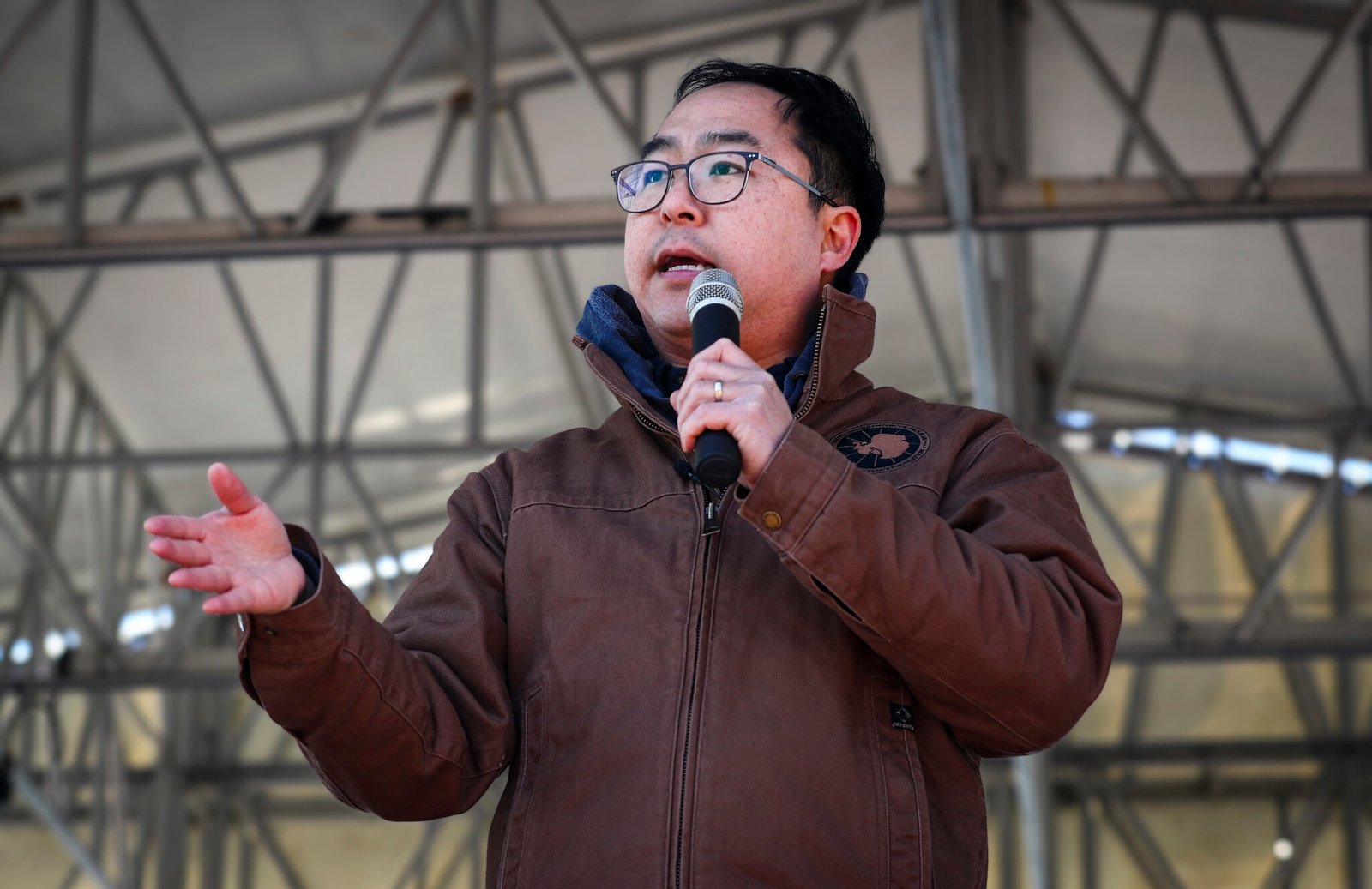
As President Donald Trump stokes international ire with threats of death to a ‘whole civilization’ in Iran, Sen. Andy Kim plotted a future without him, stopping by Princeton University to share his foreign policy vision for how the United States can recover from its sinking status globally.
Kim spoke to students at Princeton’s School of Public and International Affairs Tuesday and assured them that he remains hopeful the United States can reverse its “self-sabotage,” even though anxiety grows among American citizens and the country’s global allies increasingly keep their distance.
“We are living through a fundamental shift in global politics, that much is undeniable. The world is adapting to a post-America global era, and they are skating to where they think the puck is going,” said Kim, a Democrat. “Americans across our country in the political spectrum are saying that the current state of the world isn’t working for them, that they do not want us to continue this interventionalist foreign policy of the past, but want their leaders to ensure security, stability, and access to quality of life that they deserve.”
But the window to act is narrowing, he warned.
“The cost of complacency has never been higher. So we have to act,” he said. “Now if we live in a time of crisis and global competitiveness where our power and credibility is waning, then we need to change what we are doing. We need to adapt to meet this moment.”
This is a moment where we need a politics of humility, not a politics of hubris that we have so often had in America.
Kim, who worked in national security and diplomacy at the White House, State Department, and Pentagon before joining Congress in 2019, laid out strategies to ensure the United States’ “resilience” and ensure opportunity and security for its people.
First, American leaders must prioritize economic security at home, he said.
“We should protect the economic security of American families with the same intensity as we do our nation’s physical securities. The American people saw money go into the Iraq and Afghanistan wars seemingly without end, and then we’re told that there’s no money for health care or child care or education and student loans or rebuilding our roads or public transit or elder care,” Kim said. “And now they are seeing the same thing happen again with this senseless war in Iran, and they see the divestments in our lives isn’t written in stone. It is a political choice.”
The U.S. must minimize its dependence on non-trusted nations especially for priority resources such as minerals, energy, and pharmaceuticals and update its alliances “to organize them not just around defense relationships or geography, but around the economic and technological relationships that will power our future global economy,” he said.
Future leaders should work hard to restore Americans’ faith in government and root out corruption, he added.
They should also strive to create an “opportunity era,” he added.
“Few factors will shape opportunity more than innovation,” he said. “Americans must lead in the innovation and the technology that will power the future and ensure that this positions all Americans, not just a few, for prosperity and global competitiveness.”
That includes embracing immigration, he added. The country is hemorrhaging scientists, researchers, and skilled labor, and that endangers innovation, he said.
His faith in America’s future comes from sheer necessity, he added. As the father of 8- and 10-year-old sons, he said, he can’t give up hope because he wants to leave them with a better world.
“This is a moment where we need a politics of humility, not a politics of hubris that we have so often had in America,” he said. “We are not going to be able to come out of this moment and try to again dictate to the rest of the world what they should be doing. They do not trust us. We have a lot to be able to repair.”
GET THE MORNING HEADLINES.



