
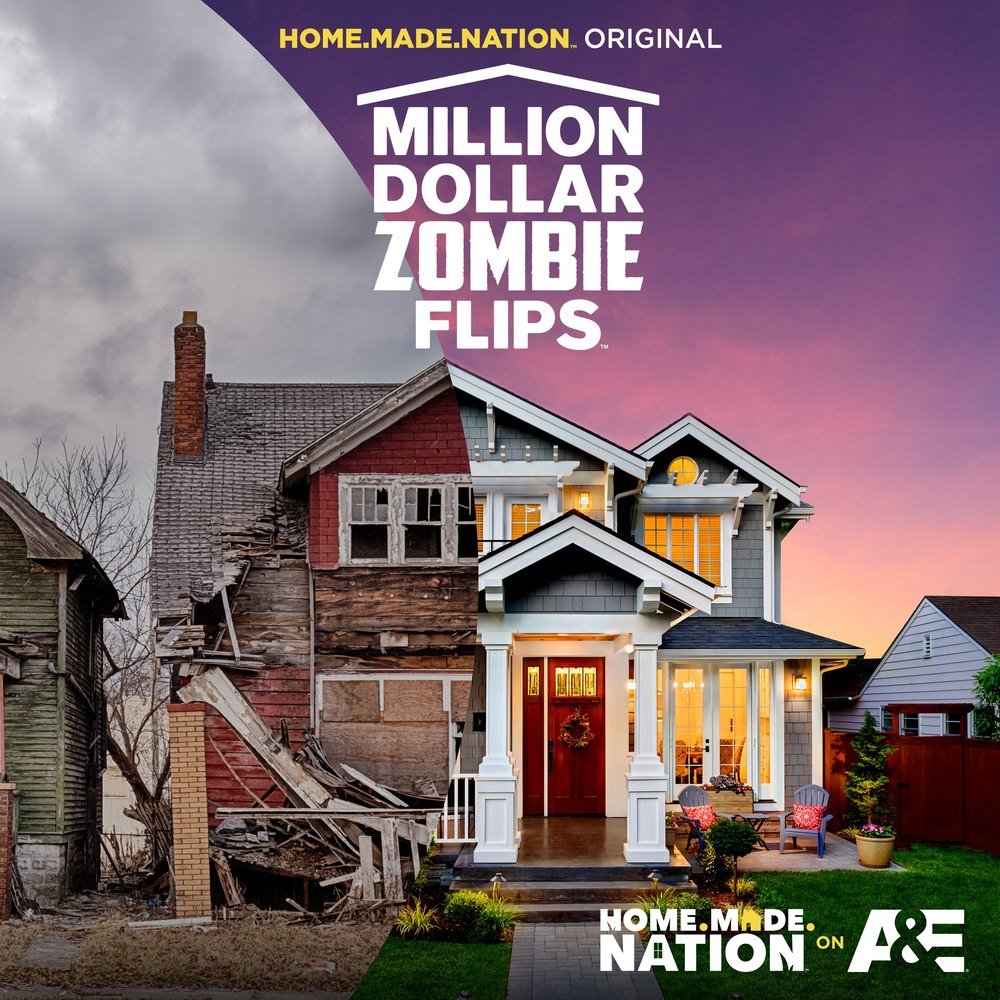
Real estate investor James Dainard is fearless about tackling renovation projects that few would dare to go near—from hoarder homes to abandoned properties to “zombie” houses, the latter of which take center stage in his latest series, “Million Dollar Zombie Flips.”
The A&E show, which premieres its second season on April 11, follows 42-year-old Dainard as he attempts to restore crumbling, dilapidated homes around Seattle in a bid to turn them into million-dollar residences. Many of the zombie properties—homes abandoned by their owners before foreclosure proceedings concluded—featured in the show are in such dire shape that they’ve been written off as lost causes.
Needless to say, Dainard has seen more than his fair share of ghastly dwellings. Yet, he tells Realtor.com®, there is one particularly horrific house that continues to haunt him years after he brought it back from the dead.
Dainard first got into the business of flipping homes “over 20 years” ago, when he was a senior in college. He has since helmed more than 2,000 renovation projects, many of them zombie dwellings.
Opening up about his work, the “Million Dollar Zombie Flips” star reveals that after two decades of doing this often disturbing labor, he’s unafraid of the challenges the abandoned abodes present. But he still gets genuinely surprised by the conditions he comes across.

“Every time I think I’ve seen the weirdest thing I’ve ever seen, I find the next thing, which I kind of get a high out of it because I’m like, ‘No way!’ It’s the shock value. I need the shock value,” says Dainard.
To date, the most shocking home Dainard’s ever worked on is one that famously disgusted viewers of another A&E hit series.
“It was actually on the show ‘Hoarders.’ It was called ‘the poop lady house.’ It was so bad,” divulges Dainard, before describing how he came to purchase the place.
“I bought it sight unseen,” he shares. “This is in 2009. Someone presented it to me in a pretty affordable number, and I was like, ‘Why is this so cheap?’ But I was like, ‘I’ll buy it.’ And then I walked through and I found out why.”
The discounted domain, Dainard quickly discovered, was quite literally a dump.
“There was containers of human feces everywhere, and as we’re trashing the house out, I get text messages from my contractor, like, ‘Turn on A&E right now,’” he recalls. “I turn it on and it’s my house, and this lady’s pouring poop in the yard, and it was the grossest house I’ve ever been in.”
Despite the unimaginable filth Dainard and his crew had to deal with to complete the house flip, the team ended up clearing a clean profit.
“We paid $155,000 for it, and I remember back then we put in $150,000, and then we sold it for $475,000,” he recounts. He had to invest more than usual in this flip due to its foul reputation.
“We had to spend more because as soon as we saw it hit the TV, I was like, ‘Oh my gosh, we have to go through so many extra steps,’ because this is when the market was not doing well. So people were looking for any excuse not to buy a house,” he explains.
“We ended up scrubbing this house down with bleach, taking every piece of drywall out of it, and then we documented it, because as soon as we listed it, everyone’s like, ‘That’s the poop lady house,’ and so we had to get rid of that.”
While Dainard was able to successfully flip the poop house, some zombie homes possess such insurmountable issues that he’s had to kill the projects, he says.
“Many times, unfortunately, [but] that’s how you learn,” he says. “One of the houses we bought in a great neighborhood, good views—definitely a zombie.
“When we started working on it, the house started shifting … and then the city was going to have us do about 12 months of permitting for it, so we ended up just knocking it down and building. We built an amazing, beautiful home there, but we had to bail out of the flip. It just wouldn’t work.”
Dainard points out that bureaucratic red tape is one of his profession’s worst time vampires.
“Permits [can be] a challenge because you have to wait on the city, and they can be backed up or understaffed, and so the city always delays you the most,” he says.
“Then the other thing that delays flippers the most is lack of making a decision,” he notes. “They go back and forth, and then the contractors can’t work because they don’t have a clear vision, and then all of a sudden they lose weeks just because they can’t quite figure out how they want that island.
“What I’ve learned about flipping, you just got to kind of point, click, and fire, and hopefully it turns out the way you want it to. But if you don’t, you end up going back and forth and costing you way more money.”
Creeping budgets are another surefire way to bury a flip, and Dainard exposes home systems and landscaping as a couple of the biggest financial offenders.
“Your biggest budget busters are always going to be actually what’s inside the walls: your electrical, plumbing, and HVAC,” he clarifies. “Right now, [those] are the stuff that we’ve seen gone up about 30% in the last 12, 18 months, and it’s constantly increasing. You know, short staff, short labor, and then just the materials have gone up so much.”
Landscaping is another line item that can easily put renovators in danger of going over their budget.
“That’s one thing I’m very passionate about—everyone flips the house and they forget about the yard and they run out of money because it’s the last thing, and they just dust it up. But, you know, for me, we really try to emphasize our yard space, and that can turn into a huge creep,” explains Dainard.
“There’s a house I’m doing right now, and the landscaping budget is as big as the renovation budget,” he shares. “It’s 10 acres. It’s a cool, cool property.”
Luckily, Dainard has unearthed creative strategies to keep costs under control.
“You can always find stuff cheaper,” he preaches. “You can always switch up the flooring and save, like, a dollar a square foot. And that adds up very quickly. Or your tile, you can switch up.
“There’s little tricks you can do, like if you go to a big-box store and they want to get rid of their inventory,” he continues. “We have bought, like, 800 square feet of flooring for a dollar because they want to just clear it out. You can get amazing deals on products.”
To further boost the bottom line, Dainard suggests investing in the usual suspects—“kitchens and primary bedrooms”—but he says close attention needs to be paid to the floor plan.
“Layout is one of the biggest things for salability, and how you put the house together really affects how much you have to spend on that house,” states Dainard.
“Most importantly for modern living [is] the open-concept kitchen,” he says. “People want to entertain. Probably the most important layout change that you can make is creating that big, open concept.
“You want to make people want to have their friends over because that’s really what it’s about. People fall in love with it. As they’re walking through a home, if the layout’s right, they can envision themselves living in it, and that’s what we really want to achieve.”
Indeed, giving life to a previously grim house is the ultimate real estate resurrection.
Season 2 of “Million Dollar Zombie Flips” premieres on April 11 on A&E’s Home.Made.Nation.



