
Unlock the Editor’s Digest for free
Roula Khalaf, Editor of the FT, selects her favourite stories in this weekly newsletter.
The writer is the founder and chair of the Mo Ibrahim Foundation
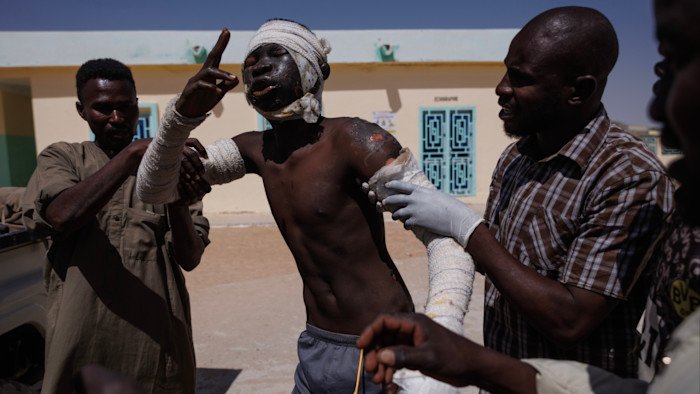
This week, the war in Sudan enters its fourth year. The cost to our people has been severe. At least 150,000 are dead, 19mn face severe food shortages and 12mn have been forced to flee their homes. Millions of children are not in school, hundreds of thousands have no birth certificate, while untold thousands of women and girls have been raped.
Why do we have this savage and brutal war? For what purpose? What are the two adversaries trying to achieve? I cannot find any reason other than lust for power and for the riches that power brings.
To understand how we got here a bit of history is required. Both of the main protagonists, the Sudanese Armed Forces (SAF), and the Rapid Support Forces (RSF), were pillars of the Islamist dictatorship of General Omar al-Bashir. It was the SAF officers led by Bashir who toppled the democratic government of Sadiq al-Mahdi in 1989. They dissolved parliament, banned political parties and started decades of terror, declaring a “jihad” against our citizens in the south, which culminated in the division of the country and the creation of South Sudan in 2011.
From 2003-2005, we had a genocide in Darfur, the birthplace of the RSF. Bashir fell in love with these desert warriors and made their leader, Mohamed Hamdan Dagalo or “Hemeti”, a senior general. Keen to safeguard his rule, Bashir created a divide-and-rule strategy between the SAF, the RSF and the intelligence services.
Then in 2019 the youth of Sudan staged a peaceful revolt to topple Bashir. Unfortunately, a compromise negotiated by the African Union created a power structure that included soldiers from the SAF and RSF as well as democratic civilian forces. Sudan’s soldiers are not big fans of civilian oversight, and soon we had a coup. Before long, fighting flared between the RSF and SAF in a fratricidal war between yesterday’s partners.
Three years of this war have resulted in a de facto partition of Sudan. To add to the complexity, there are some dozen or so other militias, mostly on ethnic lines. Under such circumstances, neither side can win this war and unify the country.
But what happens in Sudan will not stay in Sudan. The country shares borders with Egypt, Libya, Chad, the Central African Republic, South Sudan, Ethiopia and Eritrea. Most of our neighbours are fragile, with internal insurgencies and external tensions. Sudan’s war risks destabilising an entire region, triggering proxy wars elsewhere in the Horn of Africa and beyond.
The disintegration of Sudan would complete an arc of ungovernable lands across the Sahel from the Atlantic to the Red Sea, which has even greater strategic value given what is currently happening in the Strait of Hormuz. That vast stretch of lawless territory, awash with arms and marauding groups of all ideologies, threatens not only Africa, but also Europe. It is like having a combined Afghanistan and Syria on its very doorstep.
So what is to be done? Regional international mediation efforts have been halfhearted. Our first priority should be to stop the fighting, not by appeals but by firm collective action.
The UAE, Iran, Turkey, Pakistan and others must stop supplying arms and support immediately. All those countries profess love for the Sudanese people. We welcome your affection but not your bullets and drones. You are enabling bloodshed and famine and causing the displacement of innocent civilians. Instead, you should put pressure on both sides to stop this madness.
Revenue from gold and gum arabic, used in products from make-up to Coca-Cola, is filling the coffers of both the SAF and RSF. Like “blood diamonds”, they should be labelled “blood goods” and banned.
A political process should run in parallel to ceasefire negotiations, and must involve civilians, including the Islamic groups that parted ways with Bashir and his regime. All Sudanese who believe in a democratic future should be part of this.
How can we convince the generals to lay down their arms? We need both sticks and carrots. The bank accounts and assets of the military men and their families are mainly held abroad and war crimes have no statute of limitations. The US role here is essential, if only Donald Trump could turn his attention to this tragedy.
Still, we need some carrots too. However distasteful it may seem, we could offer amnesty and safe passage to those generals willing to quit the war. If it can save lives, it would be a worthwhile, if unpleasant, bargain. Anything that can stop the nightmare of destruction in Sudan is worth trying.



