
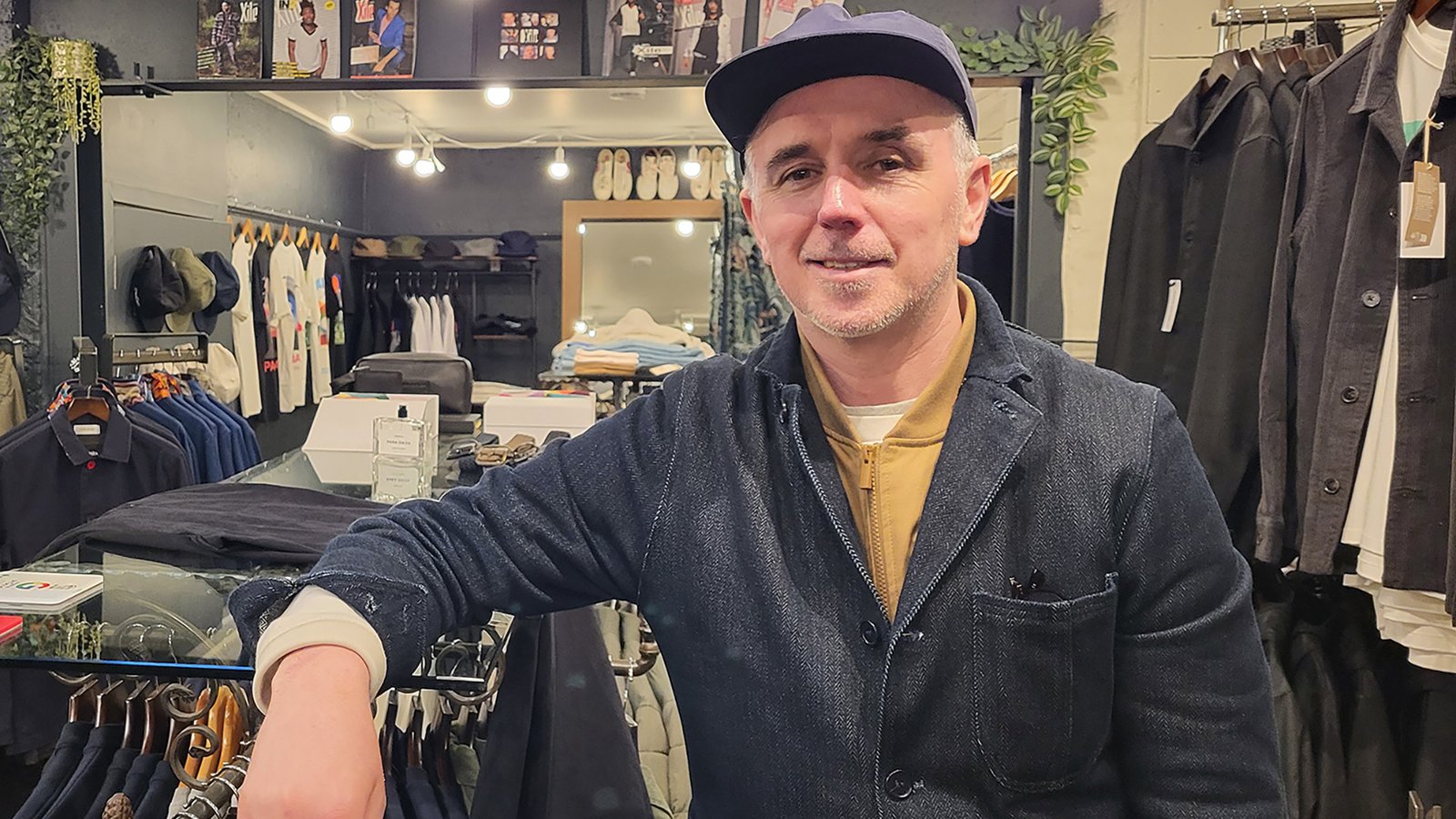
Paul Mullen has brought more than 30 years of experience of multi-brand retailing to Paradaiza, which sells only clothes designed and sourced by him. Since August 2023 market knowledge, hard work and a sharp eye on the finances has made his shop in the lively Stockbridge area of Edinburgh a popular destination for locals, visitors from other parts of Scotland and international tourists. Online sales are picking up nicely too.
Born in Edinburgh in 1974 and brought up in the city, Mullen emigrated with his family to Australia in 1989 and at the age of 16 started working in fashion retail in Sydney. After a few years of moving back and forth between Oz and Scotland, in 1993 he returned for good and took a permanent job at Xile, Edinburgh’s multi-brand unisex fashion indie founded by Pat O’Flaherty in the mid-1980s , where he had done some part-time shifts.
He stayed at Xile for 30 years, following a classic retail career path – part-timer, full-timer, assistant manager, manager, buyer and, ultimately, a partner with O’Flaherty and David Weeks, who was already there when he joined the business, which was strong in denim, streetwear and sportswear from brands like Diesel, Adidas and Barbour.


“In my first week we were robbed at knifepoint. David and I ended up in the High Court facing the biggest drug-dealing thugs in Edinburgh,” Mullen recalls. “I was thinking, wow, it’s the Wild West.”
Regarded as one of the premier independent mini-chains in the UK, Xile rode the multi-brand fashion boom as the 20th century moved into the 21st. It opened five franchise stores with then-hot Dutch denim brand G-Star and one with Italian jeans brand Replay, while eventually running eight of its own Xile stores at its height.
“Our best decade was probably around 1998 to 2008, which was a really good time in our industry. Xile’s best year was 2010, when we were turning over almost £13m, but I could already see it crumbling. G-Star was wobbling, Replay hadn’t really taken off. We had an Xile business, an online business, a G-Star business and a Replay business, all different models, all under the one umbrella. It was chaos.
“We had had our glory period. By the 2010s things were changing and we were getting caught out because we were a medium-sized business with multiple high street locations and we weren’t web- or tech savvy. Even with a £12m turnover, we were still using pen and paper for everything. We were in trouble.”
The collapse of the G-Star franchise network in 2013 brought more trouble and by 2016 the business was put into pre-pack administration and picked up immediately by JD Sports, which under chairman Peter Cowgill had been acquiring controlling stakes in premium fashion menswear chains, such as the north-west based Tessuti and Scotts. JD was in direct competition for such businesses with Mike Ashley’s Sports Direct group, later known as Frasers Group.
O’Flaherty, who died of cancer in 2018 aged 71, had withdrawn from active involvement in the business, leaving Mullen and Weeks to run Xile as joint MDs with mainly arm’s length involvement from JD for six years. In December 2022, following the ousting of Cowgill, new JD CEO Régis Schulz surprised the sector by selling almost all the group’s fashion interests to Frasers. Some 14 retail, online and wholesale businesses, including 50 to 60 fashion-focused stores like Xile’s, changed hands for just £47.5m.
It soon became clear Frasers intended to close most of what it had acquired. By April 2023, Mullen, Weeks and virtually their entire team of 27 people were paid off with the statutory redundancy settlement. Xile was finished and Mullen’s 30-year career there was over.

Mullen on the shop floor with Rita the collie
What skills had 30 years at Xile given you to start your own business?
On my way up, it was just great fun. You’re not really paying attention to anything. I was always a product buyer, that was my thing. I’m also a people person and relationships were important when I joined the industry. But I also learned resilience and firefighting with all the problems at Xile from around 2013 onwards. Pat (O’Flaherty) had a great shoot-from-the-hip approach and gave me and David (Weeks) the freedom to do what we wanted, but he lacked a little bit of finesse and structure in the back end. He never changed anything and progressively got further away from the business.
I could have left when things were getting tough, but I would never have abandoned the Xile staff, which was like a family. From 2013 I was out meeting people, trying to find someone to invest in us. After our G-Star problems we had restructured, but we couldn’t get an overdraft or a loan. It was tough to be buying seasonal collections like that. I was the one who met Peter Cowgill at JD Sport, but it took two years for them to move. Then at the last minute, instead of investing, they insisted we went into pre-pack admin. A standard procedure, I guess. Dealing with all those problems was probably my biggest learning curve.
What skills were you lacking to run your own business?
Everything! Ultimately, I’m still sales and products. Everything else I’ve had to learn. I didn’t even have a Facebook account or an Instagram account. I knew how to stock a website but not how to do one. Now I can run my Shopify store, I can build it, I can change it. I don’t need staff to do it. So there’s so many things I’ve learned from the ground up in the past two years.
Did Xile’s closure come as a surprise?
I wasn’t shocked. Things had been going on behind the scenes, then everything went quiet when the new CEO (Régis Schulz) came in at and Peter (Cowgill) was out. So things were changing at JD. I was quite relaxed as I had never seen Xile lasting forever. JD seemed confused about where to take everything. Hence the new guy came in and just got rid of the fashion side, which was a great win for Frasers. Time will tell if it was the right thing for JD to do, but I thought it was stronger having a foot in the higher end branded sector.

Rail Work Jacket, made in Scotland using herringbone denim from Orta of Turkey
Did you consider staying with Frasers?
For a while I’d been sending ideas in to JD to tell them they should develop (the casualwear chain) Scotts, where I liked what they were doing. I sent the same thing in to (Frasers CEO) Michael Murray, but I lost interest and was quite happy to take redundancy and get out.
How about working for another retailer?
My wife Kerry, who owns her own dog-grooming business, was very keen I got a job quickly because we have four kids aged 16, 18, 21 and 24 and we were just finishing refurbishing our five-bedroomed house. But the redundancy gave me a bit of time to figure things out.
I was about to turn 50 and I did have my moments of doubt but I applied only for one job and that was in the drinks sector. To be honest, I just kept on committing mentally and financially to my next step, to starting the brand.
I’d been pitching my own brand thing to JD for quite a while, suggesting they gave me something like Duffer or One True Saxon to relaunch. I wanted to prove my worth to them. I thought there was merit in a high-margin own brand strategy. I had all this in my head, in nice plans. I had my logos, my trademarks, all that kind of thing. It was ready to hit the ground.
Paradaiza started trading in August 2023, just four months after I’d been made redundant.
Did you get any advice about setting up on your own?
I couldn’t really phone someone I know like Jimmy Collins at YMC or Cathal McAteer at Folk and say, how do I start a brand? I was limited to a few conversations on LinkedIn. I got some good advice from James Morris, who used to run the Jack & Jones franchise within Tessuti and had also been made redundant. He started his Tribal Society brand in Liverpool. He told me the most important thing was to get a bricks and mortar presence to get in front of the customers. It was solid advice.
Were you online from the start?
Not exactly. I intended to be but my initial stock sold out so fast in the shop I didn’t start the website until eight weeks later when I’d built the stock up. Online is now about 20% of my sales. Returns are low, at about 7% across the year.

Mullen has taken a five-year lease on the shop in Stockbridge, Edinburgh
What was your original concept and how has it been amended over the past two years?
Due to finances, I was limited on what I could make. I wanted three key products. My killer pant is my pinch chino, which recalls the 1990s trend in Edinburgh for narrowing trouser legs by having a “pinch” or fold put in at the ankle. I also had my own form of a worker jacket and my version of a parka. The rest was going to be graphic Tees and sweats. At the back of the store was upcycled military stuff, like an Austrian combat pant that is a dead ringer for a Maharishi snow pant. This was like getting back to my old days at Xile. The Danish brand Junk de Luxe were putting prints on old military pants in the early 2000s. I had all these things in my head where I could have a quick win.
I was creating stuff that was unique, while using blanks and white label goods for my sweats and staples so I could repeat on them quickly, which mean quite a fast turnaround cash wise.
Pricewise, I pitched it from what worked at Xile, so never over £60 for a graphic Tee, £35 for a basic Tee, £75 for a basic sweat.
I was going for specific items rather than a sophisticated collection because I didn’t have the money or the knowledge to have things made. You make one thing and it works, so you repeat on it. It’s taken two years to get to where I can introduce new lines and new product categories. I would have been crazy to have invested my money in loads at the beginning. Controlling cash flow is massive That’s the beauty of the white label goods model. It’s sustainable, it’s accessible. The quality is fantastic.
At the start you were sourcing a lot of stuff from outside the UK, from places like India…
My Xile (branded fashion) network wasn’t much help. Big manufacturers want big orders. People wanted 300 pieces as a minimum and I wanted 50 at most. No one was picking up the phone to me for 50 pieces. I was having my pinch chinos made in India, but I’ve just moved them to a small factory in Scotland. I use cloth from (UK supplier) Brisbane Moss. Making here, the retail price is going to jump from £95 to £125 but my customers are totally fine with that. I’m really proud – British fabric, made in Scotland, 125 quid is decent, the quality is great. I am going to do more of that. I’m moving as much as I can back to the UK. I’m taking a hit on the margin, but that’s OK for the right relationships with these smaller local factories.
If there are any appropriate UK manufacturers out there reading this, they should get in touch.

Paradaiza worker jackets are a best-seller
Where have you gone from your original three key pieces?
I have products that the average guy that walks into the store wants. I have maybe 20 core products that are really strong, like Made in Scotland knitwear, overshirts, bomber jackets and versions of the worker jacket that keep on selling. Back in Xile in 2016 I thought worker jackets had had their day, but certain things just keep going.
I can customise them each season with vintage fabrics or different buttons or different sashiko (Japanese repairing) stitching. I have introduced a higher-priced Atelier range to complement our Core collection of good solid basics. In the Atelier range there are bomber jackets made with cloths from British mills like Alfred Brown, Lovat Mill, Abraham Moon, Marton Mills.
My best-selling work jacket is made in Bangladesh using an organic cotton-linen blend fabric and costs £120 in the Core collection. It’s never out of stock and never in the Sale. You can have exactly the same style in a Marton Mills tweed, made in a Scottish factory, for £300. Customers don’t have to think about it. I’m really grateful I’m catching two audiences.
I’ve got a million ideas in my head but I’ve not got the time, the budget nor the space to do them all. I was given a replica of a vintage Lee 101 rail worker jacket and I combined its shape with a collar from a Stone Island jacket. I want to do some looser pants. I’ve got three new shirts coming in. One of them is a Comme des Garçons block from the 90s. I’ve always got something going on.
Who shops with you?
Obviously I haven’t taken all the old Xile crowd with me, but the ones that have found me love it. They’re a similar age group to me and they say it’s like coming into Xile in the 1990s. They wouldn’t buy an anti-fit pant rather than a skinny jean online, but in here they can try things on. It gives them confidence. When they like what I’ve sold them, they come back for more. It’s kind of back to good old fashioned bricks and mortar retailing.
We could never have sold a £425 tweed bomber in Xile, it would have got lost in the madness of all the brands, but here we can buy 25 or 50 of a colour on a beautifully made premium garment. The Xile punters that still value their product are moving away from the brands for something new.
The locals in Stockbridge, old and young, are lapping it up too. Tourists from Scandinavia, Italy and America can’t believe Paradaiza’s an independent brand. They think it’s an international chain. If you can convert Italians and Scandinavians, you’re absolutely doing something right.
They just love buying a small brand of high quality and we convert them quite easily. Sales of £500 and £800 are not unusual. It’s back to good old trying stuff on. I haven’t sold one piece of my Made in Scotland cashmere knitwear online, but I’ve sold loads in the store.

Atelier Bomber Jacket, made in India using cloth from Abraham Moon, £425
How have you promoted Paradaiza?
Word of mouth is best, which is why I’ve been taking things slow and steady. I’ve only just appointed a social media agency. I have collected around 6,000 emails and half of those are for regular customers and most are repeat customers. Some have spent £2,500 and £3,000 with me in just over two years. I’m getting to the point where I want to find new business. I want to grow online. I’ve got story to a story to tell and great product.
Your location suits your approach…
I was looking for just a pop-up shop to get us started and this unit became available. By coincidence, the owner used to work in Xile when he was a student. When it became available with a five-year lease, I signed immediately. As an area for independents, Stockbridge has really come up in the past five or six years. As well as me, there is (Scottish menswear designer) Kestin Hare and (premium outdoor store) Meander close together, making three Edinburgh brands in a row. There’s also (premium indie) Dick’s and (premium womenswear boutique) Treen nearby, as well as great coffee houses, restaurants, pubs and food specialists like a fishmonger, a butcher and a cheese shop. It’s what a high street should look like.
Have you tried anything that hasn’t worked?
No. Everything has been well thought out and I only order small numbers. Our Sale rail is tiny, even after more two years. I do have some blazers that have been in the shop for a while because I had to order 30, but I won’t reduce them. It’s a great blazer and they will sell eventually. That is what slow fashion is about.

Made in Scotland Pinch chinos are £125
Do you regard yourself as an Edinburgh brand, a Scottish brand, a British brand?…
We are an Edinburgh brand in the sense we are understated and don’t shout about ourselves, but our appeal is international. I do, however, like people to know we are from Edinburgh. I like making things in Scotland, but I’ll happily have them made in other parts of the UK.
How much did you invest in the business?
It wasn’t masses because I was skint anyway having just finished refurbishing our house. It was around £60,000. My goal was not to fail and lose everything. I wanted to get my money back in Year 1, which I achieved. I hit the ground running and was taking three and four grand a week from the start. Turnover is now up to around £500,000 and it’s still growing fast.
How big is your team?
My wife Kerry is my business partner, but apart from that it’s all me. I work seven days a week, 24/7. I have so much to do that I try and slow down and focus, to structure my time as much as possible. I still love being on the shop floor. David (Weeks) has been a great asset. We are open seven days a week and he comes in on three days. If I’m not on the shopfloor, I’m doing the website or talking to suppliers.
Otherwise, I use freelance help, for the graphics, the pattern cutting and whatnot. I’ve just employed a social media agency – we have 18,000 followers on Instagram – and it’s taken a while to get that tone of voice right.

Specially commissioned graphic Tees are the entry level products
Are you planning more stores?
No, because I’m scarred by the industry. Everything I do today is cautious, it’s slow and it’s calculated.
Where does the Paradaiza name come from?
In 2016 or 2017 on a walk with my dog I listened to a podcast with Canadian psychologist Jordan Peterson talking about the Garden of Eden or paradise. Para-daiza is an Iranian-Persian term. Para means around and daiza means walled garden, so it’s like a sanctuary. For whatever reason, it stuck with me and I registered the trademark. People love it. And this is my little sanctuary, where I’m creating something that’s truly important to me.
How is your job satisfaction now compared to the good old days of Xile?
I’m having more fun now than I’ve ever had. I’ve loved every minute of it and I’m so grateful for the success I’ve had in the last two years.
Paradaiza, 1 Glanville Place Stockbridge, Edinburgh, United Kingdom EH3 6S2



