
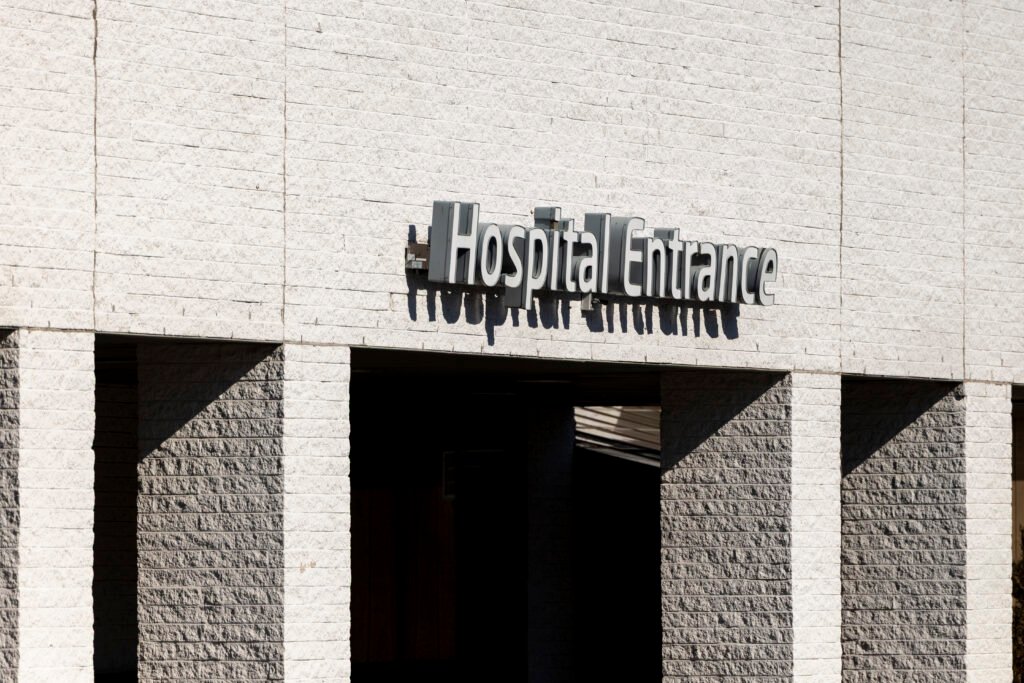
State health officials and the owner of the former Christ Hospital in Jersey City are sparring over the owner’s claim that it wants to reopen the facility in some capacity. (Photo by Anne-Marie Caruso/New Jersey Monitor)
New Jersey health officials are waging a public battle with a Hudson County hospital system that they say improperly closed a Jersey City hospital that first opened in 1872.
The operators of Heights University Hospital, once known as Christ Hospital, claimed this week they want to reopen the facility or move services to another location in Jersey City, a move health officials said was an attempt to circumvent state regulations governing hospital closures.
The dispute landed in court on Wednesday, when the hospital system won an injunction to halt a Department of Health public meeting about the hospital’s shutdown.
Gov. Sherrill’s plan to overhaul school mental health services draws criticism
This all comes as Jersey City’s leadership and its residents say the city needs more high-quality, reliable health care facilities.
“Jersey City is a large — some would say the largest — city in our state, and its people deserve access to hospital care. At a time when federal policies have already reduced access to healthcare, New Jersey should be doing better,” Debbie White, president of labor union Health Professionals & Allied Employees, which represented the hospital’s nurses, said in a statement Wednesday.
Heights University closed its emergency room in mid-March after suspending admissions and other services last fall in a way that state health officials said violated New Jersey law.
Officials with Hudson Regional Health, the hospital system that operated Heights University, have said repeatedly that they had no choice but to shutter the facility because it lacked modern amenities, failed to attract enough well-insured patients, and had cost them $61 million last year alone. Hudson Regional also operates hospitals in Bayonne, Hoboken, and Secaucus, facilities they said would have been at risk if losses in Jersey City continued.
But on Monday, Hudson Regional told state health officials they had changed their mind and wanted to back out of the ongoing process the state uses to evaluate hospital closure called certificate of need.
Attorney Alexis Goldberger, who represents Heights University Hospital, wrote in Monday’s letter that the hospital’s operators were exploring options to relocate to an “alternative site” and is in talks with the shuttered hospital’s landlord — the hospital leases the land it is on — and Jersey City officials about a constructing a new facility.
“Heights has determined that closure of the Facility is not an option inasmuch as it would effectively preclude it from fulfilling its charitable purpose and disenfranchise an inordinate number of patients who depend on Heights for their care,” she wrote.
Hudson Regional spokesman Vijay Chaudhuri declined to say what had changed financially.
Nathaniel Styer, a spokesman for Jersey City Mayor James Solomon, denied that Hudson Regional engaged with the city about relocating the hospital “or any other serious alternative proposal for the facility.”
The Department of Health, which fined the hospital $128,000 last fall for not following the state’s closure process, told Goldberger in a letter on Tuesday that a decision to restart care at Heights University would require state approval and public input.
The hospital system cannot avoid the state’s legal process for closing Heights University by suggesting a relocation might be possible, wrote Michael Kennedy, an attorney representing the Department of Health.
“Simply put, an already closed hospital cannot simply ‘relocate’ as if it had continued operations,” Kennedy wrote.
Hudson Regional Health took over operation of the Palisades Avenue hospital after its previous owners, CarePoint, filed for bankruptcy in 2024. Hudson Regional has since invested more than $300 million in its hospital system, according to Goldberger’s letter, which also says the state’s charity care system underfunded Heights University.
State health officials characterize the situation differently, noting that the hospital received an extra $10 million in taxpayer funds in 2024 to remain open during the bankruptcy proceeding and $2 million last fall to help it meet payroll, in addition to advances on annual charity care funding.
GET THE MORNING HEADLINES.



