
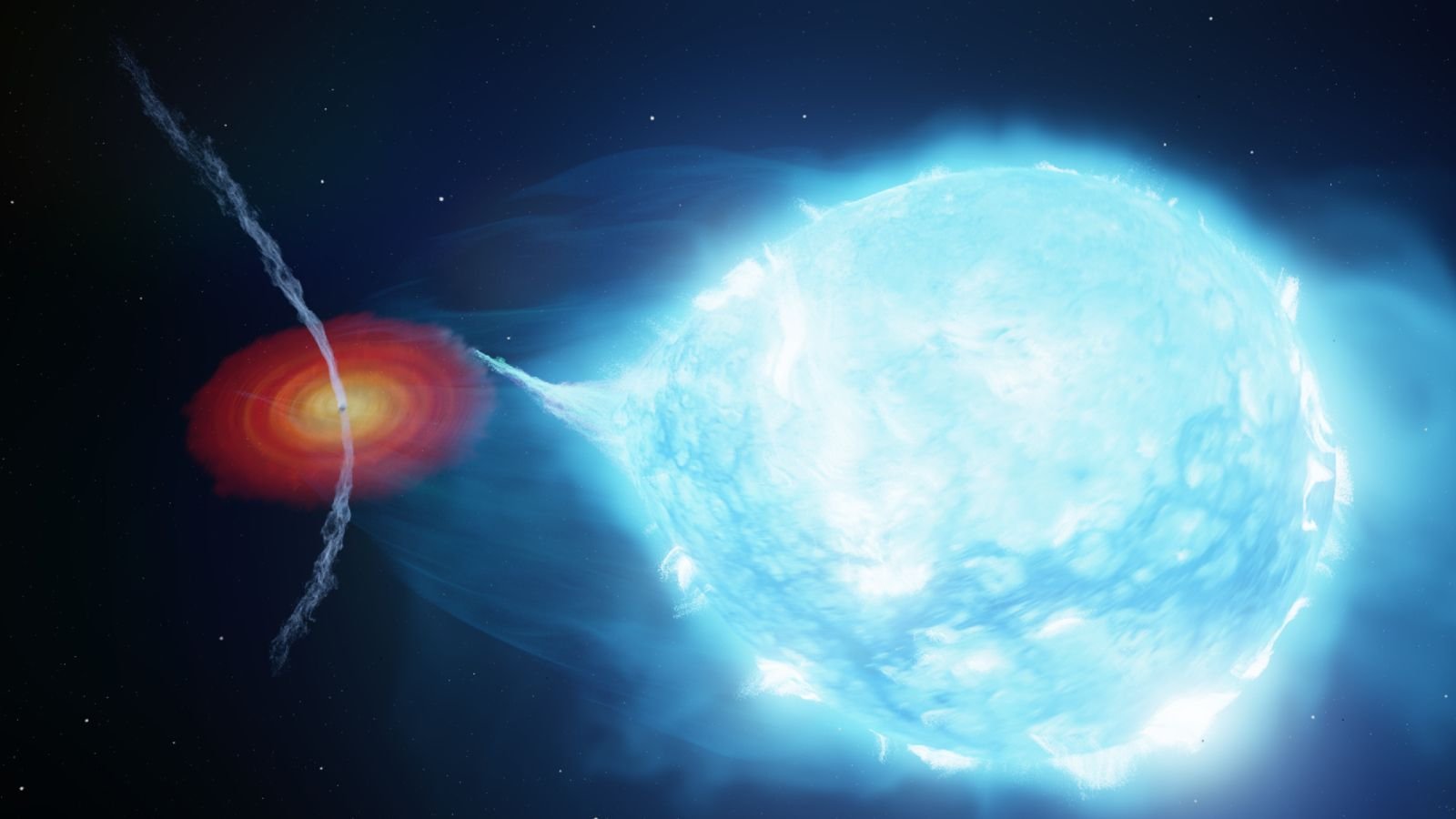
More than 60 years after it was first spotted, Cygnus X-1 — the first confirmed black hole — is still full of surprises. Researchers have finally measured the energy output of this behemoth’s “dancing jets,” and the results could help answer wider questions about the extreme behavior of black holes, experts say.
Cygnus X-1 is a stellar-mass black hole that is around 21 times more massive than the sun and located approximately 7,000 light-years from Earth, in the constellation Cygnus. It is locked in a binary orbit with an equally massive blue supergiant star dubbed HDE 226868, which it circles every 5.6 days at a distance of 0.2 astronomical unit (one-fifth the Earth-sun distance). The black hole is constantly ripping away its partner’s outer layers into a superhot ring of swirling matter called an accretion disk, which shines brightly in X-ray light.
Like most other black holes, Cygnus X-1 shoots out two massive beams of energy. These jets, made of plasma from the accretion disk, get fired outward by the black hole’s immensely powerful and rapidly spinning magnetic field. However, despite detecting dozens of similar jets and even photographing them, researchers have historically struggled to properly measure the energetic outlaws.
But in the new study, published April 16 in the journal Nature Astronomy, researchers have found a way to measure the jets of Cygnus X-1 by tracking how they wobble, or “dance,” due to their close proximity to HDE 226868.
The team found that the jets shine with the equivalent energy of around 10,000 suns and that they’re shooting outward at around 335 million mph (540 million km/h) — about half the speed of light.
“Dancing jets”
All active stars, including HDE 226868, emit stellar winds made up of charged particles accelerated by powerful magnetic fields (similar to black hole energy jets). These invisible gusts push against the atmospheres of planets and eventually collide with the interstellar medium.
In the case of Cygnus X-1, its energy jets are constantly buffeted by strong gusts of radiation from HDE 226868, causing the jets to bend away from the blue supergiant. Because the two objects circle a shared center of mass, the jets appear to bend back and forth, or wobble, from our point of view.

Study first author Steve Prabu, a radio astronomer at the University of Oxford, described this phenomenon as “dancing jets” due to their constant swaying motion, according to a statement emailed to Live Science.
Historically, it has been tricky to take accurate readings of these dancing jets, due to their constant movement. But researchers combined images captured by radio telescopes across the globe to build a more accurate picture of the jets’ shape, thus achieving what was previously impossible.
Filling in the gaps
Researchers are particularly pleased by the new findings because they can help fill in gaps in our current black hole knowledge.
“A key finding from this research is that about 10 per cent of the energy released as matter falls in towards the black hole is carried away by the jets,” Prabu said in the statement. “This is what scientists usually assume in large-scale simulated models of the universe, but it has been hard to confirm by observation until now.”
While this is just one set of jets, our current understanding of black holes — based on Albert Einstein’s 1915 theory of general relativity — suggests that all black hole jets, whether they belong to stellar-mass or supermassive entities, should emit a similar outflow.
“Because our theories suggest that the physics around black holes is very similar, we can now use this measurement to anchor our understanding of [other] jets, whether they are from black holes 10 or 10 million times the mass of the sun,” study co-author James Miller-Jones, a radio astronomer and black hole accretion expert at Curtin University in Australia, said in the statement.
A better understanding of black hole jets will also help scientists figure out how galaxies like the Milky Way have evolved over time, based on how these monstrous outflows shape their surroundings.
“Black hole jets provide an important source of feedback to the surrounding environment and are critical to understanding the evolution of galaxies,” Miller-Jones added.



