
A $60-million settlement has been reached on behalf of an Illinois woman left paraplegic after a rollover crash that her attorneys say was caused by construction companies that didn’t keep the roadway in a safe condition.
The lead defendant, K-Five Construction of Westmont, Ill., expressed sympathy for the injuries suffered by Sarah Grasser, 31, of Minooka, Ill., saying “no one should experience such life-altering consequences,” but also derided the settlement, which it said it agreed to only because it was financially untenable to proceed to trial.
“The decision for settlement was grounded in the biased political system and ‘nuclear’ settlement environment of cases in Cook County and Illinois,” said Robert Krug, president of K-Five. “The settlement was the lesser risk for K-Five.”
This is only the latest large settlement or damage award linked to roadwork or construction zone disruptions. In 2022, a jury in Kentucky ordered a paving contractor to pay $74 million related to a fatal traffic accident involving a roadway it had previously repaved. That case was ultimately settled for an undisclosed amount.
High-Speed Traffic on a Milled Road
Grasser’s spinal injury stems from an Aug. 30, 2022 accident on northbound Interstate 55 near Renwick Road in Will County, Ill., which was under construction at the time.
Another driver’s vehicle, which had swerved to avoid a large pothole, struck Grasser’s vehicle, causing it to roll over and eventually to settle in a ditch on the side of the highway, the lawsuit states.
In addition to K-Five, other defendants include Gallagher Asphalt Corp., R.M. Chin and Associates, AECOM, ATLAS Engineering Group, Traffic Control and Protection, TSI Traffic Control, Maintenance Coating Co., and Work Zone Safety, Inc., all of whom the lawsuit charges in various ways left the roadway in an unsafe condition and in violation of Illinois Dept. of Transportation safety standards.
“This incident was preventable,” said attorney Bradley Cosgrove of Clifford Law Offices. “The roadway was left in a condition that presented a clear hazard to drivers; a significant pothole created a serious danger in an active travel lane. Under those conditions, the roadway should not have been open to traffic without appropriate safeguards or corrective measures.”
The project was part of a $48-million resurfacing project on both the north and southbound lanes of Interstate 55, from Interstate 80 to Weber Road.
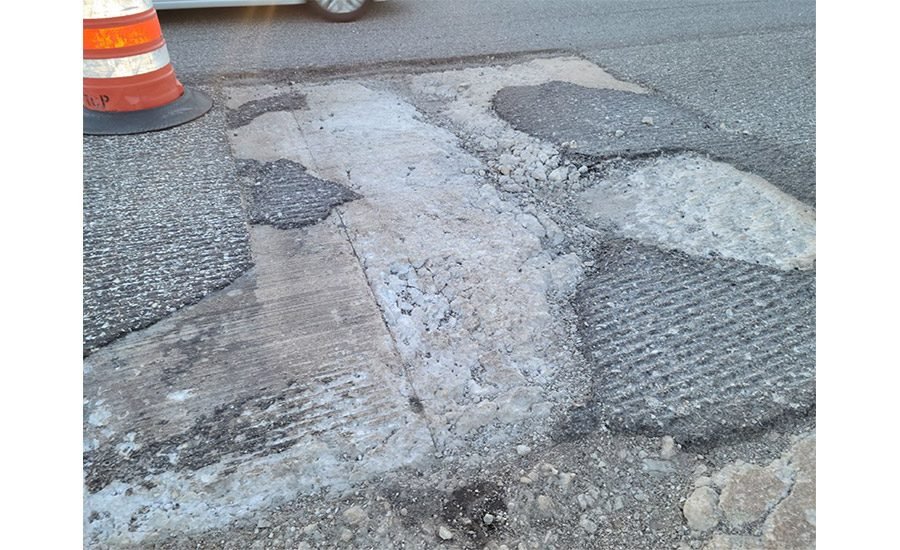
The lawsuit alleges that K-Five and its agents milled too deeply into structural layers, weakening the pavement and contributing directly to pothole formation, and that it disregarded the planned staggered milling sequence by milling all three lanes to a full 5-in. depth and reopening them simultaneously to traffic.
It also alleges that K-Five and its agents failed to perform required surface variation testing—to a 3/16-in. tolerance—after milling, as required in IDOT specifications.
Even though there were visible gouging and defects in the road, Cosgrove said the lanes were reopened to traffic including 65 mph travel, without adequate repair, warning or speed reduction.
“Defendants failed to properly inspect, monitor and maintain the work zone throughout the day, and failed to fulfill their contractual and safety obligations to protect the public,’” Cosgrove said. “Collectively, these failures created a dangerous roadway condition that posed a foreseeable risk to motorists.”
Contractor Pushes Back Against Settlement
While not responding to those specific allegations, Krug said “the public deserves a complete picture of the facts that led to this settlement.”
He said toxicology reports confirmed that Grasser had both cocaine and alcohol in her system at the time of the accident, and that an open container of alcohol was found in her car at the accident scene. Furthermore, Krug says that Grasser’s vehicle was destroyed before the defense had an opportunity to conduct an independent investigation, and despite extensive investigation, neither the alleged other vehicle or its driver was produced to corroborate Grasser’s claim her vehicle had been struck by another vehicle prior to the crash.
“These facts raise significant questions about causation that a jury never had the opportunity to weigh,” Krug said. “Instead, this case exemplifies the fundamental flaws in Illinois’ civil justice system.”
Krug also criticized the legal procedural maneuvers in the case, which allowed it to be decided in Cook County Circuit Court rather than in Will County—where the accident occurred—or in Minooka, located in Grundy County, where Grasser resides.
He called Cook County “a jurisdiction with no meaningful connection to the incident. The defense’s motion for change of venue was denied, forcing the matter to be adjudicated in a forum known for consistently delivering nuclear verdicts that bear little relationship to the evidence or applicable law.”
Krug also noted that the State of Illinois, including IDOT, contractually indemnifies itself from any and all liability related to the contracts it lets, which he said is not fair.
“While private contractors face exposure to massive verdicts, the government responsible for highway maintenance and oversight faces none,” he said. “This structural inequity further distorts accountability and incentivizes the very settlement dynamics that resolved this case.”
Acknowledging the profound impact the accident has had on Grasser and her family, Krug asserted that “safety for our team and the public will always be the cornerstone of our operations.”
Source: www.enr.com



