
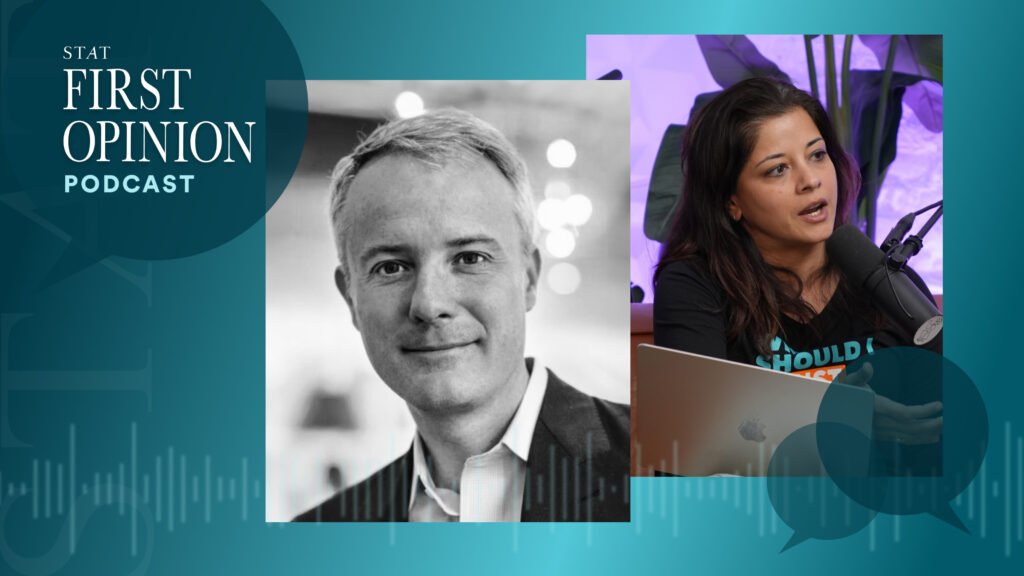
Below is a lightly edited, AI-generated transcript of the “First Opinion Podcast” interview with Brinda Adhikari and Tom W. Johnson, hosts of the podcast “Why Should I Trust You?” Be sure to sign up for the weekly “First Opinion Podcast” on Apple Podcasts, Spotify, or wherever you get your podcasts. Get alerts about each new episode by signing up for the “First Opinion Podcast” newsletter. And don’t forget to sign up for the First Opinion newsletter, delivered every Sunday.
Torie Bosch: In 2025, the well-known emergency physician Craig Spencer found himself in an unexpected place: the Children’s Health Defense Conference in Austin, Texas. There, he chatted with anti-vaccine activists, MAHA supporters, and others with deep distrust of doctors and mainstream medicine. As he wrote in an essay for STAT about the experience, “I didn’t change any minds, nor did my convictions waver. But every conversation was honest and respectful.”
Craig was at the conference as a guest of the podcast “Why Should I Trust You?” The show’s premise is to encourage just that kind of honest and respectful conversation between people with very different beliefs about medicine and health. And the podcast just might offer a way forward for public health in a time of a trust crisis.
Welcome to the “First Opinion Podcast.” I’m Torie Bosch, editor of First Opinion. First Opinion is STAT’s home for big, bold ideas from health care providers, researchers, patients, and others who have something to say about medicine’s most important and interesting topics. This season, we’re focused on the intersection of medicine and culture.
Today, I’m speaking with Brinda Adhikari and Tom W. Johnson, who host “Why Should I Trust You?” Brinda is an award-winning executive producer, showrunner, and journalist. She was Jon Stewart’s executive producer on the five-time Emmy-nominated “The Problem” on Apple TV+. Tom is an Emmy Award-winning executive producer with experience in documentary series, including Showtime’s “The Circus,” as well as digital, cable, and network news. After a quick break, I’ll bring you our conversation about bringing together MAHA and mainstream public health.
Brinda Adhikari and Tom Johnson, welcome to the First Opinion Podcast.
Brinda Adhikari: Thank you.
Bosch: So, to kick things off, I wonder if one of you, maybe Brinda, can briefly explain the premise of “Why Should I Trust You?”
Adhikari: “Why Should I Trust You?” is a podcast that looks at the breakdown and trust between public health and the public, and why it is that so many folks these days tend to mistrust mainstream science and public health, and medicine? And a big thing that we have done over the last year is we’ve moderated conversations between those who mistrust sort of systemic medicine with those who are from that very system. And oftentimes, those who mistrust the system have tended to be people who support the Make America Healthy Again movement.
Bosch: And how did the show come about?
Adhikari: So, you know, Tom and I are both journalists. We’ve been doing this for a really long time. But about a year and a half ago, Maggie Bartlett, a virologist from Johns Hopkins, reached out to me. I had just wrapped the show for Apple. And she had seen some of the stuff I’d done on the show and she’d basically wanted some help. She was at Johns Hopkins and she wanted to see if there was something that I could do to help public health communicate better with the public because she was like, “turns out people don’t trust us very much.” And I was so fascinated by that. And Tom is a really good friend of mine and we were both kind of like in a similar professional situation. And we both were like, well, let’s look into this. And we started digging into it. And then the election happened and Robert F. Kennedy Jr. became head of [Health and Human Services]. And we were like “oh, we need to get on this.” We thought we were gonna have it be a docu-series, but then we said “Screw that, let’s make it a podcast.”
Bosch: And how did you go about launching it? So what I’ve noticed is that — and we’ll get a little more into the actual guests — but it’s really sort of an A list of both public health and MAHA. How did you get people to trust you as you were starting off?
Johnson: That’s a great question. I don’t think we’ve paused to think about it. We’ve been in such a race for about a year, but I remember when Brinda and I both were like, “we’ve got to do a podcast,” I remember saying, “well, who’s going to host the podcast?” And she’s like, “well, we’re going to host the podcast.” I’m like, “What do you mean ‘we’re going host the podcast?’” So we just sort of, you know, tore into it last January.
I think there was such a need out there to have a convening place. For public health folks, for science, for medicine, and leveraging off of our other hosts, as we mentioned, a virologist and a doctor and medical reporter, Dr. Mark Abdelmalek. We just started to call up people and sort of create trust by listening to them and hearing their stories. And then we said, “hey, we would like to have you come on.” And more often than not, people said, “All right, it’s time, let me talk.”
And a lot of it in the beginning was about kind of reliving and thinking through what went down during Covid. But once we could get past that topic, it really opened the door and we started to getting a lot of different voices on a lot different subjects because as we know, last year was a frenetic year for public health and for funding for science especially.
Adhikari: I think a big key to why I suspect many of those people come on our show is we really took the time to build relationships with both of these groups well before we even started production. We decided that, you know, oftentimes as journalists we’re very used to getting that soundbite from someone for the story that we need or getting a fill in that space: “Oh, we need a farmer” or “we need this.” And we were like, “What if we approach this totally differently?” And we actually built a community with these people and we actually got to know them and they got to know us and we got to know each other. And everyone, when they come on the show, no matter what their quote unquote, expertise is, they’re all equals. Everyone gets time to speak. And I think that’s maybe a reason why people of all types are comfortable coming on.
Bosch: Yeah, and it really is all types. So, you know, certainly lots of leaders within traditional public health, but also, like I said, the sort of A-listers of MAHA and vaccine skepticism. So Zen Honeycutt, who still has the greatest name I’ve ever heard. Kelly Ryerson, the glyphosate girl, Del Bigtree, Pierre Kory. You know, a lot of names that I think sort of, to be honest, maybe strike fear in the heart of a lot folks within public health.
So I’m curious how you go about hosting those conversations when it does feel like there are people kind of leading a charge against public health. How do you approach facilitating those discussions?
Johnson: Yeah, we get a lot of that, we got a lot of, “hey, you’re platforming this person.” And the funny thing is we get it from both sides. Sometimes it’s MAHA saying, “Hey, you’re platforming this public health person.” And others in public health sometimes say, “Hey, you’re platforming the supporter of MAHA or this leader of MAHA.” We don’t think of it that way. We look at this as an opportunity to bring sides together and to talk. And sometimes it works really well. And sometimes we all sit there and there’s a lot of kind of butting heads and talking points.
But more often than not, as everybody sort of steps back from the conversation, they definitely have an appreciation that “this person I just spoke to is not a caricature of what I’ve been told or what I have seen on social media. They’re a real person. They care about people. They have a life. They got into this for a reason. They want to help people.” I do think it’s an opportunity to kind of put down your weapons and just listen, really. If you can just do that, we get a little bit of progress.
Bosch: Yeah, I think a great example of that are the three episodes from the Children’s Health Defense conference, which I just re-listened to. They really stuck out to me for, first of all, it was quite interesting, everybody going to Austin for this big conference, but also three episodes, long episodes, long conversations. And I wonder if you could talk a little bit about those episodes and what some of those conversations look like for people who haven’t heard them.
Adhikari: I’m sure a lot of your listeners are familiar, but Children’s Health Defense is a group that Robert F Kennedy Jr. once headed up. It’s a group, that is self-proclaimed anti-vaccine. It is a group that has been around for quite a while. And while its name is Children’s Health Defense, a lot of its work is focused on talking about what it believes are the sort of wrongs of vaccines. It’s in an interesting moment where it’s colliding with this MAHA movement.
And while recent surveys have actually shown that while the majority of the country is quite pro-vaccine, including huge numbers of the MAHA movement, which I think would come as a surprise to many people, there is still this very alive, very vocal group at Children’s Health Defense. And because now there are parts of it that are kind of cross-pollinating with this MAHA movement, and our show looks at this movement a lot, there’s going to be like a thousand people there. So of course we’re going to go — it’s more like, why wouldn’t we go? So that was the reason behind going.
Then once we were there, Tom and I had no agenda. We’re like, we’re just gonna go and see what we get, you know? And then as you’re walking around the halls there, you meet people. He and I are journalists and we’ve done this for our whole lives, which is when you meet interesting people, you sit down and you talk to them. And that’s really just what we did. We’d meet someone interesting. I would text Tom or he would meet somebody and he would text me and we’d be like, “all right, let’s go to the conference room. Let’s put the mic up and let’s talk to them.” What’s interesting about a conference like Children’s Health Defense is that you have, of course, the big name speakers, you just mentioned Del Bigtree and Bret Weinstein and all these people. But mostly it’s thousands of parents and their kids who are there, who feel very seen by that movement, who believe that they’ve experienced some sort of an injury that’s gone unnoticed or dismissed by the medical establishment and they feel the sense of camaraderie and togetherness.
And so we wanted to capture that. So really what you’re gonna hear in those three episodes is talking to people who are very influential and talking to people who maybe don’t have that influence but are very moved by the message. So we talked to parents, we talked to somebody from the Mennonite community where the measles outbreak had struck last year. And yes, we did talk to really big names from, I guess you could call them the MAHA movement, but they’ve been around a lot further back than the MAHA movement, like Del, like Bret Weinstein, like Pierre Kory.
Bosch: That’s such an important aspect of what you do — talking to these leaders, but also members of sort of the community. And I’m curious, how do you approach, particularly when it comes to, I don’t know how you feel about the term “misinformation,” but information that might not be correct when it’s coming from a Del Bigtree or even an NIH director, Jay Bhattacharya, versus a mom at the Children’s Health Defense Conference who thinks that her child has been vaccine-injured.
Johnson: Yeah, that’s a great question. When we believe that somebody on our program is saying something that’s just not based in fact, we will say, and if it’s a prominent person, we’ll say, “we see this study that says something very different than what you’re saying.” And it’s either a moment to wrestle with that or it’s a moment to make that clear to the audience, but that’s not the point of what we’re trying to do here talking to this person. If we spend the whole time fighting between our study and your study, we’ve actually gotten kind of nowhere. We absolutely wanna make it clear that there’s a different perspective, a different piece of information on something, but we wanna move past that.
Now, if it’s an everyday person who says, “I believe this and that,” that’s a real opportunity to say, “OK, well, that’s interesting because in a different ecosystem, information system, there’s different message that’s being sent out. Are you hearing that message? Why is this message resonating with you?” And we can explore just deeper and get into a little bit more about how people are hearing things, where it’s coming from, and what they choose to trust.
And that’s really the essence of what we do, no matter whether it’s a Del Bigtree or just a mom or dad who’ve come to a conference because they’re scared and they feel cut off and let down. We just wanna understand: Where do they trust? Why do they trust? How do they see this? And why is it so different than what other people are seeing in the country?
Adhikari: I think it’s really crucial to understand why people in power think the way they do and to sort of show how they think and to almost reveal a sort of logic ladder that they’re building to make the points that they feel strongly about.
And I think if you listen to the Jay Bhattacharya interview, you’ll see that there are moments there where we kind of explained to him what we’re seeing and hearing, and we ask him to respond to that. And yeah, sure, it got contentious and things like that, but I don’t know that that happened because we were one side really digging in to how we felt about something.
When someone’s in a position of power, I do think it is fair to ask them to have to account for things that they have said or that are in the public domain. But I do feel very differently, like Tom said, when it’s a mom, when it is somebody without that level of power and influence, and they’ve seen information that’s really resonated with them.
And for us, we’re really interested in that moment where something resonates with somebody. Whether it’s good information or bad information, what is it that clicked for them and why? And so we do these sort of almost autopsies into that moment where either they felt rejected by a doctor, so they sought information from somebody else, or they felt really seen by a leader inside the MAHA movement, because they said something in a certain way that really worked for them. What was that, you know? And the same thing goes for public health. There are certain people in public health who have really broken through, and we want to amplify those voices.
Bosch: So you do a couple of different modes of episodes. There’s ones in which you’re one-on-one with an official or with an individual person, and there are some in which you’re sort of facilitating dialogs between people with divergent views. And I wonder if you could talk a little bit about which episodes you most enjoy and feel the most productive, though maybe those are not necessarily always the same.
Adhikari: Man, we’re gonna be giving away all our secrets here. Gosh, I mean, they’re all so fun and different in their own ways. The amazing thing about those big MAHA group conversations, I will just say, they are long, they’re exhausting at the end of them. Like, there’s like sweat sometimes pouring down my face when we’re doing them, but they’re so special. And this doesn’t always make it onto the episode, but we spend quite a bit of time in the beginning, just kind of getting to know each other. And that part is just amazing to have people just sort of putting their like rhetorical spears down, their politics aside and being like, “yeah, I’m from like Tulsa, Oklahoma, and I grew up on a farm,” and then somebody else, maybe from public health, would be like, “I did too.” And then they have this little moment of connection. I love that.
We just recently did this episode, and maybe this is just fresh in my mind, but we recently did the episode with Kelly Ryerson from MAHA and then two Democratic congresspeople, Chellie Pingree from Maine and Jim McGovern from Massachusetts. That was a super fun episode because it was two types of people who maybe diverge on certain things, but are really aligned in this one space and are speaking really passionately and in a very real way about this issue. In this case it was glyphosate and what they believe are dangerous pesticides and is like a betrayal of the Trump administration to the MAHA movement.
There was just something, I don’t know, very easy. By easy I don’t mean that the issue is easy, but because of how passionate everyone was about the topic, it just lent to this vibe that was really fun to be a part of. Tom, I don’t know what you think.
Johnson: Yeah, those are super fun. I also really like a different mode, which is a deep dive into like a subject that’s kind of tearing people apart. We found that so often people are so quick to jump into the opinion section, having never covered, like, what are the basics of this subject even? They just look for whatever camp they’re coded with. You know, “I’ll agree with that. What’s the take? I agree with.” So we’ll do a deep dive into a subject. It could be mRNA, it could be the hep B birth dose, it could liability shields for vaccine makers or for pesticides makers, like the episode Brinda’s talking about, and just really say, what are the facts here? What are the basics of it? And then we’re gonna bring in people with different opinions about this, and hopefully then, after we’ve done this for 20 minutes, moving through this as a group, understanding all the aspects of it, the opinions will land better. You’ll be able to make up your mind in a more robust way than if we just said, “here’s the subject, you’ve heard about it, here are the guests,” you know? So I think we really enjoy diving into those subjects too.
Bosch: There’s an episode that really stuck with me, actually, about the hepatitis B birth dose given to newborns in which two people who are staunchly pro-vaccine, Paul Offit and Michael Mina, disagreed a bit, which I thought was interesting since I think we seem to see each side on vaccines as sort of in lockstep. Can one of you talk a little bit about what that disagreement was?
Johnson: Sure. I mean, it was, as you said, two, you know, acclaimed scientists who believe in vaccines. And Paul Offit, you now, just to summarize, was taking the position that the hepatitis B birth dose was a very, very important line to draw and something to support. [He said] that moms were making it through pregnancy, either not being tested, or their hep B status was not being caught, or there was a change in status between a test earlier in pregnancy and birth. [Offit said] that this was a catch-all way to protect children. The vaccine is safe. What is the problem? Get it done in the hospital. Get that first dose done right in the hospital. It’s the safest thing.
And Michael Minna was looking at it saying, “we have an issue here. Trust in vaccines is dropping, and if we don’t listen to the public, then how are we really fulfilling our role of public health?” If we say to do things and the public is sort of breaking trust with these things or something, is there room on some of these things? In the right circumstances, if the status of the mom is known and documented, if the mother is going to come back for a second appointment after birth pretty quickly or a first appointment after birth pretty quickly, could this be pushed off a month or two? Is there flexibility here in certain circumstances? And his position was, I think there could be. And I think he spoke personally about him and his wife making that decision and saying there’s room here and that there are areas where we can be a little adaptable and not be one-size-fits-all.
So it was a fascinating conversation. It was one of those where we could kind of step back and say, you guys have, not have at it, but have a rigorous conversation. And that’s what that was. So I think we all learned a lot from that. I don’t even know if we called debate, but that kind of intellectual wrestling match maybe.
Adhikari: I love that episode too, it was one of my favorites and I think it was because, you know, it has to be OK to have these conversations in places and sometimes it can be easy when it feels like you’re in huge disagreement with someone over everything to sort of have a conversation to not kind of take anything they’re saying seriously because you disagree on so much. But what happens when you agree with somebody on most things and you respect them and you respect their science and you may even look at the same science and see the same thing, but on one or two things, you really diverge. And I think that’s when some of the most interesting, rich conversations can take place.
Bosch: And I think that example also, just the way you’re talking about it, like Dr. Minna saying, “is this a place where we can perhaps to build trust, step back a little bit?” I think sometimes, I’ve heard from lots of public health folks who seem frustrated that sometimes it feels like so much of the onus is on them to meet people, to always engage in good faith even when they think people aren’t engaging with them in good faith, to just always be the patient educator and maybe making concessions where they don’t feel comfortable. I wonder if you see any of that in talking with public health folks.
Johnson: We do. The first couple group discussions that we hosted with supporters of the Make America Healthy Again movement and members who you sort of consider like traditional public health leaders. There was a lot of, “Let me tell you how much your policies during the pandemic screwed up my life and how I felt censored. I felt like my liberties are being trampled.” And there was just session after session of hearing that POV. And public health folks that we had in these conversations were explaining and at times saying, “you know, this was an unintended consequence. We never wanted you to feel that way.”
And then I think it was — Brinda, correct me if I’m wrong — but after the shooting at the CDC building on the exterior face of the building, there was a shift. And I think from that point forward there was a notable shift in public health. Not like “we’re now coming to debate you and fight you,” but those conversations about the pandemic, we evolved past that. And it was like, “here’s what I think about the changes that are occurring now. And here’s what I think about the cuts that are occurring to scientific research now. And here is what I think about upending ACIP [the Advisory Committee on Immunization Practices] now.” And so the conversation suddenly became, “You know, this movement is ascendant. Its leaders have taken the reins of federal public health, they’re making changes. How do you feel about it? Because this is how I feel about, and this is how my colleagues feel about. And this is what worries me about where we’re going.” And suddenly it was like a very, very different conversation.
Adhikari: Yeah, I think that’s exactly right. Every once in a while it flips in terms of who is being criticized for what. And part of that is the feeling of who’s in power, right?
And one thing I always try to say to some of the public health folks is: Some of reason why those criticisms are coming at you is because there’s this assumption that the power dynamic still lies mostly with you. And if you were in a position to do something, why didn’t you, blah, blah blah, right? And now just to underscore the point that Tom’s making, I think from the perspective of public health, they feel like the power has shifted. And now folks in the MAHA movement have that power and why aren’t you doing more to blah, which is really fascinating. And I think that’s another really interesting role foe Tom and I and Mark and Maggie. But I’d say even, because Tom and I are not physicians or scientists ourselves, we get to play this sort of role of, “all right, I’m hearing what you’re saying, I’m also hearing what you’re saying, let’s figure this out, right?” It’s not to both sides in terms of giving them equal that everyone’s right or everyone’s wrong. I think he and I play a unique role because of the fact that we’re not in public health or MAHA.
Bosch: One thing I’m envious of is your episodes get to be so long. Some of them are closing in on two hours. How do you decide what episodes are going to be supersized?
Johnson: I mean, sometimes they just lay out that way. When we did an episode, was it last week? We just had a lot of beats to it. This is the one where we took up, what did the federal judge in Boston say about the HHS’s approaches to vaccine policy? Why was this day placed on this? Then we had a return visit of Kirk Milhoan, Dr. Kirk Milhoan, who is, you know, the chair of ACIP, to react to the suspended ACIP. And then we had a conversation about vaccine injury, long COVID, what do we know, what can be done, what could be done differently. So we just knew going in, that was gonna be a big one. And, you know, correct me if I’m wrong, Brinda, but we don’t really see fall off on the longer ones. I imagine people are chunking them out and listening to them — like I’m walking the dog, I’m coming into work — and they kind of get their way through them. But it’s not like the long ones are duds. I mean, if anything, some of our long ones have been the most popular.
Adhikari: Yeah, this is one thing I’ve noticed, that some of the right-leaning podcasts tend to be very long and quite popular. And what we decided with this was we sort of threw out the rule book when it came to some of like, well, the best length podcast is this. We were like, “we don’t really care. We want to really put something out that we’re really proud of, that really reflects the urgency that this country is feeling about a particular thing.” And if that’s best reflected in an hour 40 minute episode, that’s what we’ll do. And like Tom said, I mean, some of those episodes, like the ones that are north of an hour, like all of our top episodes tend to be north of an hour for some reason.
And I think it’s because if you are going to listen to our show, based even on just what we’ve been talking about here, like these are tough, tricky subjects, and you don’t want short shrift someone, because if you cut them off, you know, it can seem much more explosive than if you let it play out. And sometimes it may still be explosive to you, but we don’t actually, and maybe this is like a terrible thing on our part, but we don’t put out short clips of our episodes. We don’t like put ourselves on TikTok for 30 seconds saying “this is what a person says,” because we really honor all of our guests and we honor the totality of they’re coming on our show. And so, yeah, it’s been working for us.
Johnson: Yeah, short clips we find, you know, run the risk of really breaking trust with people that we’ve had on where we’ve, had an hour conversation with them. And then we’re cherry-picking out one thing and putting it out there, suddenly it’s like, “wait, what was this about, guys?” And we don’t want to be in that position. We’d rather, if you’re going to come to us, come and take the journey with us because you know that’s what we do each week, we take this journey. I think we’re learning stuff, but it’s a complex topic.
Bosch: It’s interesting that you say that, because something I was thinking about a lot, especially while listening to last week’s episode, is that when Kirk Milhoan, who was the chair of the Advisory Committee on Immunization Practices before this ruling kind of threw everything into chaos, when he came on in January, a short, maybe 30-second clip of him sort of went viral in which he appeared to express some hesitation about the necessity of the polio and measles vaccines. And I think that was maybe the show’s most viral moment so far. Is that right?
Adhikari: Yeah, and by the way, we didn’t put any clips out. But yes, we remember that.
Bosch: When he came on the show for the second time, he seemed sort of frustrated about the backlash to the appearance, which, you know, sort of makes sense. I can understand why people focused on that part of the interview, because it was an explosive statement. But it also took place in a 75-minute or whatever episode. I guess I wonder when you are doing these really intense, lengthy episodes, but we also live in an environment in which, while your listeners can have a two-hour attention span, the average listener doesn’t. How do you sort of balance the fact that you’re creating the lengthy version, but also know that people are going, especially when you interview these prominent figures, are going to be pulling moments out? Do you think about that much?
Johnson: So yeah, for sure, that was a very viral interview for us. It sort of happened around us. We posted the interview. It was a long interview. He felt, I think, we heard back from him right after we posted it, he felt very good about the conversation. That took off.
So, very much in keeping sort of with the way we approach these things, when we had him back on to talk about the federal judge’s stay on his committee and to talk about the subject of long Covid and Covid vaccine injuries, we wanted to give him the opportunity: “The way this played out across all media, were you happy with that? Is that what your message was?” And we gave him the chance to sort of respond and say, “no, I felt like in the totality of the conversation, I made my points clear about my support for the current vaccine schedule, which has a measles vaccine in it, which has a polio vaccine in it.” And he explained what he was talking about. So again, we really just wanted to give him the chance to say, hey, how did this go down for you?
Bosch: All right, and I have a couple really quick questions before we unfortunately have to wrap up. The first is, who is the audience for the show? Who did you intend it to be and who is it in actuality?
Johnson: Who we intended to be was both the community of, I guess, we’re coming up with these terms of mainstream or traditional public health, science, medicine, and followers of MAHA, followers of the medical freedom movement, people who feel dislocated from both, frankly. I mean, if you look at KFF, their polling, four in 10 American parents today feel aligned with the principles of MAHA. It’s an amorphous group and we wanna be a place that’s sort of in the middle of this conversation that’s going on about health. And we don’t want to just be on one side or the other, we want to be factual, we want to be clear, we want to be informative, and we want to host this intersection that’s just not happening elsewhere. These sides aren’t talking to each other. And there’s a lot riding on it. So we want to be in the middle, and based on the feedback we get, we feel like that’s working. I mean, you know, we’re a year in, but it seems to be working. We’re pulling from these different communities. They’re listening and they have a lot to say and a lot of opinions and they fill up our inbox with comments and story ideas, and it feels good.
Bosch: And have any of your guests changed their minds and/or have you changed your minds about anything over the course of the show?
Adhikari: You know, it’s funny, we tend to not even approach it that way because I think as soon as you view what you’re doing as like a potential opportunity to convert or persuade somebody, it sort of falls apart. Because then somebody else is like, “oh, you’re just trying to get me to like change my mind.” I’ll say that the biggest thing that’s happened, I think, for anybody involved is that we’re all kind of seeing the humanity in each other more. Absolutely, when I started this project, did I also have a certain point of view about the Make America Healthy Again movement? And also, did I have a sort of view of the infallibility of certain public health points of view? Absolutely, and I think I’ve definitely softened my opinions on all sides in some ways.
But in general, I think the way it’s changed me is that it’s made me a sharper thinker. Because I’m sort of able to see where different folks are actually coming from and not where Twitter is saying they’re coming from, but to actually understand the sort of origin of where that particular really entrenched take is coming from. It just changes you. There was a guy on the show, he’s been on a few times, Aaron Everitt, who is a MAHA and Kennedy supporter. He was recently at this public health conference, and Tom was at that conference. I unfortunately wasn’t able to attend, but he then wrote a piece in his Substack about how he’s kind of changed since being a part of the show and that he sees public health differently. It doesn’t mean that he has kind of changed his mind on everything, but that there’s a humanity in a sense that this is a group of people really trying to help and do their best that he is seeing now. I mean, you can’t ask for more than that.
Bosch: I think that’s a great note to end on. So, Brinda Adhikari, Tom Johnson, thank you so much for coming on the “First Opinion Podcast.”
Be sure to read Tom and Brinda’s First Opinion essay about their goals for “Why Should I Trust You?” on STAT as well as Craig Spencer’s piece about his time at the Children’s Health Defense conference.
And thank you for listening to the “First Opinion Podcast.” It’s produced by Hyacinth Empinado. Alissa Ambrose is the senior producer and Rick Berke is executive producer. You can share your opinion on the show by emailing me at [email protected]. And please leave a review or rating on whatever platform you use to get your podcasts. Until next time, I’m Torie Bosch, and please don’t keep your opinions to yourself.



