
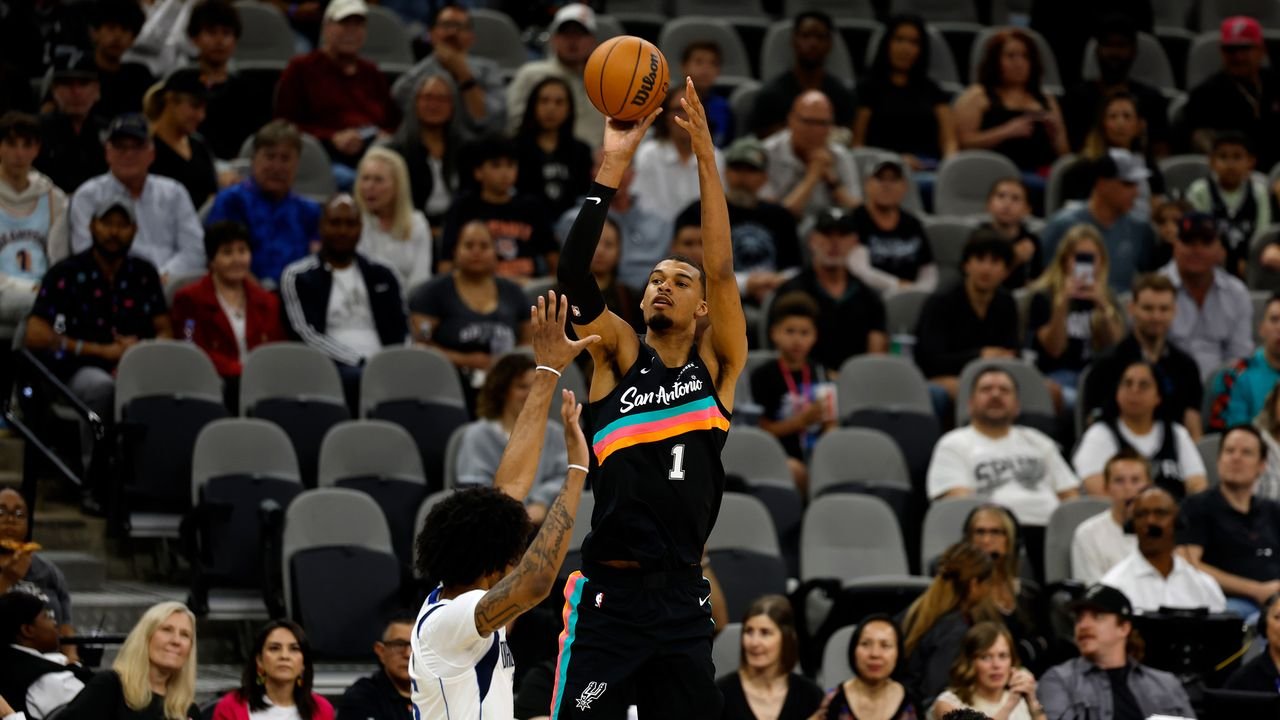
Last June, Victor Wembanyama, a young center for the San Antonio Spurs, went to Zhengzhou, China, to study martial arts and meditation. Wembanyama, twenty-one at the time, was already known for his unconventional training methods. Even at seven feet four inches tall, with an eight-foot wingspan, he did handstands. He played speed chess in between bursts of cardio exercise to hone his pattern recognition and decision-making while under intense physical stress. He practiced (really) high kicks, astonishing his teammates. Wembanyama astonished people easily and often. He could dunk without jumping, and he blocked shots so easily that before long all it took to stop an opposing ball handler was an intimidating glare. But he could also dribble the ball up the court and drain step-back threes, or toss elegant little lobs to his high-flying teammates—not the sort of stuff associated with seven-footers. When he arrived in the N.B.A., in 2023, he was the most heralded rookie in recent memory, and the salient thing about him wasn’t his size. It was his audacity.
But, last February, a little more than halfway through his second year in the league, he’d been diagnosed with deep-vein thrombosis in his shoulder, and he’d missed the rest of the season. The narrow, specialized life of a professional basketball player had taxed his body past its limits. And so Wembanyama decided to expand those limits, any way he could. That June, he quietly went to the Shaolin Temple, the birthplace of the ancient discipline Shaolin kung fu, for ten days, to see what he could learn. His first question for the monk who oversaw his stay was whether he would have to shave his head in order to become “a true kung-fu practitioner.” Yes, the monk answered. And so Wembanyama sat down on the temple’s stone steps, and the monk got a razor and shaved off the center’s soft brown curls. “There was no ritual, no audience,” the monk later wrote, in an account of Wembanyama’s time at Shaolin. The monk was struck by the seriousness of his commitment. “When it was done, he touched his head and smiled.”
Without Wembanyama last spring, the Spurs cratered, losing nineteen of their remaining thirty games. Once the paragon of consistent excellence—from the late nineties to the late twenty-tens, the Spurs made the playoffs every year, twenty-two seasons in a row—the team now seemed oriented toward the future, toward Wembanyama’s prime. But Wembanyama was not the type to wait around.
The Spurs began this season 5–0, and even thrived for a time without Wembanyama, who sat out twelve games in November and early December with a strained calf. Things seemed different in San Antonio. The team’s longtime coach, Gregg Popovich, the winningest coach in N.B.A. history, had retired, and he’d been replaced by Mitch Johnson, who was in his thirties. Two smooth, explosive players, Stephon Castle and Dylan Harper, had been plucked from near the top of consecutive drafts, and a third promising young player, Carter Bryant, drafted last year, had, like them, a seemingly limitless athleticism. The shooting guard Devin Vassell did myriad things on the court that made life easier for other players on the floor. Julian Champagnie was on his way from the fringes of the league to becoming one of its best three-point shooters. The forward Keldon Johnson made up for his relative lack of size with his fearlessness. And so on. Last season, the team had traded for De’Aaron Fox, an All-Star guard in his prime, which appeared odd to some—wasn’t he too old to be on Wembanyama’s timeline? Now it seemed like a stroke of genius. Fox was a seasoned floor general with the capacity to control a game or, on occasion, even to take it over. Luke Kornet, a backup center who’d come from Boston, held the fort when Wembanyama was injured or on the bench. And when Wembanyama was on the court, the whole geometry of the game shifted, as a consequence of his unique reach, range of skills, and gravity.



