
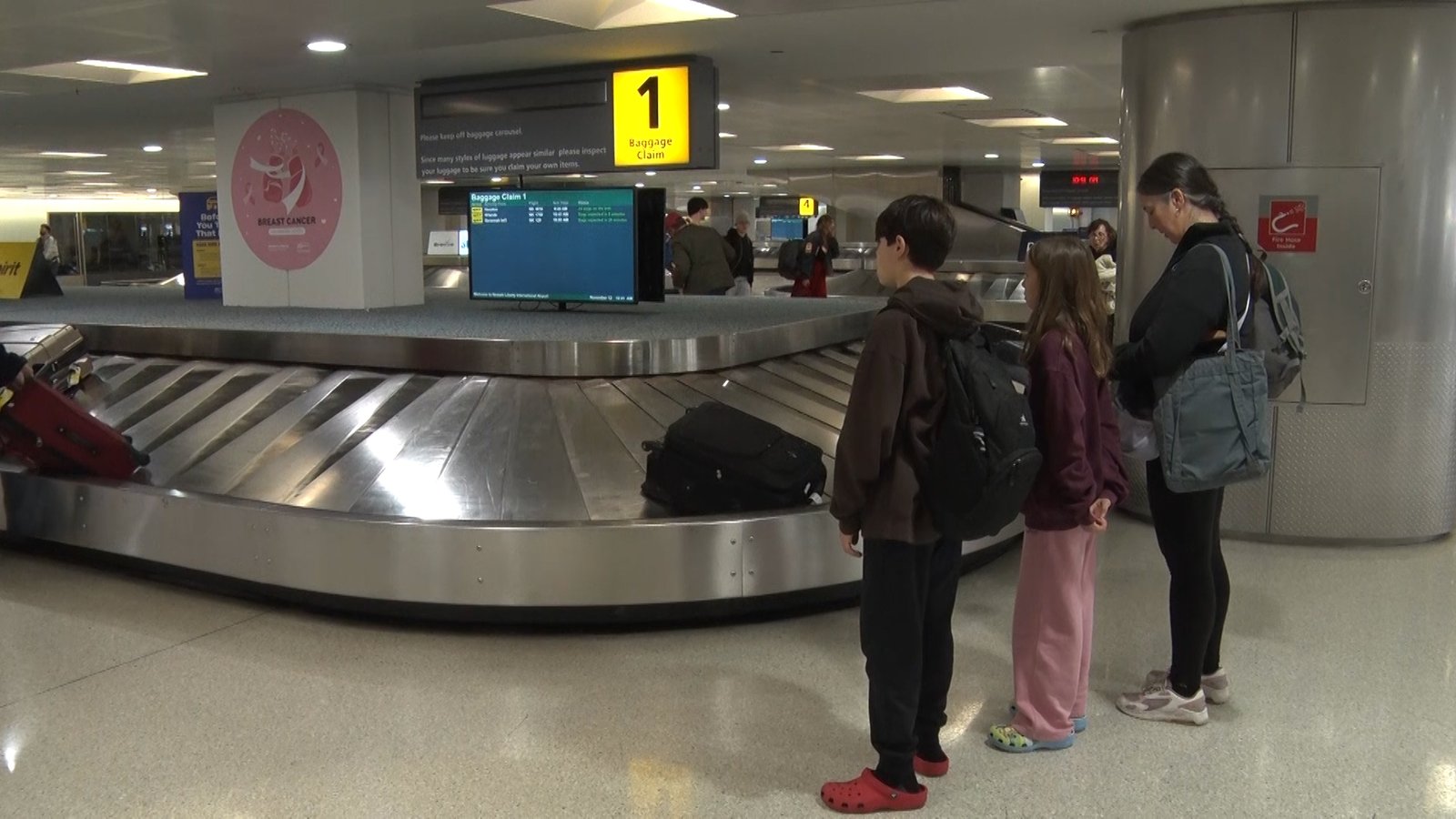
Checking your luggage at an airline counter or bag drop before a flight at Newark Liberty International Airport? Keep an eye on the baggage scales for phantom weight: You could be told to pay extra for more pounds than you packed.
That’s because Newark’s weighing equipment routinely gives unreliable readings for passenger baggage that’s bound for jet cargo holds. During the scales’ most recent tests by New Jersey state regulators, the devices gave inaccurate results 27% of the time, according to a review of data by NJ Spotlight News and NYCity News Service.
No other major New York City area airports’ scales come close to Newark’s rate of wrong readings, public records show. While New York City officials conduct annual weight tests at LaGuardia and JFK airports, the watchdog New Jersey Division of Consumer Affairs hasn’t done an examination since 2023.

Passengers — increasingly pressed for extra fees for seat choices, priority boarding, snacks and other onetime free amenities — have no way to know whether they’ll be socked with surprise charges for bags that in fact are within weight limits. Some airlines charge as much as $200 per bag for excess weight.
“The difference between having a regular bag and an overweight bag can mean a lot of money for consumers who have to pay fees to airlines to carry that baggage,” John Breyault, vice president of public policy for the National Consumers League, told NJ Spotlight News. “That scale can mean real money to the average passenger in Newark.”
Last year, U.S. carriers collected an estimated $5.5 billion in baggage fees, according to the Bureau of Transportation Statistics. This month, American, Delta, United, Alaska and JetBlue announced plans to increase such charges, citing the rising cost of fuel driven by the Iran War.
The Division of Consumer Affairs said its lack of annual tests was due to a staffing issue.
“Providing world-class service to our customers includes ensuring fairness in all commercial transactions,” the Port Authority said in an emailed statement. “We thank DWCP” — the New York City Department of Consumer and Worker Protection — “and the New Jersey State Consumer Affairs for their effort in verifying the accuracy of the airport’s luggage scales. We will continue working with terminal operators and airlines to implement corrective measures as needed.”
One flunked Newark scale, repaired and then reinspected, remained off by as much as 35 pounds, the records show. Another scale didn’t detect 300 pounds, or 350 pounds. Or 400 pounds. Or 500 pounds.
‘Every bag is heavy’
The scale test records make no suggestion of equipment tampering. Aviation experts say the incorrect weights are highly unlikely to raise the risk of unbalanced cargo holds or overtax an aircraft’s fuel supply. And scales that show inaccurate lower weight can work in passengers’ favor if the bags in fact carry more pounds than allowed.
 Credit: (John Mooney/NJ Spotlight News)
Behind every piece of checked luggage, though, are workers who risk their health loading cargo bays and carousels.
“I’m doing the physical therapy, but my back is still not healing,” Iyona Rambert, a baggage handler for three years at Newark, said in an interview. Injured on the job with a bulging disc, she’s been out of work since March 6.
“They got the heavy tags on it,” Rambert said of the pieces she moves. “The purple one — that means extra-heavy. The yellow ones mean heavy as well. Tags don’t even count no more because every bag is heavy.”
More than 140 million passengers fly out of the New York area’s three major airports annually, and roughly one in four checks bags, according to industry data. Most airlines allow 50 pounds per bag, then can charge extra according to what the scales indicate.
At LaGuardia and JFK, inspections are conducted every year by the New York City Department of Consumer and Worker Protection.
In November 2024, inspectors examined 670 scales at JFK. Two scales malfunctioned at Terminal 4, where several airlines take turns using the counters. The faulty equipment was quickly repaired and returned to service, according to a spokesperson for JFK International Air Terminal LLC, which manages Terminal 4.
Of the 209 scales at LaGuardia Airport, all worked properly, the records show.
Those tests showed major improvement from almost two decades ago, when inspectors found 102 scales at the two airports were inaccurate, according to NBC News. In 2011, JFK failed 7% of scale inspections and LaGuardia failed 8%, according to ABC News.
False readings
Newark Liberty’s most recent examination, in October 2023, had a far different outcome. New Jersey Department of Consumer Affairs inspectors failed 105 of 384 scales, or 27%, for giving false readings.
The bulk of problems — 60% — were at Terminal B, the hub for most international flights.
For one exam there, inspectors placed weights on the platform. At the start, with 50-100 pounds, the scale was correct. At 250 pounds, it was off by 8 ounces. At 300 pounds, the scale registered no weight at all, just as it did at 350 pounds, 400 pounds and 500 pounds.
That scale was condemned, which means it was taken out of service. So was another scale, which registered zero at 50 pounds and 500 pounds.
Other scales falsely added weight. A 50-pound test added 8 ounces. At 200 pounds, the scale measured 201. At 500 pounds, the reading was 502.5 pounds. The scale was condemned.
When scales fail tests, inspectors give operators a chance to repair. Even then, they can fail re-inspections. One scale in Terminal C was off by as much as 35 pounds when it was reinspected. It remained condemned.
In all, the agency found 86 scales whose bad readings could lead to overweight luggage fees for consumers — many whose bags, checked on their home scales, had appeared to be under the limit.
Industry experts acknowledge that the airport equipment can go off kilter.
“Three out of 10 scales becoming inaccurate is going to happen from time to time within an airport scale’s lifetime,” said Glenn Zalusky, a vice president at Rice Lake Weighing Systems, a Wisconsin company that makes scales for airports and other industries.
Scales typically weather a lot of use, Zalusky said, and problems can pop up when heavy people stand on them or the equipment is bumped by floor cleaning gear.
After the state’s most recent inspection at Newark Liberty, any malfunctioning scales were repaired and examined again. Seven remained out of compliance.
‘There’s a fee for that’
During a U.S. Senate hearing last year on airline surcharges, U.S. Sen. Richard Blumenthal, a Connecticut Democrat, decried baggage fees.
“If you want to reserve a seat, there’s a fee for that. If you want to change or cancel your reservation, there’s a fee for that. If you want to travel with a bag, there’s a fee for that,” he said. “Two of the five airlines here today generated $25.3 billion in check bag fees over the past six years.”
In an interview, Breyault, from the National Consumers League, said passengers are trapped.
“Unless you’re the kind of passenger who can afford a first class ticket, chances are you’re going to be nickel and dimed at every stage in the process of flying,” he said.
Editor’s note: This story has been corrected to include a response from The Port Authority of New York and New Jersey, which had emailed it to the reporter several months ago. This story was produced in conjunction with the NYCity News Service and with the support of the Equity Through Data Project at the Craig Newmark Graduate School of Journalism at CUNY.



