
 WASHINGTON — From Thursday afternoon into the evening, the House floor sat empty, an eerily similar scene to what played out a day prior, when Republican leaders in the chamber scheduled a vote, scrambled to pass it and then canceled.
Republican leaders, who hold a majority in the House, could not muster the votes to reauthorize a spying law.
Minutes before 9 p.m., after hours of no activity, staff in the office of Katherine Clark, the Democratic whip, emailed a cheeky “non-update” about the chamber’s status, noting the House had been in recess for six hours. After two votes to extend the law failed, the House, a little past 2 a.m. Friday morning, passed a short-term extension for the law — 10 days.
“We were very close tonight,” Speaker Mike Johnson, a Louisiana Republican, said after the vote.
Such is life these days for Johnson, a constitutional attorney and former back-bench lawmaker elected to Congress in 2016, who sets the House’s legislative agenda. During tight votes in the chamber, he’s often found shuttling from one House Republican to another trying to corral the necessary votes for passage.
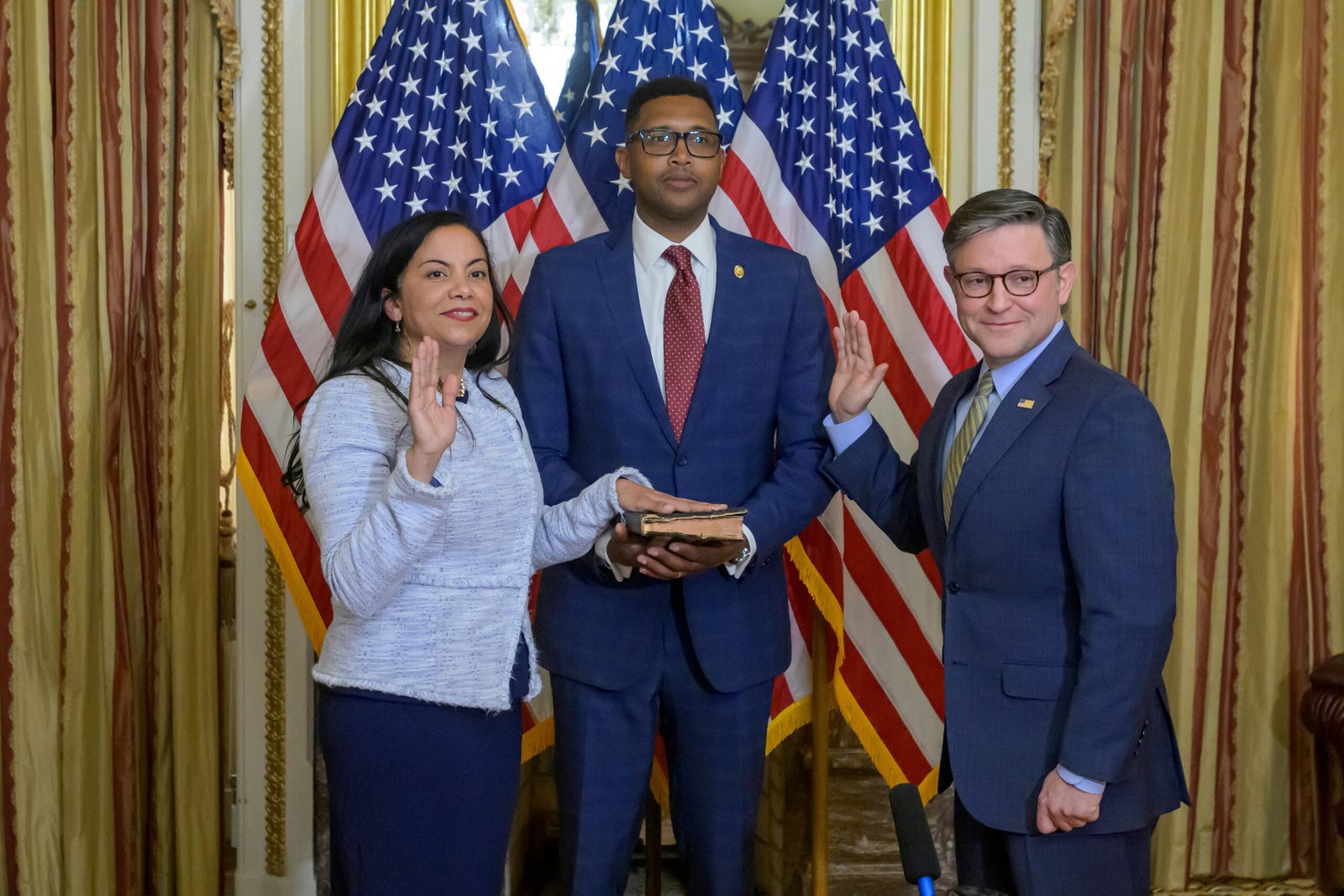
Republicans held a 218-213 majority in the House until Monday night, when Analilia Mejia was sworn into office, bringing Democrats’ ranks to 214.
“It’s just Day One. I’m trying to get my footing,” Mejia said in an interview with NJ Spotlight News after she was sworn in. She took the oath on her late father’s Bible, brought from the Dominican Republic. A staffer placed it gingerly in a plastic zip bag after the ceremony.
Mejia did not say which committees she would serve on.
“I’m concerned about cuts to Medicaid. I’m concerned about health care generally,” Mejia said. “Concerned about the issues that impact folks with fixed incomes.”
Mejia won a special election Thursday to fill the seat that Mikie Sherrill vacated to become New Jersey governor. Now that Mejia is a member, Johnson can lose one member on a vote, if every lawmaker is present and votes. A tied vote fails to pass.

“It’s really close,” Charlie Dent, a former Republican congressman from Pennsylvania, said in a phone interview with NJ Spotlight News. “This is closer than anything in my time,” said Dent, who served in the House from 2005 -2018.
One vote can make a significant difference, said Dent, citing a trade deal the U.S. reached with Central American nations in the mid-2000s. The bill that created that law squeaked through the House: 217-215. More recently, Republicans advanced a budget law last year, by one vote, when Rep. Donald Norcross (D-1st) was hospitalized.
From the 1950s through the early 1990s, Democrats ran comfortably large majorities in the House. But during recent congresses, when both Republicans and Democrats stood a chance at winning control of the House every two years, party politics and identities have shifted, said Matt Glassman, senior fellow at the Government Affairs Institute at Georgetown University.
In a narrowly split House, one member, a pair or a small bloc of lawmakers has power in a way they don’t when the margin is wider. For their votes, members ask for legislative and political help, Glassman said. “They want earmarks, they want their bills to pass, they want committee seats,” he said.
Earmarks — federal money set aside for certain projects — can be particularly useful because, unlike political donations to a House campaign or committee seats, there is not a finite supply, he said.
“Some members may be bold enough to ask like that,” Glassman said, adding that not every member is so politically aggressive. “There’s not a lot of legislative wizardry in the Capitol.”
Ultimately, when a member needs a hard sell, Trump calls them, at times at the request of Republican leadership. “Trump is really the heavy,” Glassman said, not Johnson.
Trump undercut the House by plucking former Republican lawmakers to join his Cabinet: Mike Waltz of Florida became his national security adviser and Matt Gaetz was nominated to be attorney general.
After Republicans complained Trump was eroding their House majority with these picks, the president reversed the nomination of Elise Stefanik, a New York Republican, to be U.S. ambassador to the United Nations.
Trump, speaking in March at a public event, noted Johnson’s difficult path leading the House.
“But he does it as easy as anybody I’ve ever seen do that job. It’s never easy when you have a majority of two or sometimes less.”
With painstaking effort, Johnson and his deputies will tally who is physically present to vote. In the winter, after 80-year-old Indiana Republican Jim Baird was in a car crash, he rushed back to Washington, with a neck brace and fresh bruises, to vote. Other votes this Congress on authorizing the military activities in Venezuela and Iran have come down to a handful of votes.
“You have to whip for votes, but you also have to whip attendance,” Glassman said. “Attendance becomes a problem.”
For example: New Jersey Republican Tom Kean Jr. has not been in attendance since early March, when he last voted in the House, due to a medical issue whose nature hasn’t been disclosed by his staff.
Promotions and nominations to the Trump administration, deaths, two resignations amid sexual abuse allegations have shuffled the House majority, though nothing close to the 72nd Congress (1931-1933), when 14 members-elect died before the House was seated, flipping control of the chamber to Democrats from Republicans.
“People die, people get hurt,” Dent said. “That’s not uncommon.”
The right-most edge of elected Republicans has forced Johnson into head-scratching legislative moves. In early April he and John Thune, the Republican Senate leader, cut a deal to fund the Department of Homeland Security, which has gone without complete funding for months.
It was the same deal Johnson had called a “crap sandwich” a few days prior — a bill to fund the Department of Homeland Security into the fall.
Typically, a speaker would turn to the minority party in the House and reach a bipartisan deal that could become law, Dent said.
“But we’re not living in normal times,” Dent said. “They’re going to have to eat that ‘crap sandwich.’ The House will have to eat it,” he said. “This speaker is afraid of his right flank.”
Early into Mejia’s time in Washington, the House will likely vote on funding for the ongoing war the U.S. and Israel started against Iran, authorization of that war, funding for Homeland Security and a multibillion-dollar mass deportation bill. Plus the bill to reboot the spying law that flummoxed the House last week.
“Everyone that knows me, knows I’m a fighter,” Mejia told an election-night crowd last week at the Montclair Art Museum, as the House sat vacant in Washington. “I did not come to play, my friends.”



