
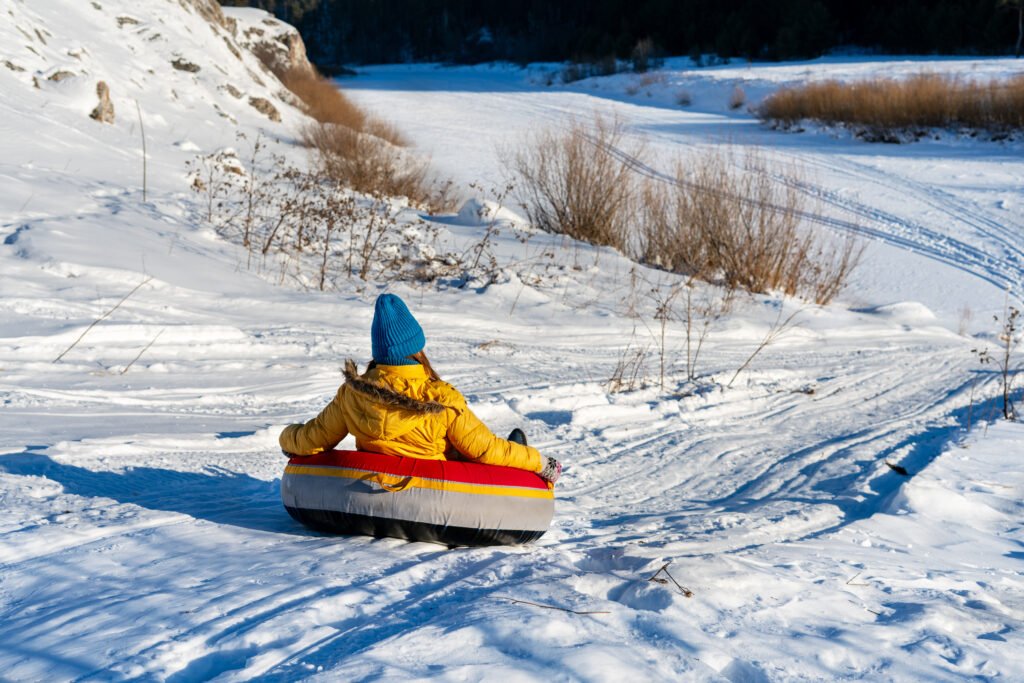
Snow tubing falls under New Jersey’s Ski Act, according to the New Jersey Appellate Division. The law protects ski resort operators from sweeping liability. (Getty Images)
A New Jersey man who went headfirst down a snow tubing lane and landed in court over his injuries has hit a legal wall.
The state Appellate Division ruled Monday that snow tubing falls under New Jersey’s Ski Act, a 1979 law that protects ski resort operators from sweeping liability when injured guests attempt to sue over their injuries. Their decision tosses out Martin McGuinniss’s lawsuit against Campgaw Mountain in Bergen County, where he fractured his collarbone after a rubber deceleration mat bunched up mid-lane and sent him flying off the tube in December 2020.
The panel of three judges determined that the Ski Act includes snow-based recreational activities like toboggans, skis, and sleds. Judge Berdote Byrne wrote in the 23-page decision that “snow tubing fits comfortably into this class of activities.”
When McGuinniss, who was visiting the mountain with his wife and two children, began his final run on the slope, he opted to lie flat on his stomach rather than sitting upright as he had the previous two or three times he went down. He said the mat bunched up, he was moving too fast, and he “kind of catapulted off of it” and landed on his left shoulder.
According to the lawsuit, McGuinniss did not alert anyone about the bunched-up mat, walked away after an employee at the bottom of the hill checked on him, and didn’t speak to any employees about the injury. He sought treatment at a hospital and returned to the mountain the next day — after speaking to a lawyer — to file an incident report.
He filed a six-count complaint against the mountain, the county, and the Campgaw Management LLC alleging negligence, improper upkeep of the equipment, and that defendants violated their duties pursuant to the Ski Act.
The state Legislature passed the Ski Act in 1979, in part spurred by a Vermont Supreme Court decision that year that dramatically expanded ski resort liability after a skier hit a snow-covered tree stump, and sent insurance costs rising across the industry. State lawmakers cited the Vermont ruling directly and warned that they were uncertain over its effect, since only a handful of insurers offered insurance to ski resorts. But the law was meant to draw a line and shield operators from liability for inherent risks of skiing and snow-related activities that are impossible to fully eliminate. A 2003 Law Division ruling extended the law’s protections to snowboarding as well.
A trial court found that the mountain did not have any knowledge of the hazard before McGuinniss was hurt, and resort employees testified that they monitored the hill continuously. And while discovery revealed 45 incidents involving snow tubers and deceleration mats in the two winter seasons before McGuinniss’s crash, no evidence was presented that those incidents involved a mat bunching up.
The state’s Ski Act states that operators are shielded from liability unless they had constructive or actual knowledge of a hazard and the reasonable opportunity to fix it. The appellate court found that Campgaw easily met that standard, as resort employees testified that they continuously monitored the hill.
The trial court sided with McGuinniss, finding the Ski Act inapplicable to snow tubing because it was “fundamentally different” from skiing due to the lack of steering mechanism or ability to control speed. The defendant sought to appeal, which the Appellate Court denied. Campgaw took the case to the New Jersey Supreme Court, which remanded the case back to the Appellate Division.
The court held that once the Ski Act applies, it displaces the common law entirely, leaving the statute as the basis for liability claims against ski operators. The court also noted that the Ski Act’s statement of purpose makes the Legislature’s intent clear, writing that the “sport of skiing and other ski area activities involve risks which must be borne by those who engage in such activities and which are essentially impractical or impossible for the ski area operator to eliminate.”
The decision Monday also notes that while snow tubes lack mechanical features to be steered or braked, riders can control speed and direction by dragging their feet or shifting their weight. The court cited signs posted around the mountain directing people to do that to maintain direction and stability.
“Therefore, the claim that snow tubes are so uncontrollable as to be ‘fundamentally different’ than sleds or toboggans is belied by the facts,” Byrne wrote.
The appeals court ordered the case to be dismissed with prejudice, barring McGuinniss from bringing those claims again.
An attorney for McGuinniss did not respond for comment.
GET THE MORNING HEADLINES.



