
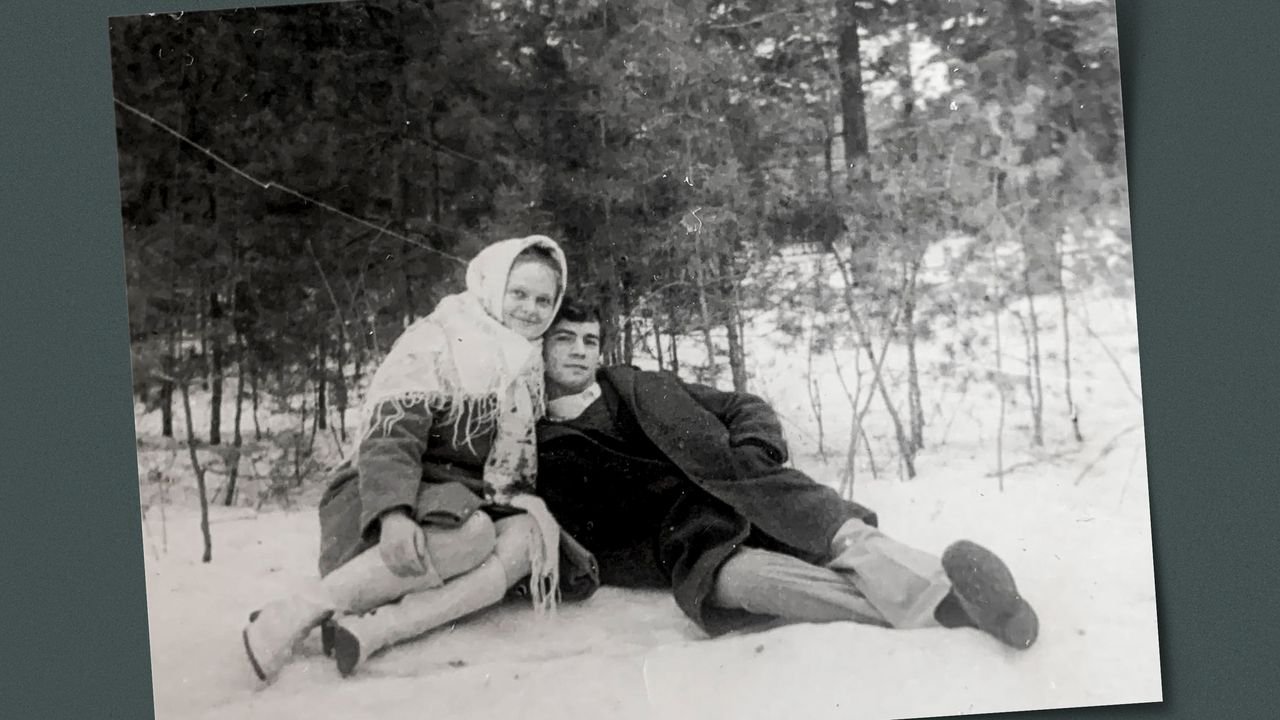
We parked near Nataliia’s former workplace, the water-pump station, which is still in operation. The operator on shift that day, a squarely built fifty-eight-year-old man, with close-cropped gray hair, remembered Nataliia from one of her visits to Valerii’s monument. He was born nine miles away and, though he was forced to evacuate as a teen-ager, he still considered Chernobyl his “fatherland.” He worked ten-day shifts at the station to stay connected to the place where he’d grown up. Across the street, through a thick tangle of forest, the Khodymchuks’ building stood tall and gray in the snow. The willow out front, where the children used to play, was thick and crooked with age. Our guide cautioned us to watch our step as we entered the building. The foundation was crumbling. On the door of a first-floor apartment, a message was written in marker: “We remember you.”
Larysa had said their apartment was just up the stairs and to the left. Serhiy, my photographer and fixer, stopped to study a bank of mailboxes in the stairwell. He saw Valerii’s name— faded but still legible—on apartment 39. We climbed to the second floor. The Khodymchuks’ front door was thrown open. An icy wind blew through the buckled windows. The bright wallpaper that Nataliia and Valerii had hung was sloughing off in layers, green giving way to roses. Broken furniture was piled in a front room. A bouquet of dead flowers, wrapped in plastic and tied with a blue ribbon, rested on the sink in the kitchen.
That night, as we drove through the exclusion zone and back to Kyiv, we passed what remained of Kopachi, the village where Nataliia’s family had lived for generations. The houses, deemed radioactive, had been levelled and buried, along with the apple orchard. Only mounded hills remained. After the accident, Nataliia and her sister had taken a walk to say goodbye to their ancestral land. Strolling across a small bridge, they recalled the chore of wintertime laundry. The stream rushed by, as clear and inviting as the nearby lake that their father forbade them from swimming in. Deep marshes concealed quicksand, he told them. If they stepped in, they’d never be able to leave.
This land, now dotted with Russian mines, is currently inaccessible. After Russia’s invasion and illegal annexation of Crimea, in 2014, Nataliia couldn’t visit her husband’s ceremonial grave, in Mitinskoe Cemetery, in Moscow, either. She’d fought for Valerii to receive a headstone there in 1998, alongside twenty-seven other plant workers and firefighters who had died in the blast or from radiation poisoning. She interred a shirt that Valerii had worn in the days before his last shift. She could never bring herself to wash it, hoping to retain the scent of him.
Larysa and Oleh had accumulated other losses at the hands of Moscow. Oleh had moved from Ukraine to Germany, in part, to give his son, who was then seventeen, a life that wasn’t dictated by Russia’s war. His five-year-old daughter, Valeriia, named after her grandfather, was growing up in a country that wasn’t her own. Meanwhile, Larysa was stuck in Belarus, a country allied with Russia that Nataliia despised and had refused to move to, despite her daughter’s many pleas. “We have now lost everything,” Larysa told me. “We are now in the same state that Mom once was. To lose your home, your native land, that’s like falling from a bridge into a huge abyss with no way back. Now we have no way back either. We had Mom, we had a home, an apartment—somewhere to come back to. Now there is nothing.”



