
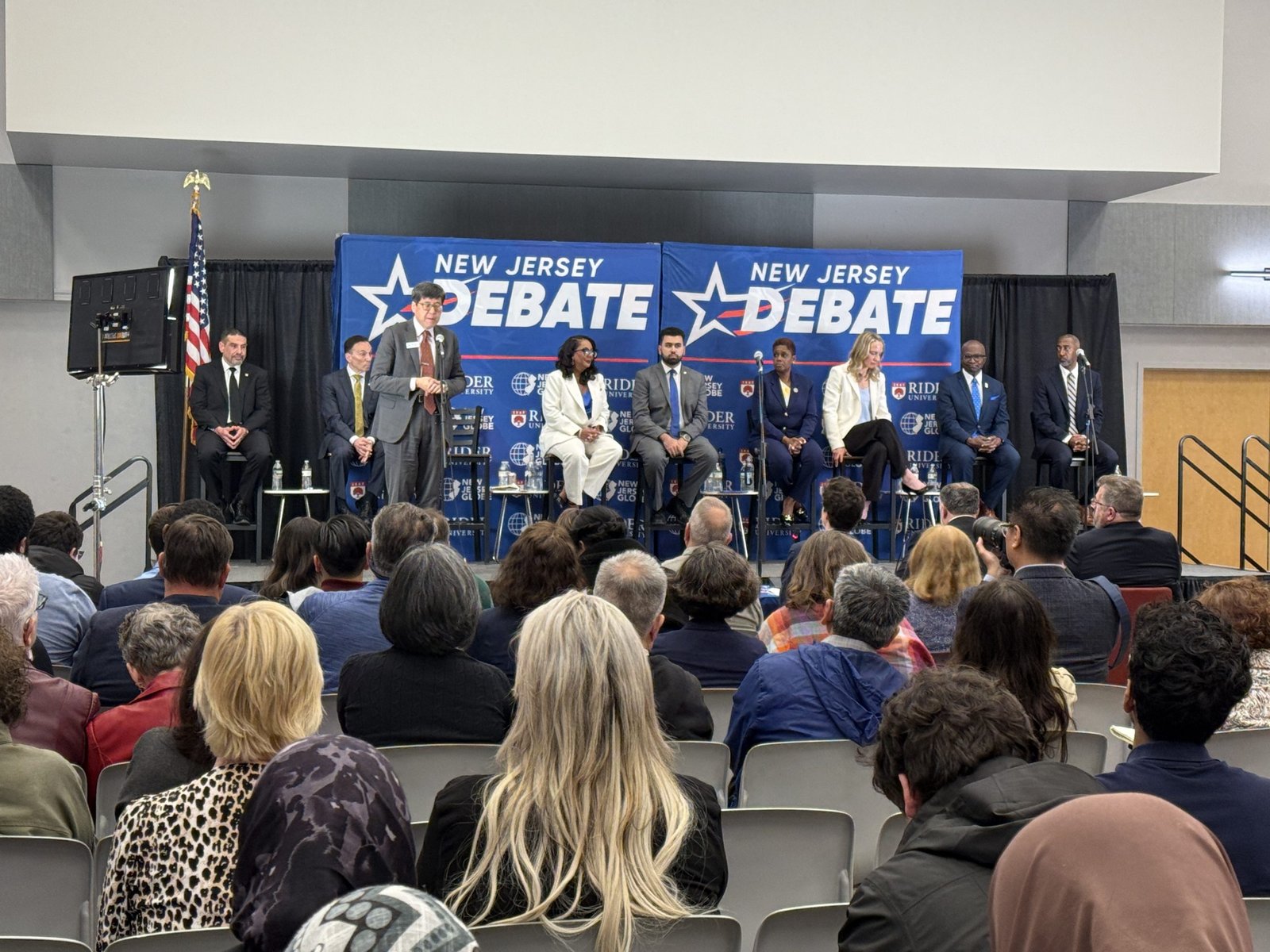
The leading candidates in the 12th congressional district’s Democratic primary met on the debate stage Sunday evening, sharing a vision they hope will distinguish them from a crowded field in the Democratic-controlled district.
The Democrats are looking to succeed Rep. Bonnie Watson Coleman (D-Ewing), the 81-year-old congresswoman who’s served the district for 12 years. Nine candidates met the qualifications for the debate — they must have reached a certain fundraising or endorsement threshold to receive an invitation — and squared off at Rider University in Lawrence.
Like much of the Democratic base, the candidates expressed frustration with the party’s leadership, including Senate Minority Leader Chuck Schumer and House Minority Leader Hakeem Jeffries. Sue Altman, a former state director of the Working Families Party and state director for Senator Andy Kim, said the party needs a clearer vision forward, one that embraces a fight against corporations and billionaires.
“One of the most jarring aspects of the past 18 months has been watching the fact that Democrats do not have an answer for Project 2025,” Altman said. “They came in, and they ran their play, and we seem to have no comparable vision.”
The field largely declined to promise support for Hakeem Jeffries, who would be a leading candidate for the speakership if Democrats gain control of the House. Princeton professor Sam Wang said he would not be “favorable” toward Jeffries’ leadership (he named Rep. Jamie Raskin (D-MD) as a potential replacement), and Somerset County Commissioner Shanel Robinson promised not to support Jeffries as Democratic leader. Adam Hamawy, a former Army combat surgeon who has received the backing of many national progressives, said Democratic leadership is failing to meet the moment.
“We need people who are actually going to stand up and speak against the transgressions that are happening,” Hamawy said. “We don’t need more backroom deals and the same business as usual that we see in Washington that has gotten us to where we are today.”
The candidates also largely agreed to pursue impeachment of Trump, even if the Senate proved unamenable to conviction and removal from office.
“He has done too much harm to the American people, and he has not demonstrated that he is capable of leading this nation,” Plainfield Mayor Adrian Mapp said. “And Democrats have got to have the balls to make sure that they impeach President Trump, and I will vote when I get to Washington to impeach President Trump, regardless of whether or not we have the votes in the Senate.”
Discussions over military aid to Israel — perhaps the sharpest wedge in the campaign thus far — also prompted debate Sunday evening. Assemblywoman Verlina Reynolds-Jackson (D-Trenton) said she supported Israel and turned her criticisms to President Donald Trump and the ongoing war in Iran. Hamawy, an outspoken skeptic of Israel, said the U.S. shouldn’t be supplying weapons to Israel.
“We need to be consistent with our laws and how we treat all countries, and based on our law, we should not be providing any weapons to any country that is not following the rules of international human rights, let alone committing atrocities and genocide,” Hamawy said. “So I am against giving any kind of weapon to Israel or any other country that is not following these rules.”
Jay Vaingankar, a 28-year-old former U.S. Department of Energy official, stirred the debate with criticisms of several of his opponents (he would later launch campaign finance-related attacks on much of the rest of the field). He accused Altman of formerly supporting unconditional aid for Israel while campaigning in the 7th congressional district, Reynolds-Jackson of attending AIPAC conferences, and East Brunswick Mayor Brad Cohen of embracing AIPAC.
“They’ve been careless and oftentimes deliberate in the killing of innocent civilians, and that is why I’ve said it is time to restrict aid to the [Benjamin] Netanyahu regime and directly sanction the genocidal ministers that continue to keep us in this crisis,” Vaingankar said. “You know where I stand. You don’t know where a lot of folks on this stage continue to stand.”
Altman said she supports Israel’s existence, but called Netanyahu a war criminal and said the country can afford to pay for the Iron Dome missile system itself. Cohen said Israel, a U.S. ally, deserves assistance in protecting itself even though he disagrees with its leadership, and Reynolds-Jackson mentioned a trip she took to Israel and said the country had a right to defend itself.
“When we talk about protecting the right for Israel to defend itself, when we talk about the innocent lives that have been lost, I am not afraid to say that I am pro-Israel,” Reynolds-Jackson said. “These are people that deserve to live in peace.”
Reynolds-Jackson touted the John R. Lewis Voter Empowerment Act, a piece of state legislation that would expand services for voters, and said she would push similar legislation in Congress. The assemblywoman repeatedly declared that she would fight against President Donald Trump, whom she criticized for rising prices and worsening conflicts domestically and abroad.
“Everything [Trump] touches is increasing: our utilities costs, our health care costs,” Reynolds-Jackson said. “Our taxes are going up. Everything is back to Trump. I’m sorry, I just can’t help it.”
Cohen said Congress must push to return to the Paris Climate Accords in developing a plan that relies on safe and reusable energy.
“We need to work at innovation and making sure that we continue to innovate in ways that provide a way in which we don’t need to depend on energy that is dirty and environmentally unsafe,” Cohen said.
Robinson, an Air Force veteran, detailed the military service of her family and said the president should be reined in from conducting further wars.
“We have a lawless president, we have a radical Supreme Court, and we have a Congress that has not restored the constitutional order and doesn’t have the backbone to do it,” she said. “We have failed the American people.”
Wang similarly argued that Congress should reclaim control over the political process and protect the country’s “soft power” that comes in the form of research and international relations.
“Congress has the ability to start restoring some of that soft power,” he said. “Congress has the ability to legislate to make sure that we build greatness in our American institutions … and rebuild our relationships with NATO and other organizations. We need to work with our allies and start rebuilding those soft-power alliances that were a true source of American freedom.”
Most of the candidates said they were willing to increase taxes on the wealthiest residents of the 12th district. Squire Servance, an attorney and member of the Rutgers University Board of Trustees, said he would push for an expansion of the state and local tax deduction, which allows taxpayers to deduct up to $40,000 in state and local taxes from their federal taxes.
“We’re getting taxed twice, from the state and from the federal government, and we can and should do better,” Servance said. “I think the [SALT] cap needs to be increased so that we can provide some benefits to the people in middle-class families in this country.”
Thirteen Democrats are seeking the nomination in the 12th, and the New Jersey Globe invited nine. To qualify, candidates must have raised at least $250,000 through March 31, or received endorsements of at least five people from the following categories: current county chairs, statewide elected officials, state legislators, countywide elected officials, and mayors, all from within the 12th district or representing a part of the district.
New Jersey Globe editor David Wildstein moderated the debate, and Micah Rasmussen, the director of the Rebovich Institute, and Joey Fox, the New Jersey Globe’s Washington reporter, served as panelists. The New Jersey Globe and Rider University co-sponsored the debate.
You can watch the debate here.



