
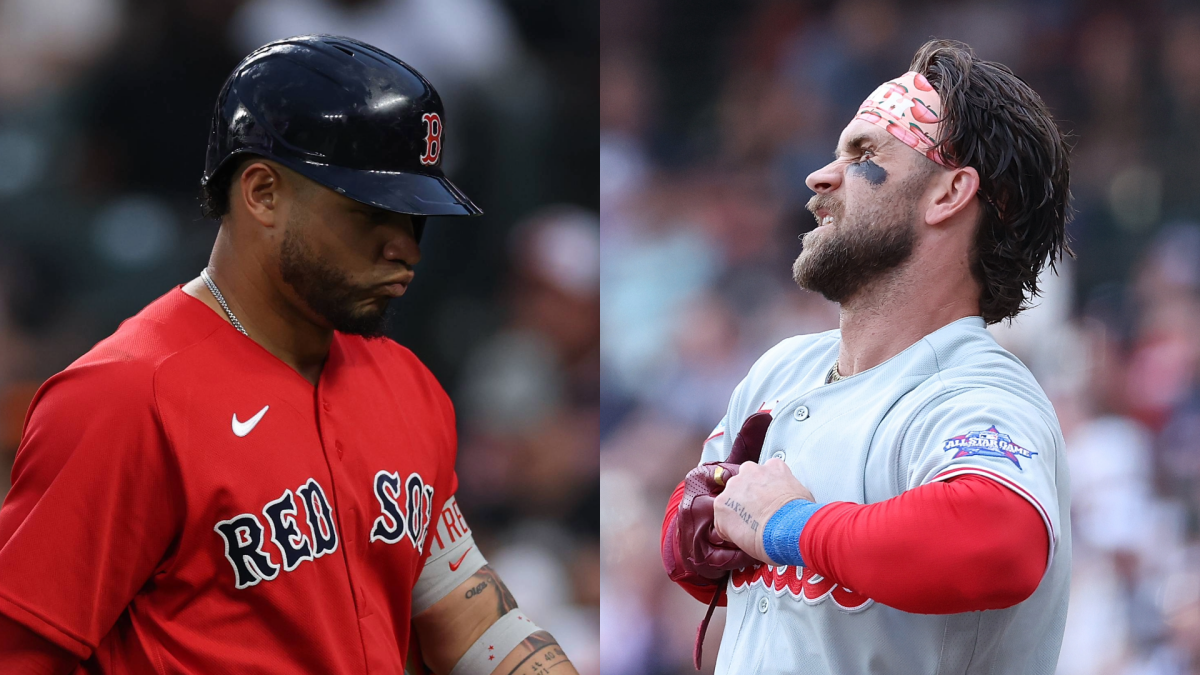
After 19 losses in their first 28 games, the Philadelphia Phillies have made a change in manager. Rob Thomson was fired Tuesday morning and replaced by bench coach Don Mattingly, who was named the interim through the end of the 2026 season. Thomson had been the club’s manager since replacing Joe Girardi in June 2022. He led the team to the NL pennant that same year.
The manager always deserves some share of the blame when a team starts this poorly, though Thomson is not the reason the Phillies are 10 games under .500 for the first time since 2017. The Phillies are dead last in defensive runs saved. Alec Bohm and Bryson Stott have a combined .468 OPS and minus-0.2 WAR. Starters other than Cristopher Sánchez have a 6.73 ERA.
Here is the run differential leaderboard a month into the season:
1. Los Angeles Dodgers: +68
2. Atlanta Braves: +65
3. New York Yankees: +49
…
29. New York Mets: -30
30. Philadelphia Phillies: -54
The Phillies are last and not by a little either. They have roster construction issues more than they had a Rob Thomson issue, but you can’t fire the players, so the manager gets the axe instead. That is the way it has been for decades and the way it will continue to be for decades more. The Phillies will hope for an in-season turnaround under Mattingly similar to what they did under Thomson in 2022.
Philadelphia is the second underperforming team to fire its manager in less than a week. The similarly disappointing Boston Red Sox canned Alex Cora and most of his coaching staff this past weekend. The Red Sox have won three straight games, which includes their final game under Cora, though they remain in the AL East cellar at 12-17. Mets manager Carlos Mendoza could be next to go.
There is a long way to go in a long season, but the Phillies have done real damage to their postseason odds. Per FanGraphs, they had 68.8% postseason odds on Opening Day. They’re down to 32.6% today. The Red Sox are in a similar boat: their postseason odds have dipped from 60.8% on Opening Day to 39.1% today. These two clubs have to dig themselves out of a pretty big hole.
Fortunately, the third wild-card spot is very forgiving, and there are still five months to play. The Phillies and Red Sox do need to start stacking wins, though, and soon. Which team has a better chance to right the ship and return to the postseason? Let’s dive in.
Boston’s lack of power is a major problem
Even after winning three straight games, including scoring 17 runs on Sunday, the Red Sox have hit 20 home runs in 29 games, the third fewest in baseball. They’re slugging .356 as a team. Boston has several underperforming players, yes, but power was a question coming into the season and it still is. They have to string together hits and walks to scratch out a run.
The Phillies rank 17th in baseball with 30 home runs. They haven’t exactly banged the ball around the yard themselves, but you can reasonably assume an offense led by Bryce Harper and Kyle Schwarber will hit a lot of home runs over the course of 162 games. You can’t do that with an offense featuring Wilyer Abreu and Willson Contreras as its top two power threats.
It has never been harder to hit in baseball history. Pitchers are too nasty and defenses are too good. Offenses that rely on a long sequence like Boston have always had a ceiling, and that is especially true in 2026. The Phillies can put points on the board with one swing several times a night. The Red Sox’s lack of power will continue to hold the team back.
The Phillies just got Wheeler back
He did not look like peak 2021-25 Zack Wheeler, but the two-time Cy Young runner-up was solid in his return from thoracic outlet syndrome surgery this past weekend. Also, he’s replacing Taijuan Walker, who had a 9.13 ERA before being released. The bar is on the floor. Wheeler could be a league-average starter the rest of the season and that would qualify as a major upgrade over Walker.
The Red Sox will get Sonny Gray back from his hamstring issue soon, maybe Kutter Crawford or Johan Oviedo at some point as well, though I’m not sure any have a chance to be as impactful the rest of the way as Wheeler. Even Gray, at this point in his career, is more of a high-end No. 3 starter than someone who fronts a contender’s rotation.
If anything, Boston’s big rotation addition will be top prospect Payton Tolle, who struck out 11 Yankees in six innings in his season debut last week. I have a hard time seeing how the Red Sox can keep Tolle out of the rotation. Brayan Bello has allowed eight homers and 24 runs in 22 innings this year. He should be the odd man out when Gray comes back.
It shouldn’t be difficult for Wheeler to be an upgrade (and a big one) over Walker. The same applies to Tolle and Bello. I guess the difference is we know Wheeler will be in Philadelphia’s rotation. Bello is three years into a six-year, $55 million extension. Money has a way of keeping players on the roster even when their performance says they belong in Triple-A.
Philadelphia has the schedule advantage
It is sort of silly to talk about the remaining schedule only a month into the season, but when you’re 9-19 and have baseball’s worst record, you take whatever positives you can get. Per FanGraphs, the Phillies have a .499 remaining opponent’s winning percentage at the moment. That number is based on projections, not simply each team’s record to date.
Only 10 teams have a lower mark than Philadelphia’s .499, and four of the 10 reside in the AL Central. The Red Sox, meanwhile, have a .505 remaining opponent’s winning percentage, fourth highest in baseball. They’ll have to contend with some pretty good teams in their own division, better than most of what the Phillies have to deal with in the NL East.
Boston has the league advantage
By that, I mean it may take fewer wins to secure the third wild-card spot in the American League than it will in the National League. The Phillies will have to compete with the San Diego Padres (or the Dodgers if the Padres manage to win the NL West), maybe the Arizona Diamondbacks, and at least the second- and maybe the third-place team in the NL Central, plus any NL East teams that make noise.
In the AL, the Red Sox really just have to compete with their AL East competitors. The chances that the AL Central and AL West both send multiple teams to the postseason are pretty small. The Red Sox have to compete with their division rivals for a wild-card spot and that means they get to take matters into their own hands with head-to-head games. That’s a big advantage.
I don’t feel great about either the Phillies or Red Sox turning their seasons around and reaching the postseason. Boston’s lack of power is a big problem, as is its underperforming pitchers. The Phillies have an awful defense and too many players playing to something close to the worst-case scenario. On paper, the schedule favors Philadelphia, but does that really matter in April?



