
An attorney representing Gov. Ron DeSantis said Tuesday that the proposed congressional redistricting map he presented Monday to the Legislature is constitutional because federal law supersedes language in the 2010 Fair District Amendments.
DeSantis’ new map is likely to add as many as four Republican congressional seats to the 20 out of 28 that they now hold in Florida. DeSantis only began speaking about redistricting after President Donald Trump last year called on red states to change their congressional maps to aid Republicans in the 2026 midterm elections.
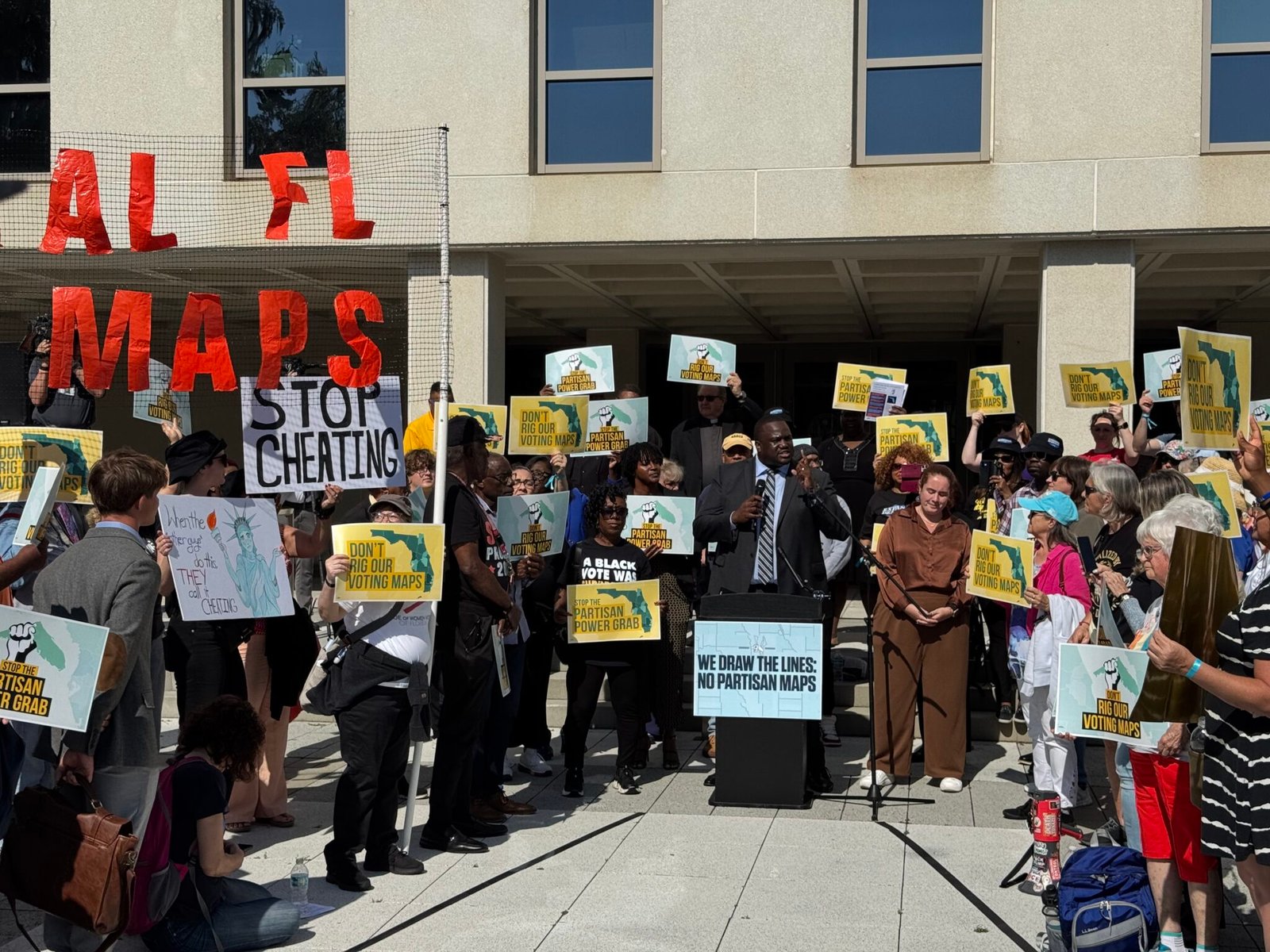
That’s prompted Democrats to allege that this is a clear gerrymander, a violation of a provision of Fair Districts that says “no district shall be drawn with the intent to favor or disfavor a political party or an incumbent.”
However, the governor’s office insists another part of Fair Districts is unconstitutional and is the reason he doesn’t need to abide by it. That provision says that “districts shall not be drawn with the result or intent of denying or abridging the equal opportunity of racial or language minorities to participate in the political process or to diminish their ability to elect representatives of their choice.”
Attorneys for DeSantis say that language violates the 14th Amendment of the U.S. Constitution and that the Florida Supreme Court indicated agreement with that position when it approved the governor’s 2022 redistricting map last year.
They maintain the race-based requirements of the FDA “cannot be severed” from the other parts of the 2010 Constitutional amendments, like the provision banning partisan gerrymandering.
“The PDA was sold to the voters as a package. There was no severability provision included in the FDA when it was presented to the voters. And because one part is unconstitutional, there’s limited reason to think that voters could have approved the remaining parts by themselves,” wrote DeSantis attorney David Axelman in a letter accompanying the new map sent to state lawmakers on Monday.
The map (HB 1D) passed the House Select Committee on Congressional Redistricting by a party-line vote. The Senate Rules Committee also passed their (SB 8-D) on Tuesday, with three Republicans (Senators Jennifer Bradley, Ileana Garcia and Erin Grall) joining NPA Senator Jason Pizzo and all of the Democrats to vote against it.
The map goes to the floor in both chambers on Wednesday.
Florida Supreme Court precedent
“In the recent Black Voters Matters decision, the Florida Supreme Court recognized that complying with the Florida Constitution is not a compelling enough reason to use race,” attorney Mohammed Jazil told the House Select Committee on Congressional Redistricting.
“Now, if you can’t point to the Florida Constitution as a basis to use race, then what effect if any should the race-based provisions of Article III, Section 20, have? And it’s the governor’s position that they should have no effect.”
In its written decision in the case known as Black Voters Matter Capacity Building Institute v. Secretary, Florida Department of State, last summer, there was this passage, written by then Chief Justice Carlos Muñiz, hinting how the court could rule on the Fair District Amendments:
“Finally, we conclude by emphasizing that the defendants have not asked us to decide whether every district intentionally drawn to comply with this Court’s interpretation of the Non-Diminishment Clause [of minority voting strength] is necessarily race-predominant and therefore subject to strict scrutiny, even if the district satisfies the [Fair Districts Amendments] race-neutral standards. That issue can wait for another day.”
DeSantis and the GOP-controlled Legislature believes that day is now.
DeSantis and Republican legislative leaders have denied they are doing the mid-decade redistricting because of pressure from the White House to keep the House of Representatives red. They say it’s a combination of accounting for greater population growth since the 2020 Census that was not fully captured in the 2022 redistricting process as well as ensuring the state has a race-neutral congressional plan.
‘Race neutral’
Jason Poreda is a senior analyst in the DeSantis administration and author of the congressional map now before the Legislature. He testified he used updated data from the state’s Office of Economic and Demographic Research and the American Community Survey as well as the 2020 Census numbers to draw the map.
He insisted he drew it in a “race neutral” way. However, in the Senate Rules Committee on Monday, he acknowledged that “partisan or electoral performance data was considered, but certainly not at the exclusion of all of the other standards.”
If the Legislature approves the map, four Democrats’ chances of re-elected would be imperiled if they stay in their existing districts: Kathy Castor in the Tampa Bay area; Darren Soto in Central Florida; and Debbie Wasserman Schultz and Jared Moskowitz in South Florida.
Castor’s district, for example, shifts 18 points from the 2024 election, according to Matt Isbell, a data analyst for Democratic campaigns. Going by the results of the 2024 president election in their respective congressional districts:
- Castor’s District 14 seat goes from +7.6% Kamala Harris to Trump +10.5%.
- Soto’s seat goes from +3.5% Harris to Trump +17.7%.
- Moskowitz’ District 23 moves from +1.9% Harris to +13.8% Trump.
- Wasserman Schultz’ goes from +5.3% Harris to +9.1% Trump.
Motivation
Speaking with reporters earlier in the day, House Speaker Daniel Perez rejected the contention that the real purpose for the special session is to do Trump’s bidding.
“That would be the easy headline and that is what people want to write about. That is not the position that we’re in,” Perez said.
“The governor drew a map. And it is our job to entertain that map. To debate it. To converse it. And to eventually vote on it. That is what this body is going to do.
“And everyone in this chamber is going to have an opportunity to ask questions, to have debate, and eventually, to vote, either in favor or in opposition to the map. That is what we are going to do over the next couple of days.”
Overriding the voters
Floridians approved the Fair District Amendments in 2010 by 63%, yet it appears that the Republican-controlled Legislature is ready to accept the DeSantis administration’s arguments that they are now unconstitutional. When asked whether the DeSantis map, which would blow up the ban on partisan gerrymandering, should also now go to the voters, Fort Myers Republican Rep. Jenna Persons-Mulicka dismissed the notion.
“Our process does not require maps to go before the voters,” she said. “We are following the process. This is the same process we went through in 2022, when the governor presented a map to the Legislature. We took it up. We reviewed it. We took it through subcommittee. We will take it to the floor. This is the process. It goes through the bill process, and then it can be challenged in the legal court system.”
Note that the governor vetoed the initial congressional redistricting map passed by Florida lawmakers in 2022, which would have moved the state from a 16-11 Republican-over-Democratic advantage to an 18-10 Republican map (Florida earned an extra seat through reapportionment in the 2020 Census).
DeSantis then produced a new map that gave Republicans their 20-8 advantage that was legally challenged by voting-rights groups but upheld by the Florida Supreme Court last year.
While undoubtedly litigation will ensue presuming DeSantis signs the legislation enacting his map, some observers doubt the Florida Supreme Court would overturn the governor, since he appointed six of the seven justices.
‘They can read the Constitution’
Florida Democratic Party Chair Nikki Fried said Tuesday that, as a practicing attorney for 25 years, she still believes the justices “may have been appointed in a partisan lens, but they can read the Constitution like every first-year law student.
“It is black and white that these maps cannot be drawn on partisan levels. And that is exactly what Ron DeSantis did, and he has admitted to it. So it’s not like we have to even play that argument and making sure, well, was it partisan? Was it not? It is clear on its face,” she said.
“So, the question is whether this Florida Supreme Court will live up to their oath of office that they took, not only on admission into the Florida Bar but as their judicial oath of office to uphold the Florida and U.S. Constitution, and that will be on them and whether or not they believe in the rule of law.”
The process
When asked how he designed the maps, Paredo said he started by going south and redrawing Congressional District 20, encompassing parts of Broward and Palm Beach counties.
The DeSantis administration has previously contended that is a minority-opportunity district drawn to comply with Section 2 of the 1965 Voting Rights Act (VRA), written to protect minority voting rights. Paredo said that redrawing that district required to him to alter how the other districts in South Florida had to be reconfigured.
That produced a ripple effect up to Central Florida, he said. The districts in North Florida would not be significantly changed.
For months, DeSantis maintained the state would be “forced” to do a new congressional map because of an expected ruling from the U.S. Supreme Court in the Louisiana v. Callais case regarding Section 2 of the VRA. The case centers on whether a newly created majority Black district was legally mandated by the VRA or if it violated the 14th Amendment by prioritizing race.
However, the justices haven’t ruled on that case yet. When asked whether the new congressional map conforms to the VRA, Jazil acknowledged that he didn’t know whether “it still performs for African Americans.”
Dissent
More than 100 people signed up to speak out against the proposed map in the House committee.
Fernandina Beach resident Chadd Charland, a political independent running in the Florida House District 15 seat this year, blasted the Legislature for rolling over and failing in its responsibility to draw the map itself instead of relying on the governor to do so.
“This is subjugation without representation,” he said. “Race neutral? Try race neutralized, perhaps. The map effectively neutralizes minority voters. Forty-one percent of Florida voters are registered Republicans. The governor’s new map gives 86% of Florida’s congressional representation to Republicans. Forty-one does not equal 86, and you should 86 this map.”
Amy Keith, executive director of Common Cause Florida, told the committee it would be okay to reject DeSantis map.
“The people of Florida made partisan gerrymandering illegal when we passed the Fair Districts Amendment in 2010. The people of Florida across party affiliation in poll after poll after poll have made it clear that they continue to oppose this partisan mid-decade redistricting effort,” she said.
“The people of Florida deserve not to have their districts changed at the last minute before a midterm election. They deserve an opportunity to know their districts, the people voting with them, and the people vying to represent them.”
In the Senate Rules Committee, Karen Woodall of the Florida Center for Fiscal and Economic Policy noted that she has participated in four previous redistricting efforts, and said none of them faced less public scrutiny than the one moving through the Legislature this week.
“In 1982, there were 24 public hearings around the state,” she said. “In 1992, there were 32. In 2010, there were 26, and in 2020, there was a web portal created for constituents.
“Throughout all of that, there were multiple meetings with more testimony and the evolvement of you guys, the elected officials, the legislators. I have never heard of one person drawing a map with absolutely no impact.”
Orlando Rep. Bruce Antone, the ranking Democrat on the House Committee on Redistricting, said nothing he had heard during the three hours of testimony had caused him to believe there was any reason to redistrict.
“Nothing felt right” about the process, he said, noting that DeSantis leaked a color-coded map showing the red and blue parts of the state directly to Fox News on Monday, an hour before he sent it to the Legislature.
Rep. Johanna Lopez, D-Orlando, complained the map would deny Black and Hispanic Floridians their power to elect candidates of their choice, another violation of Fair Districts. As noted by Isbell in his analysis, the new plan cracks the region now held by Rep. Soto, which is heavily Puerto Rican, into “four or five different congressional districts.
With additional reporting from Christine Sexton.
Independent Journalism for All
As a nonprofit newsroom, our articles are free for everyone to access. Readers like you make that possible. Can you help sustain our watchdog reporting today?



