
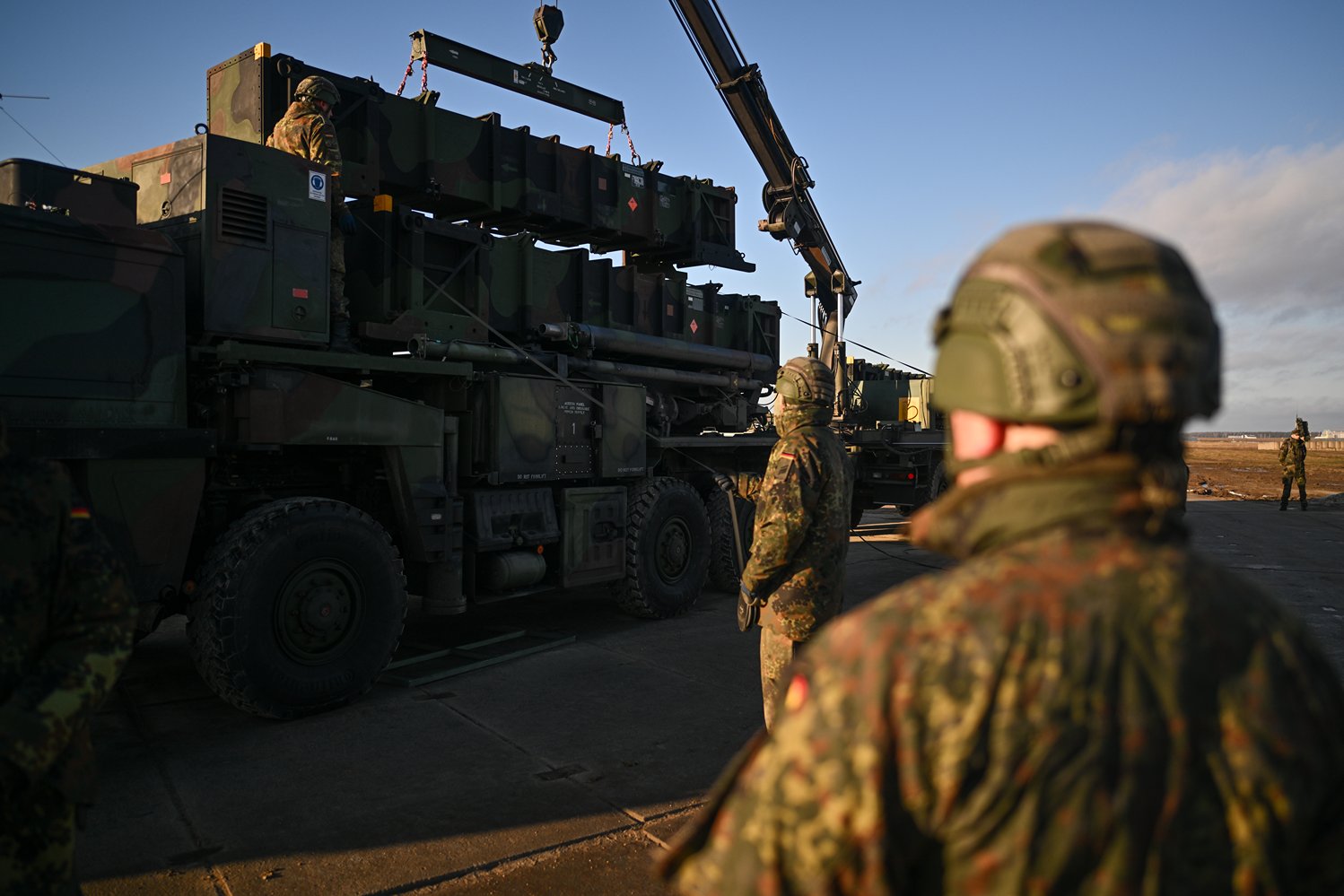
Estonia is some way from the Persian Gulf. Even so, it has vocally supported U.S. President Donald Trump’s war against Iran. That has done it no good, despite Trump’s railing against NATO allies for not joining his attack on Tehran: This month, the United States canceled military deliveries to the Baltic nation because it needed the weapons for the Iran war. Other allies are encountering similar delays. The United States has the legal right to suspend weapons deliveries—but such suspensions will hardly encourage nations to buy American.One has to feel for Hanno Pevkur. Estonia’s defense minister has his plate more than full building up his country’s armed forces and worrying about the future of NATO. Remember that Estonia is one of the alliance’s most committed members, painfully aware of Russia’s imperial ambitions, constantly volunteering for assignments and spending 5.4 percent of its GDP on defense. Imagine, therefore, Pevkur’s distress when, on April 20, he received a phone call from U.S. Defense Secretary Pete Hegseth. The United States was pausing deliveries of ammunition for HIMARS launchers and Javelin anti-tank systems until the war’s end at least, Hegseth confirmed to his Estonian counterpart.
“We were already aware that the U.S. had put all outgoing ammunition shipments on hold,” Pevkur told Estonia’s public broadcaster ERR after the call. “Rather, our question and discussion with Pete Hegseth concerned what the future prospects might be for resuming ammunition deliveries, and if those deliveries were to remain suspended for a very long time, then what alternative options there might be for increasing defense capabilities with production from the United States.”
Estonia is some way from the Persian Gulf. Even so, it has vocally supported U.S. President Donald Trump’s war against Iran. That has done it no good, despite Trump’s railing against NATO allies for not joining his attack on Tehran: This month, the United States canceled military deliveries to the Baltic nation because it needed the weapons for the Iran war. Other allies are encountering similar delays. The United States has the legal right to suspend weapons deliveries—but such suspensions will hardly encourage nations to buy American.One has to feel for Hanno Pevkur. Estonia’s defense minister has his plate more than full building up his country’s armed forces and worrying about the future of NATO. Remember that Estonia is one of the alliance’s most committed members, painfully aware of Russia’s imperial ambitions, constantly volunteering for assignments and spending 5.4 percent of its GDP on defense. Imagine, therefore, Pevkur’s distress when, on April 20, he received a phone call from U.S. Defense Secretary Pete Hegseth. The United States was pausing deliveries of ammunition for HIMARS launchers and Javelin anti-tank systems until the war’s end at least, Hegseth confirmed to his Estonian counterpart.
“We were already aware that the U.S. had put all outgoing ammunition shipments on hold,” Pevkur told Estonia’s public broadcaster ERR after the call. “Rather, our question and discussion with Pete Hegseth concerned what the future prospects might be for resuming ammunition deliveries, and if those deliveries were to remain suspended for a very long time, then what alternative options there might be for increasing defense capabilities with production from the United States.”
Estonia’s considerable investment in its own defense includes buying a whole lot of weapons from the United States. Many other U.S. allies similarly spend large chunks of their defense budgets on U.S.-made weaponry: The kit is good, and—crucially—buying it secures U.S. friendship. When Russia launched its full-scale invasion of Ukraine in 2022, Estonia placed yet another order for six HIMARS launchers.
Now Hegseth has told Pevkur that Estonia will have to wait for the munitions it ordered. The United States needs the ammo for its war against Iran. “It is not known when the deliveries will start again, but Pevkur said this pause would ‘certainly last longer than weeks, more likely months,’” ERR reported. “The initial understanding is that this is on hold for as long as the war in Iran continues,” the minister told the broadcaster. That may be a long time; the U.S. military is burning through its munitions stockpiles at a rate faster than anyone seems to have expected—to a degree that’s even endangering its ability to react elsewhere.
Other friends, allies, and partners of the United States are experiencing similar postponements of ammo, missiles, defense systems, and more. Last September, Switzerland got so irate that the Patriot missiles it had ordered were several years late that it stopped paying for them. (The United States responded by moving funds that Switzerland had paid for yet-to-be-delivered F-35s to cover the Patriots, Swiss public broadcaster SRF reported in March.) And last summer, the United States halted deliveries of Patriots and other weapons to Ukraine “to put America’s interests first following a DoD [Department of Defense] review,” as a White House statement explained.
America’s massive foreign military sales (FMS) system, an industry worth more than $100 billion per year, does allow the Pentagon to claim military equipment ordered and paid for by other countries if the United States needs the weapons itself. Such buyers simply have to wait longer to receive their weaponry, and ordinarily that has not been a huge problem because there has been no massive urgency. Now, though, the situation is indisputably urgent. Europe is rearming and is dutifully doing so by buying a lot of kit from the United States.
Between 2016-20 and 2021-25, European countries increased their weapons purchases from the United States by more than 200 percent, the Stockholm International Peace Research Institute reports. Today, the United States sells more weapons to Europe than to any other region.
The assumption had been that such orders would result not just in weapons deliveries but also in U.S. friendship. The latter seems to be on the rocks, and if the weapons don’t arrive on schedule, that’s a real problem.
“It’s highly frustrating because European countries have been trying to boost defense procurement because of the war in Ukraine, and this is the latest challenge they’ve had in trying to speed up procurement processes,” said retired Gen. Jarmo Lindberg, a former Finnish defense chief who is now a member of the Finnish Parliament. “First, you have to get the money, and if you get a huge chunk of money fast, then the problem becomes how to quickly provide a comprehensive operational capabilities and procurement plan. After that, you need the experienced personnel to run the actual procurement process. The challenge and the long pole in the tent are the most sophisticated offensive and defensive systems, of which many are of U.S. origin, and that means lengthy foreign disclosure policy and FMS processes [in the United States]. Nobody wants any additional delays in that process, but that’s what is now happening.”
That makes the current delays especially frustrating. “For the European countries that already had active U.S. weapons procurement processes, this means months or years of delays in a situation where they are trying to prepare for a probable peace deal in Ukraine and potential Russian actions after a possible peace,” Lindberg said. Such actions are likely to involve aggression, gray-zone or otherwise, against Russia’s western neighbors.
Buying American has become a fraught option. “The logical conclusion of the delays is that European countries will need to review their entire defense supply chains,” said retired Rear Adm. Thomas Engevall, a former chief of staff at the Swedish Defence Materiel Administration. “Longer contracts in particular will become more difficult, and they’re the strategic ones. Sweden, for example, has also bought Patriots. What do the current suspensions mean for those deliveries?”
Estonia has to find a solution to its suspended ammo delivery pronto; the situation regarding HIMARS is particularly acute. Pevkur told ERR that the country will ask the United States for permission to buy ammo elsewhere. Fortunately, the Estonians are not completely without options.
“We decided around three years ago that we should diversify our defense imports of products like ammo to also import from places like South Korea and Israel, which has turned out to be a wise decision,” said retired Gen. Riho Terras, a former Estonian defense chief who is now a member of the European Parliament. “The effect of the delays is that countries won’t buy as much from the United States as they used to. They will buy from others, and today there are other countries you can import from. We’ll always buy from the United States, since it’s a political decision. But Turkey, for example, is a country we can import more from, too.”
Even if U.S. allies in Europe and elsewhere wanted to end all weapons imports from the United States (and they do not), doing so would be impossible. The United States is, after all, the world’s largest arms exporter by far. But as Terras points out, importers will try to reduce their exposure to disruptions, suspensions, and similar headaches. “We’ll continue buying from the United States, but what is likely to happen is that the orders will primarily involve items that can be delivered quickly,” Engevall said. That would mean smaller and less sophisticated items.
Nations that have something the United States wants—for example, cutting-edge weaponry made in their own countries—are more likely to be able to fend off U.S. delays. Indeed, a new defense landscape may develop where Europe’s large weapons manufacturing nations can bargain with the United States if it wants to postpone deliveries, while nations with no such manufacturing power will have no leverage.
“Sweden, Germany, France, Britain, and Italy have an advantage compared to other European countries,” Engevall said. But the prospect of having to bargain assertively is troubling to begin with. It’s no wonder homegrown weapons are looking more attractive—as well as weapons from countries as diverse as Turkey and South Korea.



