
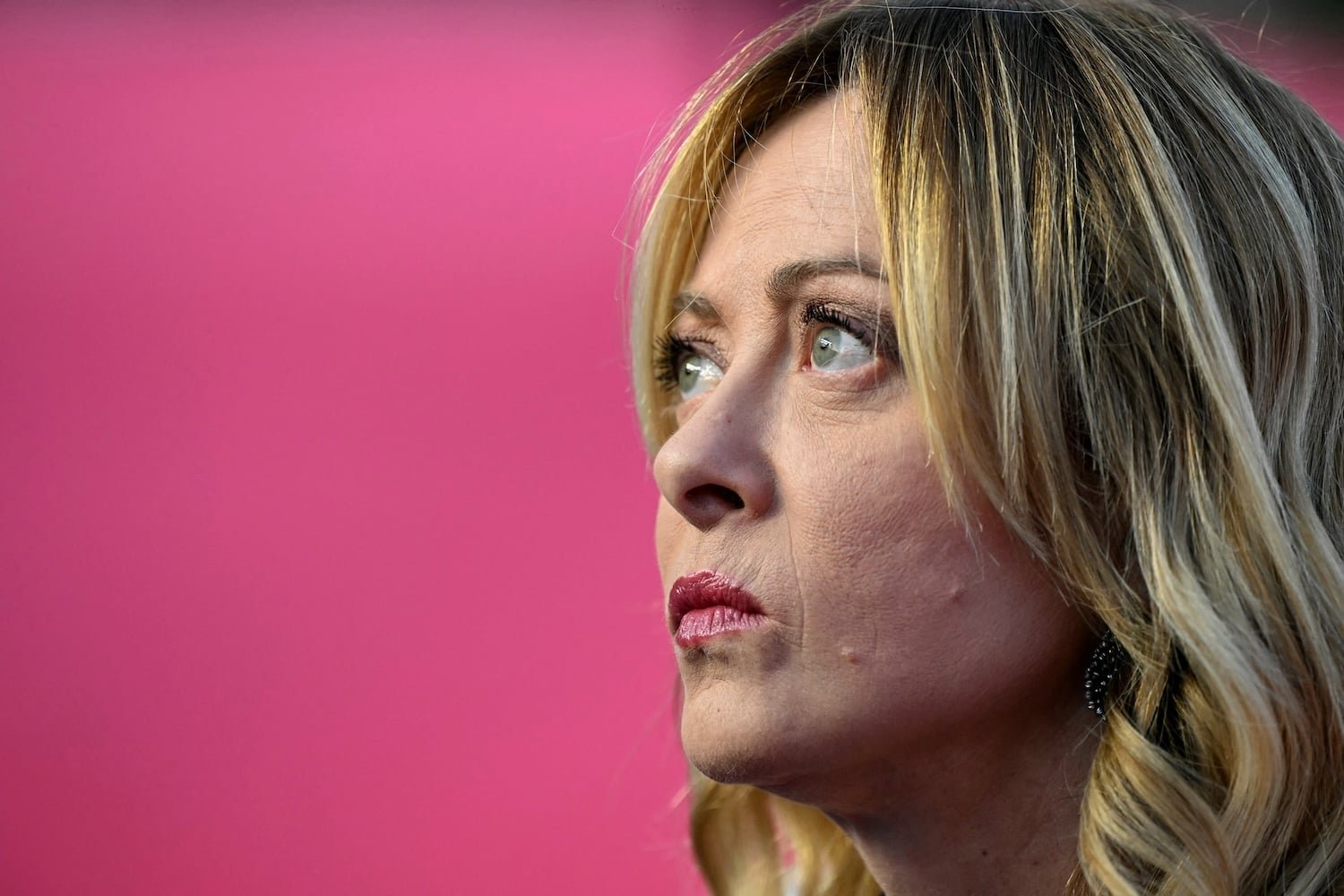
When Italian Prime Minister Giorgia Meloni swept to power in 2022, countries across the world watched her victory with interest—and apprehension, in some cases—to determine whether her government would pose a threat to Italian democracy and lead to a populist resurgence in Europe.
Meloni’s Brothers of Italy party, which traces its roots to Italian post-fascist movements, won on an anti-immigration, nationalist, and Euroskeptic platform. At her inaugural speech in parliament, Meloni pledged to take bold decisions to free up “the best energies of this nation,” even if that entailed clashing with Italian or international elites. She promised to reform the country’s bureaucracy and simplify its legal system, while ushering in a “Copernican revolution” that would establish a new Italian fiscal compact.
But more than three years after Meloni took office, these goals haven’t translated into tangible achievements, critics say.
Compared to other far-right, populist leaders such as Hungarian Prime Minister Viktor Orban and Argentine President Javier Milei, Meloni chose a less confrontational approach both domestically and internationally, threading a fine line between her nationalist agenda and pragmatic governance. However, the equilibrium she strived to maintain has resulted in economic and social reforms that are far from incisive, defining her leadership more by restraint rather than the renewal she once promised.
So far, Meloni’s government has enjoyed unusual stability by Italian standards; in early September, her administration will become the longest-lived since World War II. Most polls still show that she is Italy’s most popular political leader after President Sergio Mattarella.
“Her government has been prudent,” said Lorenzo Pregliasco, a founder of YouTrend, an opinion polling and political communications firm in Turin. “She avoided promoting radical interventions and, in doing so, she accepted not touching the vested interest of many categories … with the underlying idea that the less you do, the fewer people you disappoint.”
Many analysts say that Meloni’s strength lies in a dual identity rooted in pragmatism alongside nationalistic and Christian values. This has allowed her to convey an image of control domestically—where she commands a solid majority in parliament, in coalition with the centrist party Forza Italia and the nativist League—and internationally, where she has maintained a strong pro-West approach.
Yet the winds seem to be changing. On March 23, Meloni’s government suffered a harsh defeat in a constitutional referendum on a judiciary reform at the center of her legislative program. Given the referendum’s technical content, its timing a month into the Iran war, and Meloni’s frequent media appearances to rally support, the vote turned into a popularity test. For the first time since she took office, Meloni began to appear vulnerable.
Then, on April 12, voters ousted Orban, who steadily eroded Hungary’s democratic institutions and European relationships over the course of his 16-year reign. Meloni had endorsed Orban in a video with a host of other right-wing leaders, such as Germany’s Alice Weidel of the Alternative for Germany party, France’s Marine Le Pen of the National Rally, and Spain’s Santiago Abascal of Vox.
A few days later, U.S. President Donald Trump scolded Meloni in an interview, exasperated by her refusal to support the U.S.-Israeli war on Iran. And on April 21, Meloni was forced to accept changes to a contested migrant repatriation bill following pressure from Italy’s presidency.
Meloni seems to have quickly lost much of the glitter once attached to her name. On April 9, in her first major speech in parliament after the referendum defeat, she defended her track record by pointing to her government’s achievements, despite the economic and geopolitical constraints that it faced as a result of the post-COVID recovery process that she inherited as well as the war in Ukraine.
She listed a raft of measures approved by her government, including small tax cuts and the simplification of Italy’s notoriously cumbersome tax system, increased police hiring, higher jail terms for certain crimes, a raise in minimum pensions, and strides against illegal immigration. But she also acknowledged the need for increased progress.
“We know the situation is better now than when we took office, but we also know we need to succeed in doing more and better, and we will do so because we are used to rolling up our sleeves,” she told lawmakers.
Marina Cino Pagliarello, a research fellow at the European University Institute in Florence and a senior visiting fellow at the London School of Economics, said that Meloni “hasn’t been able to change the country’s trajectory,” pointing to the prime minister’s mixed record on the economy as Exhibit A.
Italy’s GDP grew 4.8 percent the year that Meloni took office, largely due to the rebound from the contraction suffered due to the COVID-19 pandemic and measures taken by the previous governments. But growth rates declined considerably to 0.9 percent in 2023, 0.8 percent in 2024, and 0.5 percent last year—in contrast with other southern European economies that were hard-hit by the pandemic, such as Spain and Greece, which experienced GDP growth of more than 2 percent annually during the same years.
Maurizio Tarquini, the director-general of Italian business lobby Confindustria, criticized Meloni’s latest budget, approved by parliament in December, for prioritizing stability over growth. He said the country’s economy wouldn’t have recorded its meager growth without investments financed by European post-pandemic recovery funds, of which Italy is the largest recipient.
Italian real wages are still lower than they were in the first quarter of 2021, before the post-pandemic inflation surge, while labor productivity has declined since its 2023 post-pandemic peak. However, Italy’s unemployment rate has reached its lowest level in 20 years, at 5.1 percent as of January, dropping from 8 percent since Meloni took office. Employment rates have remained mostly stable over the same period.
But Italy’s economic conditions are now worsening due to energy shocks caused by the Iran war. On April 22, Economy Minister Giancarlo Giorgetti announced that Italy had cut its economic growth outlook and hiked forecasts for the budget deficit and public debt.
“In domestic politics, Meloni used identitarian politics to consolidate support, but she hasn’t used her political capital to begin to enact structural reforms,” Cino Pagliarello said. “She has been skillful in shaping perception, much less in inducing change.”
An approach balancing nationalism and pragmatism is also visible in Meloni’s pledge to curb irregular migration. Her nationalist policies include expanding detention centers and curtailing humanitarian protection in Italy, as well as listing countries such as Egypt, Tunisia, and Senegal as “safe” even though, for example, homosexuality remains criminalized in all three countries, among other restrictive laws. Meloni also promised to crack down on migrant traffickers and establish a naval blockade to protect Italy’s coasts, neither of which have happened.
On the more pragmatic side, however, she did convince the European Union in 2023 to grant financial aid to the Tunisian government to prevent migrants from crossing the Mediterranean to Italian coasts. That helped reduce the arrivals of irregular migrants to 67,000 and 66,000 in 2024 and 2025, respectively, down from nearly 158,000 in 2023. (Regular migration increased in 2023 and 2024, primarily due to the arrival of Ukrainian asylum-seekers.)
“A nationalist government that has been successful when it received help from the European Union: This is no small contradiction,” said Giovanni Orsina, a history professor at Luiss University in Rome.
Meloni’s innovative plan to establish centers in Albania to process asylum-seekers has been blocked on multiple occasions by national courts and, so far, appears to be a legal and financial fiasco. However, Orsina said that Meloni’s message has still had an impact on the EU, which recently approved tougher asylum rules for irregular migrants.
Because they are seen as an innovative way of deterring irregular arrivals, detention centers such as those planned for Albania “are seen with favor by other European countries,” Orsina said. “They eliminate a pull factor, meaning that migrants know that if they are rescued at sea, they won’t be taken to Italy and then move freely on European soil.”
But apart from immigration, Orsina, who personally knows Meloni, said that she has so far failed to “leave a mark” on the country.
Another key feature of Meloni’s foreign policy has been forming a close relationship with U.S. President Donald Trump—with whom she shares ideological affinities—while convincing European leaders that she is a reformed Euroskeptic. In carefully positioning herself as the closest mainstream European leader to Trump, she boosted her credentials as a potential bridge between the new U.S. administration and Europe.
But the widening gulf between the United States and Europe has made her job increasingly harder, and her warmth toward Trump has backfired at home. Pollsters cite Trump’s unpopularity—as a result of his tariffs, Greenland aspirations, stance on Israel’s war in Gaza, and the war in Iran—as one of the reasons that Meloni lost the constitutional referendum.
Although the prime minister’s once-positive relationship with Trump may have granted her increased international visibility at the beginning of her tenure, some critics argue that Meloni’s investment in Trump’s friendship has had few benefits. Last year, her government successfully persuaded Washington not to impose heavy tariffs on Italian pasta. She also won Trump’s approval for a prisoner swap that freed an Italian journalist held in Iran in exchange for an Iranian businessman wanted by the United States. Beyond that, there is little else to show.
After several attempts to distance herself from Trump, including by branding his attacks on Pope Leo unacceptable, the U.S. president took notice.
“I’m shocked by her,” he told Italian newspaper Corriere della Sera. “I thought she had courage. I was wrong.”
Meloni’s political vulnerability is galvanizing the opposition, which has so far been fragmented and incapable of building an appealing and coherent counternarrative.
“Meloni has dominated less through strength than through the weakness of others,” Cino Pagliarello said.
In an attempt to capitalize on Meloni’s rising weakness, center-left opposition parties have begun talks about organizing a primary election to name a coalition leader prior to the 2027 parliamentary elections. Many argue that such a coalition should work on a shared political program and election strategy prior to naming a leader, a debate still ongoing on the left.
While Meloni remains more popular than opposition leaders, recent events “leave her facing a more challenging final year of her term and will heighten concerns about the coalition’s electoral performance next year,” said Federico Santi, a senior analyst at Eurasia Group. Adding to her troubles, Italy’s budget deficit of 3.1 percent of its GDP last year limits the prime minister’s spending leeway ahead of the 2027 election.
Meloni’s centralization of power, emotional leadership, and highly personal narrative have projected an image of solidity. Her risk-aversion and cultivated balance between nationalism and institutional pragmatism have given Italy an unusually stable government—but these traits may also have made her a far less effective leader than she set out to be.



