
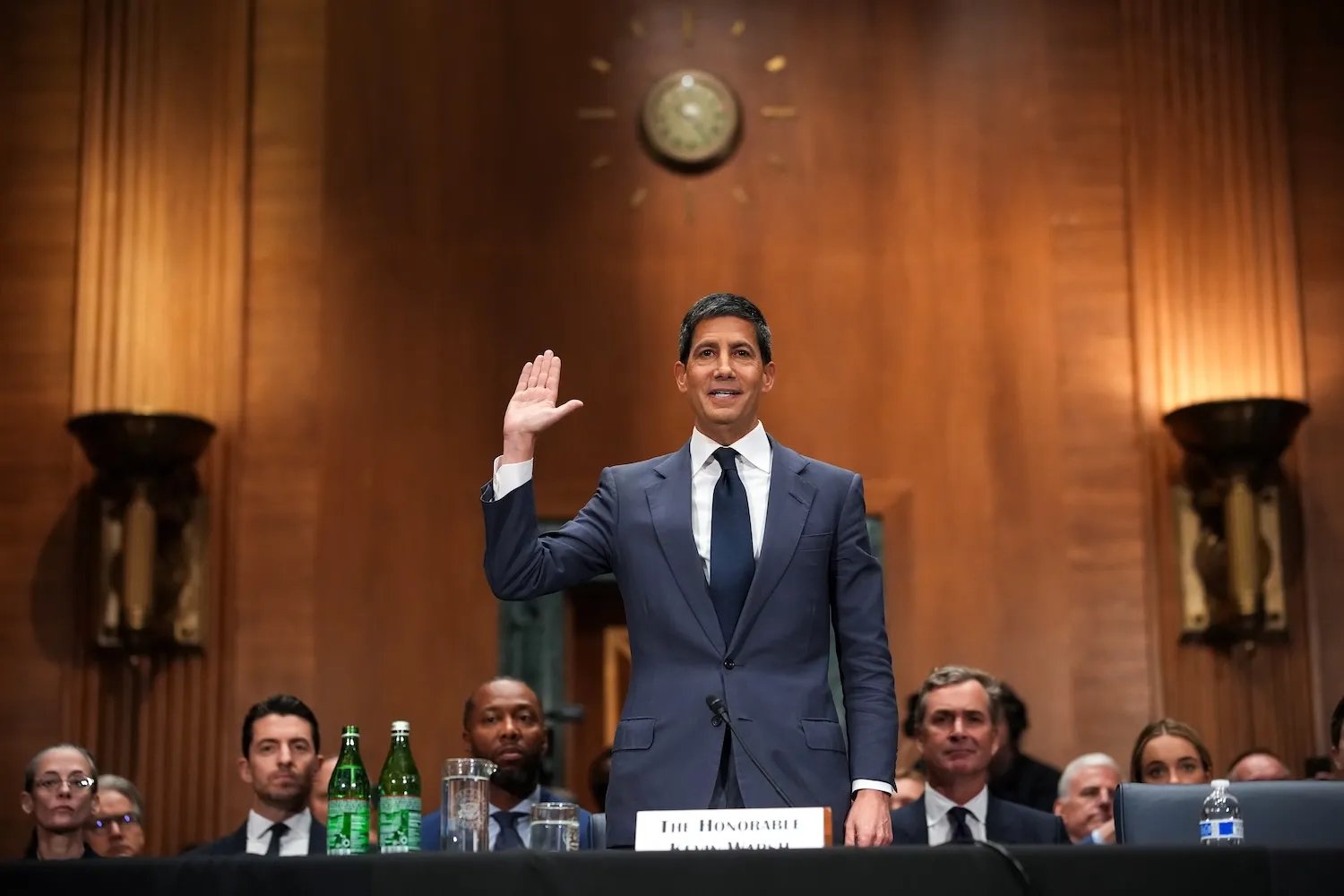
Kevin Warsh, the presumptive next chairman of the Federal Reserve, has devoted his professional life to opposing expansive monetary policies. But Warsh’s instincts seem to conflict with the preferences of U.S. President Donald Trump, who nominated him for his new role. Warsh’s pending promotion thus raises questions about what happens when an inflation hawk takes the chair under a president demanding rate cuts.
How has Warsh’s biography shaped his economic views? How might Warsh’s communication strategies affect financial markets? What does Warsh mean when he says the Fed should “stay in its lane”?
Those are just a few of the questions that came up in my recent conversation with FP economics columnist Adam Tooze on the podcast we co-host, Ones and Tooze. What follows is an excerpt, edited for length and clarity. For the full conversation, look for Ones and Tooze wherever you get your podcasts. And check out Adam’s Substack newsletter.
Cameron Abadi: How might Warsh’s biography have shaped his views on monetary economics?
Adam Tooze: Warsh is a symptomatic figure. He’s not a central banker in the mode of a Ben Bernanke or Janet Yellen. In other words, a heavy-duty econ technocrat, nerd, monetary policy or monetary economics star. He’s a smooth, very well-connected Republican insider, and he’s a lawyer. So he’s more in the Jerome Powell kind of vein.
He was born in 1970, so he is younger than me. He attended Stanford and Harvard Law, which in itself may be telling. He then moved to Morgan Stanley. And then with the Bush presidency in 2002, he was appointed as special assistant to the president for economic policy and then executive secretary to the National Economic Council. I think he was too young at that point to have a commanding role. At least at that stage, the Republicans weren’t appointing people of his age to, say, the senior roles. But in those positions, he played a key role in sorting out some of the accounting scandals of the early 2000s.
But then in January 2006, Bush nominated Warsh to serve on the Federal Reserve Board of Governors. And at that moment, he was the youngest ever Fed governor when he was appointed. And between 2006 and 2011, he was really the kind of markets liaison, the markets fixer man for Ben Bernanke, because he was in the thick of the 2008 financial crisis, and his experience at Morgan Stanley was widely considered to be important.
And at this point, a sort of doctrinal Warsh begins to emerge, which is a man who is preoccupied essentially with private sector solutions, with problems of moral hazard, and therefore is entangled in all of the difficult and, in many cases, disastrous decisions that were taken by the Fed in 2008, the first initial move, namely to stabilize the situation by way of a private sector deal between JP Morgan absorbing Bear Stearns. And then it seems that Warsh was reluctant, to say the very least, to support Lehman, with catastrophic consequences when Lehman actually then failed.
And in 08-09, he was responsible for brokering the deals that were done that recapitalized the American banking system, which are in some sense by many people regarded both as, of course, dubious from a social equity point of view or from a Democrat accountability point of view, but highly effective in terms of actually recapitalizing the American banking system. That’s in contrast with what happened or rather didn’t happen in Europe, where the European banks were not recapitalized.
He was then, however, passed over in 2009 for the New York Fed chair position, which went to [William] Dudley, who came from Goldman Sachs and was more of an economist. And then progressively, he falls out of favor with Bernanke, and through the 2010s begins to circulate outside the Fed, in private finance and in conservative intellectual circles centered on the Hoover Institution at Stanford. And it’s against that backdrop that he was then nominated. He is more and more prominent, really, in conservative conversations in the 2020s, and so it’s no surprise really that he emerged as a pick for Trump.
It’s not unfair to speculate that this isn’t purely a professional choice on Trump’s part. I mean, Trump is willful and typically personalistic in his choices. He famously picked Jerome Powell over Janet Yellen because he just didn’t think a small, nerdy woman was suitable as a Fed chair. And he thought Jerome Powell, and I’m just quoting here, looked the part. He came out of central casting. And this is something he said about Warsh as well.
It no doubt helps that Warsh, through marriage, is connected to the core of the Trump New York clique. So he is the son-in-law of Ronald Lauder. That is Estee Lauder, that fortune. And Lauder is, after all, one of the people that we think may be pushing the crazy Trump moves on Greenland, because apparently Lauder has some interest there.
So it’s not for nothing that Sen. Elizabeth Warren—in the hearings that were quite rough for Warsh—referred to him as the president’s sock puppet in monetary policy. So, he’s a man with relevant experience, with a track record, with opinions, with political connections, and with family money and the family connections that seem de rigueur in this day and age in Republican politics.
CA: One thing Warsh has talked about wanting to change is the Fed’s communication policies when it comes to offering what’s known as forward guidance to markets. And even more specifically, he’s talked about wanting to end what’s called the dot plot. What might the effect of that be? Have markets become dependent on how the Fed has communicated until now—and could removing that be even more disruptive than the problems he’s criticizing?
AT: Yeah, so this is another phase in what you might call the post-classical Fed, if you think of the modern Fed as having been created by the Volcker shock of 1979. And under Volcker and [Alan] Greenspan and Bernanke, a certain style of Fed policy having been instituted, which was interest rate-driven, relatively arm’s length, then we have the crisis of 2008, the immediate bailout, QE2. And then as part of QE2 in this package in the 2010s to try to manage this new relationship produced by the huge expansion of the Treasury’s balance sheet in Treasuries and other sorts of fixed income, this adoption of forward guidance as a key mechanism.
And this is one of these weirdly subtle mechanisms that economists end up focusing on—it’s very counterintuitive since we think of economists as being to do with the real world. In fact, they operate at the level of expectations more often than not, because given a rational choice model, how do actors, how the economic actors decide what to do? They hinge their choices in the here and now on expectations of the future.
And those expectations are very powerful in changing the choices we make in the here and now. And as far as the bond markets are concerned, the key thing is, what do you expect the future trajectory of Fed policy to be with regard to interest rates? Or rather, what do we expect future interest rates to be?
And so then, to kind of wind this all up into an extraordinary self-reflexive spiral, in 2012, the Ben Bernanke Fed started adopting this routine habit of the members of the Federal Open Market Committee publishing their own personal forecast of where they expected interest rates to be. Which of course, they have a degree of choice in influencing, they have votes on this. So it’s a strange combination of forecasts of the future of the economy plus, implicitly, forecasts on the voting balance of the body of which they themselves are part. It’s a strange, typically claustrophobic self-referential kind of feature of the world of the 2010s.
And I think Warsh positions himself as the sort of sound, properly conservative figure and says, “Well, this is crazy, this is a kind of hall of mirrors, this is a funhouse.” And one reply is, “Well, okay, if the Fed isn’t going to do this kind of thing, then it’s going to make choices behind closed doors. Is it?” And so then, you know, skeptics in the market ask, “Well, is it going to become more opaque?”
And there is a worry, I think, that somebody like Warsh, who’s not a technical economist—who didn’t grow up optimizing dynamic general equilibrium models, ultimately thinks of himself as a sort of exponent of a kind of market wisdom—will in the end be making decisions by the seat of his pants. And it’ll be a matter of market mood on the one hand or ultra short-run data for pricing, which is really just a ramped up version of the technocracy that we’ve already got, but dressed up in conservative garb.
CA: I suppose all of this falls under a more general mantra that Warsh has had when it comes to the Fed— “stay in your lane” being the proviso to the institution. What does “stay in your lane” really come down to, in essence? I mean, is this a principled position about Fed credibility—or does this bear on the more general questions of credibility that have been raised in the context of Trump’s pressure campaign on the Fed? Is there even a kind of credibility paradox at work right now, where anyone nominated by Trump by definition kind of lacks credibility by virtue of accepting the nomination from someone who clearly does not intend to respect the institution’s independence?
AT: Yeah, I mean, I think there are three possible ways of situating this whole independence issue with regard to Warsh. The first is like the classic 1990s economists’ argument for independence, which is actually based on complicated arguments that began in the 1970s about discretionary and nondiscretionary economic policy. And I think he squarely doesn’t belong in that. That’s not his bag. That’s not where he’s coming from.
I think then there is this issue of the paradox that you’re alluding to of anyone who has any connection with Trump is by virtue of that connection discredited as a representative of any kind of serious institutionalism.
But I think a third reading would be to say that the Trump administration is a coalition of different forces. And of course, to hold that coalition together, politics is necessary. And one of the forces in the Trump coalition, which we systematically underestimated, is the kind of sharpened Bannonite wing, which is waging a very serious campaign of rollback against the American administrative state. This isn’t the DOGE, you know, slashing things. This is much deeper, and it’s not Elon Musk, who doesn’t really understand much about government, but it’s American lawyers—conservative lawyers, of which Warsh is one—who have been waging a fairly sustained and principled campaign against the development of the administrative state, which they date to the early 20th century and [President] Woodrow Wilson and the first democratic administration of the 20th century. And hey, presto, who was it that brought the Fed into being but Woodrow Wilson in 1913.
And then when you get into the details of his positioning, it gets even more clear-cut, right? Because his argument about the Fed is less to do with financial regulation than the sort of points you’re mentioning, than the way in which the Fed and central banks generally from the 2010s onward found themselves pressured, including by people like me, to take on a much wider agenda of economic policy more generally.
And so there are three things that he singles out in the co-authored Hoover publication from 2022, which are the tentative engagement of central banks with climate change; the tentative engagement of the Jerome Powell Fed with the question of racial inequality in unemployment; and then the highly technical conversation, which was about average inflation targeting rather than point inflation targeting. And all three instances of this—and you could add as a fourth element his long-standing critique going back to the 2010s: a very large-scale balance sheet expansion and the purchases of Treasuries.
So it’s this lurching segue, right, from very conventional 1990s central bank independence discourse to free speech on campus debates and diversity of opinion discourse that we’re very familiar with in the last four or five years in the U.S. And the “Chicago principles” are literally a reference to the leadership of the University of Chicago, which adopted this position, which was widely seen on the right as a model of anti-woke university governance, where the university declared that it wasn’t in the business necessarily of making safe spaces, that they would tolerate a high level of viewpoint diversity, is the phrase, on campus.
And what Warsh is doing is creating a kind of analogy between the struggles over university governance and the governance of the Fed. And I believe that may be the first time in the Fed’s history that that kind of connection has been made live in the way that he’s doing.
CA: Yeah, I suppose this raises the question of how, you know, Trump’s desire for lower interest rates will fit into this culture war. What is the argument cloaked in this technical language for cheaper money at the president’s behest?
AT: He’s quite boxed in by this kind of dual positioning. But I do think it’s an interesting test case for the coherence of the Trump coalition, because this is the language that is being pushed consistently in the struggle over the administrative state. And the cynic might simply say, “Well, in the end, what this boils down to is license for an alliance between an inflationist populist president and a bond market that frankly just likes to be juiced.” There aren’t really that many votes in Wall Street for austere monetary policy. This is this conservative fallacy that business actually wants a tough governmental hand. It’s not true. It doesn’t add up.
It could just be kind of a hands-off position, but it’s going to be interesting. I mean, he will have to, after all, persuade other board members. And he has the reputation that he does. He’s young, he’s a conservative political toy, he’s a sock puppet, he doesn’t have the technocratic weight of a Bernanke or a Yellen, and he doesn’t have the gravitas and the political heft of a Powell, let alone a Volcker or a Greenspan.



