
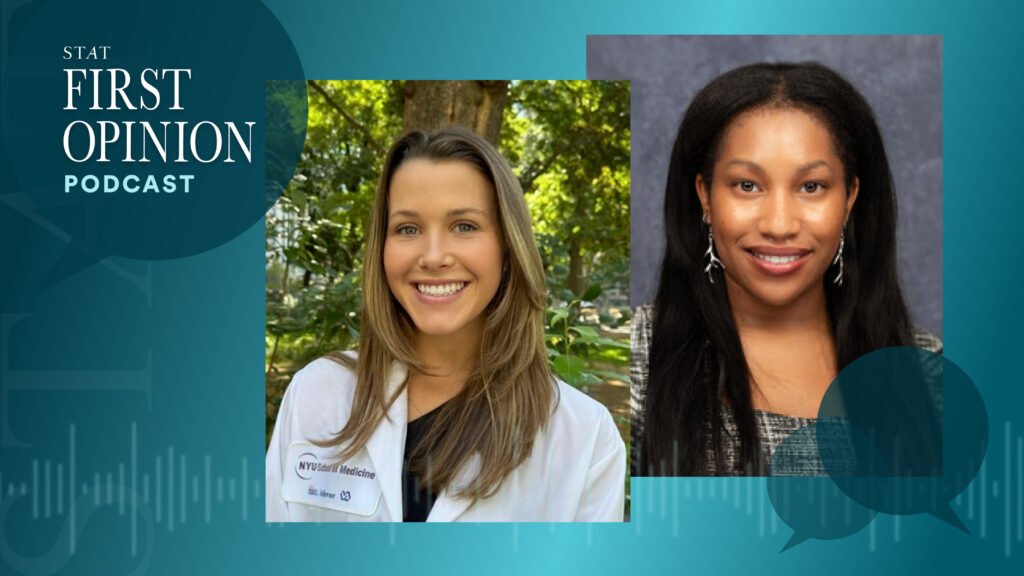
Below is a lightly edited, AI-generated transcript of the “First Opinion Podcast” interview with Tiffany Onyejiaka and Lauren Rice. Be sure to sign up for the weekly “First Opinion Podcast” on Apple Podcasts, Spotify, or wherever you get your podcasts. Get alerts about each new episode by signing up for the “First Opinion Podcast” newsletter. And don’t forget to sign up for the First Opinion newsletter, delivered every Sunday.
Torie Bosch: Amid the rise of the Make America Healthy Again movement, medical school has become something of a battleground. Health secretary Robert F. Kennedy Jr. and others have argued that future doctors need to better understand nutrition and preventive care. But what do medical students themselves think about that claim?
Welcome to the “First Opinion Podcast.” I’m Torie Bosch, editor of First Opinion. First Opinion is set home for big, bold ideas from health care providers, researchers, patients, and others who have something to say about the most important and interesting topics in medicine. This season, we’re focused on the intersection of medicine and culture.
I recently spoke with Tiffany Onyejiaka and Lauren Rice. Tiffany is a fourth-year medical student at the University of Minnesota Medical School and a graduate of the Johns Hopkins School of Public Health. Lauren will begin her internal medicine residency in Chicago this summer. After a quick break, I’ll bring you a conversation about what changes medical schools actually need to make.
Tiffany and Lauren, thank you so much for coming on the First Opinion Podcast.
Tiffany Onyejiaka: Thanks so much for having us.
Lauren Rice: Thank you for having us.
Bosch: So Tiffany, let me start with you. When did you decide to go to medical school and why?
Onyejiaka: That’s a really good question. I think for me, I had been pre-med in undergrad. So I think medicine had always been in the background. I also have doctors in my family. So it’s something I had known for a while. I think though I had a couple of different interests and there were a couple other avenues I wanted to explore, like with public health and writing. I would say when it really became med school for sure, I think was when I actually was working in a clinic. And I really enjoyed the one-to-one kind of aspect for a medical doctor and the fact that you really do have such a strong impact on people. And then also the joke is that someone was like, “if you can get through organic chemistry and get through the MCAT, then you might as well.” So I was like, “I might as well.” I think all those together was when I was, like, OK, I’m definitely going to, for sure, enter medical school.
Bosch: And do you have any thoughts about what kind of medicine you want to practice?
Onyejiaka: I am getting closer to choosing. I know probably won’t be in the operating room. I really do like talking to patients. I do enjoy the idea of having a long relationship with patients and being able to talk with them about some of the non-medical things that end up really impacting their medical care. And so I think for me, things like internal medicine, things like dermatology or family medicine are all where I’m looking at right now. So I have a couple months before I firmly decide.
Bosch: And Lauren, what made you decide to get a medical degree?
Rice: This is taking me back to residency interviews, which, Tiffany, you’ll see soon.
I’ve wanted to be a doctor since I was a kid. I didn’t really have any health care providers in my family, but I just thought the science of how our bodies work was so interesting. I played sports my entire childhood. I ended up playing college soccer at Wisconsin. And that was when I got interested in health from more of a personal perspective. I did a lot of, similar to Tiffany, public health-related stuff in college, saw how you don’t need to go across the world to do public health. There’s so much in our communities. A lot of the stuff I’m sure we’ll talk about today, like lifestyle, nutrition, preventative stuff is so important for physicians to talk about. And I became interested in that in college and then just kind of carried that forward to med school and it’s been so fun. There’s no job like being a doctor. It’s such a special career that I would not give up, at least not at this point, pre-residency, but it’s just amazing and I’m very thankful for it.
Bosch: And you’re about to start your residency. Are you excited for it?
Rice: I’m very excited. I’m gonna be in Chicago doing internal medicine, which, Tiffany, if you’re interested, and I am, I think it’s a great choice. There’s just so many options and so many avenues to do medical and medical-adjacent stuff, like teaching, education, public health, research, whatever interests you, writing. I think it’s a great career option and you get to do a lot of amazing things and have really great longitudinal relationships with patients and your colleagues.
Bosch: You know, this is a time, I think, of a lot of upheaval in medicine and in public health between artificial intelligence and changing political pressures and even the distrust that the public has in medicine right now. So have you seen much of that in your medical school experience, either of you?
Rice: I think one of the reasons I’m here today is I was working with Dr. Marc Siegel, who runs a medical journalism elective at my med school. And we interviewed a bunch of public health experts about this topic of mistrust, especially around conversations like vaccines, because that’s a big one that’s going on right now. And just in general, I don’t know that I saw it quite so much in my personal experience, but I think in the general media, there is a lot of mistrust in medicine and that’s something we need to work on rebuilding as a community, in a public health community, so that we can help patients to do preventative medicine and to be healthier long term.
Bosch: Tiffany, have you seen any of the sort of tensions or changes going on in medicine affect your experience in medical school?
Onyejiaka: I would say that in my experience, some of the tensions I’ve seen with patients is less about things like AI and medical misinformation and more about their frustrations with the limitations that exist in the system. So for example, I’m doing an emergency department rotation right now and I’ll see patients really upset about the long wait times, or I’ll have patients upset that someone comes in, then they don’t hear anything for two, three hours, or I see patients upset because they’ll be like, “I want my IV out,” but they can’t get the IV out for an hour plus, and then they’ll really frustrated by that.
And so I think for me, the tensions usually come from things where people are kind of upset about structural things that might not allow their physician or nurses to maybe give them the care that they need or they want, especially for people with anxiety. I think one thing I’ve noticed particularly is that people who do have anxiety, particularly health anxiety in our current health care system, probably can’t necessarily get the most ideal care for them. So I think that tends to be most of what I see with patients.
At least in Minnesota, and I haven’t really done any rotations in other states, I haven’t seen too many concerns about AI. I think that whenever physicians want to use AI to take notes, they always ask the patients. Most patients are fine with it.
In terms of vaccines, I think during pediatrics, I did see parents that were like, they don’t want vaccines. And there was a little education, but once they said no, we kind of just were like “OK, we’re going to move on.” I did hear some people bring up how the vaccine schedule had changed. Unfortunately, I wish I could remember which one specifically, but I do remember hearing one mother speak about how I think there was, I don’t know if it was maybe hepatitis C. I can’t remember which when it was, but she was like, “well, I’m seeing that different health organizations are differing on the timeline. I’ve got to wait.”
But I think most of the real frustration, the anger is really a lot of the systemic limitations and I’ve seen doctors who say, “I hate that this is the way it is,” but they literally can’t change it, unfortunately.
Bosch: Well, it’s nice that it seems at least like you’re insulated from some of the more rollicking debates happening around medicine, but you each actually did decide to weigh in, at least on First Opinion on STAT. A recurring idea from Health and Human Services Secretary Robert F. Kennedy Jr. Has been that medical schools need to teach students more about preventative care, particularly nutrition. And you both wrote essays several months apart about those ideas.
So. I’d like you to each sketch out what your argument was in the essay you wrote. Lauren, can you start?
Rice: Yeah, I’d be happy to. I think, building on what I said before about my background, I was someone who looked forward to going to med school. I wanted to learn how to make people healthy. And like, that’s big. I realized kind of how naive that is in retrospect, but in the grand scheme of things, I think coming away towards the end of med school, having done several projects in kind of that realm of lifestyle medicine, prevention, internal medicine, I just felt like something was missing, maybe not so specifically in terms of the education that physicians receive, but just the general mindset in medicine about how we take care of patients. A lot of my article, I hope, came across the point that we need to be more proactive about medical care. And a lot of that includes prevention and lifestyle, which it sounds like are things that all three of us agree are vitally important to people’s health. And I really just wanted to bring that point across just as we need a mindset shift.
This isn’t as simple as adding another nutrition class to med students’ busy schedules. This is about insurance. It’s about reimbursement. It’s about incentivizing doctors to go into primary care and to take on these big roles that this need requires of people. There’s a lot of details I talked about, like nutrition contact hours and some of those different aspects of that in my article.
But I think the grand scheme is just, our country’s health is going down a very poor trajectory and something needs to change. I don’t have the answer to what that needs to be. I don’t think Robert F. Kennedy Jr. has the answer. I don’t think anyone has the answers. But the conversation needs to start and it needs to a conversation with a lot people at the table.
Bosch: And Tiffany, you wrote back in November, if I remember correctly, and what was the gist of your argument?
Onyejiaka: I actually kind of had a different view on RFK because I had felt that one, I had learned nutrition education in my med school. Although I will say I do think that a lot of the nutrition education was more nutrition in the context of disease manifestations, like neurologic manifestations, versus like just general eating.
However, at my school, we do have interprofessional education. And so it is pretty common that we, as medical students, will interact with pharmacy students, nursing students, students in the RD programs, etc. And so my big argument had been that instead of focusing all this time and attention on getting medical students to learn more about nutrition, the investment should be in really helping to one, increase medical students’ collaboration with people who are already in programs dedicated to this. And about how some of the most successful interventions I’ve seen, for example, in Minnesota was I saw a resident, a medical student, and a chef in the Somali community do a series on how to cook Somali food, but in a healthier way.
I thought that was kind of the future that I see as being accessible. And then also talking about how we need to make sure we’re looking at the accessibility portion, because when I worked in a clinic, there was a nutritionist, but it was really difficult for Medicaid patients to be able to see her. So I think that was kind of the gist of mine was yes, doctors need more help, but I feel like there’s so many people that are already doing the work and there’s are so many barriers that I feel we would get more of an impact by trying to really focus on helping them and then having doctors engaged instead of starting with us. Because I think doctors have a very central in healthcare, but I don’t think they’re the only [opportunity].
Bosch: Yeah, and you mentioned RDs, and so that would be registered dieticians, right?
Onyejiaka: Yes, registered dietitian.
Bosch: That’s what I’ve enjoyed about your argument, was the idea about sort of using the system to kind of prop up another part of the health care system rather than maybe kind of throwing more at doctors who are already learning so much.
So I assume that you two have read each other’s pieces and I think you agree on a lot of things, but I’m curious, Lauren, maybe what you thought about Tiffany’s argument when you first read it.
Rice: I was just rereading it today since we had talked about doing this podcast. I agree with honestly, pretty much everything you said. I think that, like we were talking about before, a lot of arguments get pitted against each other nowadays. And we all have the same goal and kind of want the same things. Absolutely, we do not need to reinvent the wheel on this. There are professionals who go to school, have masters and Ph,D.s in this and they’re experts, I think similar to what you were just saying, Tiffany, access is a huge problem.
I worked at Bellevue Hospital in New York, which is a public safety net hospital in New York City. A lot of patients are uninsured or on Medicaid. And I sat in on our obesity medicine clinic, where you would think patients — and a lot of these were pediatric patients — are getting good education on what to eat. I just remember feeling like there was such little time to spend with them. There was such an access problem of, patients were not able to access healthy foods. The parents didn’t really understand what healthy eating looked like or weren’t able to provide that for their kids due to time constraints, financial constraints. So it’s very complicated, but absolutely registered dietitians are central to this and doctors should not be expected to do it all.
I don’t think a doctor needs to be a nutrition expert, but I do think that every single doctor should be appreciative of the fact that this is the foundation of our health. And that’s kind of what I think is missing. I don’t think that we need to be experts on how to calculate all of a patient’s nutrition needs. But we need to have a greater understanding as physicians of how interrelated all of these chronic diseases are and how we can actually change things through lifestyle and preventative measures versus in addition to like the pharmaceuticals and all the amazing that doctors are like so uniquely qualified to do. But I think I just wish we had more of a mindset and foundation that this is really where it’s all coming from.
Bosch: Lauren, what does that look like to you? So if you’re not so much suggesting more courses on nutrition or whatever, and it’s more of a mindset, I mean, how do you envision medical school being different to make your goals come to fruition?
Rice: That’s so hard. I think it’s a million tiny things if that makes sense. Like mentioning this repetitively as a two-minute add-in throughout all of training. Like in pre-clinical blocks, a lot of schools do it by organ system. So having — and a lot schools already do this, I don’t want to say this a lot, of this stuff does not exist — but maybe just not to the degree that is necessary. Like having registered dietitians doing tidbits throughout each organ system on how this is related, having blocks where we kind of bring everything together and talk about these metabolic and chronic diseases as a whole instead of learning them completely as separate things.
I think where I really saw an absence of this kind of prevention mindset was during clinical training. I don’t know, Tiffany, if that was similar to what you experienced or maybe that’s just because I’m in New York City and everything is hyper-specialized. But I think integrating small moments of like, “hey, we have this patient who’s in the hospital. They are here where they have diabetes, they have heart failure, they have chronic kidney disease. Let’s talk about their medications and the management of that stuff because that’s what we are being trained to do as physicians and what we uniquely can do. But let’s take a five-minute pause and talk about how they got here and discuss maybe small ways we can have conversations with the patient about the big picture of their health.”
I feel like that’s what was missing is we just learned to treat all these problems separately and no one’s pulling the pieces together and we can’t expect someone’s primary care doctor who is already doing so many things to be the only person to pull those pieces together for a patient and to teach that to the next generation of doctors.
Bosch: Tiffany, does that sound right to you?
Onyejiaka: Yes. And so actually, something that you brought up, Lauren, about being in New York, when I was reading your piece, it brought to light another thing about medical education that I don’t think we talk about, about how there are very much regional differences, there are differences in states, even certain medical schools. Because my medical school is, I think, probably fairly primary care-focused, but also Medicaid to Minnesota, shockingly, you probably wouldn’t think this, is actually probably one of the more generous ones in the country. And we’ve actually had people move from Chicago to Minnesota.
And so for me, some of the things you’re talking about, I feel like I’ve had the privilege of sometimes seeing them. For example, I remember when I was doing internal medicine at the VA, one of my attendings was like, “look through the chart, look through any like mental health notes,” ’cause she was like, “Any time you see someone with chronic pain, a lot of that can’t be fixed with medications. You always want to look through mental health and trauma.” And lo and behold, yes, almost every single patient who had pain that couldn’t be treated with opioids ended up having some sort of very traumatic thing that had happened.
But at the same time, this was an attending at a VA in Minnesota who had a caseload of I think eight or 10 patients max, which I don’t think that’s the norm for an attending to have in a place like New York, a place like D.C. And so I do think that there are some structural elements that do get in the way of people being able to get the care. And even for me, in my school, we do two years of preclinical and then two years of clinical, but some schools, it’s like one year of pre-clinical. Some schools it’s 18 months pre-clinical.
So there’s not necessarily that extra time to get to give people education. And then even for my school, we’re lucky, we have a building where all the schools are together, but in other places it might not work necessarily that way. And so I do think that structurally it can be really difficult because if someone has a caseload of 20 patients, they’re not gonna have the time to dig through notes from years ago to really find the root. If someone is in a place where the Medicaid reimbursement is tiny, then they have to literally get patients in and out so they don’t have time to really dig into that.
If there’s not enough reimbursements for people to see a registered dietician, for there to be a diabetic nurse educator, that does get in the way. And so I think when I was reading your piece about like how you did a lecture, like I was kind of surprised that a medical student would be doing a lecture about health to M2s cause in my head, I’m like, “why wouldn’t there have been like a professor dietician or why wouldn’t t one of your medical professors have been doing that?” But then I realized not all people have the bandwidth.
And I just think that the way the system is set up, it can be really difficult for some people. It kind of opened my eyes. It’s really hard because everything is so different and a lot of this stuff takes time. It takes resources. And that can look very, very different based on where it is that you live. Because some people are learning internal medicine with a patient load of eight. Some are learning it with a patient load of 20. And that could mean very different things for when you’re trying to get to root causes. And so that’s something about medical education that I don’t know is really talked about enough. But that’s something that reading your piece really did make me think about.
Bosch: Lauren, can you explain what Tiffany is referring to there about the lecture that you did on nutrition?
Rice: I’d be happy to. And before I say that, I completely agree. I go to a med school in New York that is not primary care-focused at all. We do three weeks of primary care and that’s it. And a lot of people in my school don’t go into primary care-related fields. So that works, but I’m from the Midwest, went to school in Wisconsin, which also has like a big public health school similar to Minnesota. When I have interviewed there for internal medicine, it’s totally different focus. They do so much primary care.
So there’s a lot of like differences, not just in medical school, but in residency training programs where you train is going to impact how good of primary care training you get.
And then like you just had mentioned, Torie, the lecture is my passion project from med school. I had a lot of extra time because my school was going through a bunch of curriculum changes and I just had all these free months that I could do whatever I wanted with essentially. And my mentor who I started this project with is a stroke neurologist at NYU in Bellevue. So she is amazing and she discovered a lot of this stuff that we’re talking about a little later on in her training. She didn’t have that prevention-focused mindset so early on and she’s treating patients who are having acute strokes, which probably like 80% of the risk factors for are lifestyle factors and prevention-related factors. And she kind of came onto this later of, why aren’t we treating my patients differently?
So she was like, “I see a gap working with my residents who don’t acknowledge or understand this yet.” And we worked on this project to design a lecture that brought all of that together. So I was talking big picture ideas of like, we need to have more of a prevention and proactive medicine-focused mindset.
I’m not a nutrition expert. I’m not gonna stand up here and lecture anyone on nutrition or any of the other like lifestyle modalities whether that be mental health, sleep, exercise, all of those things. But just kind of emphasizing this idea I’ve said a couple of times today of, we can’t just rely on primary care doctors to be the only people in America who care about this because they are already overextended on so many things. We need our stroke neurologists to understand how important this is. Whether they’re the ones doing the counseling or referring to a registered dietician like your article was talking about, I don’t necessarily care what the method is, but the end result is where we need to figure out how to get there.
And I think it’s probably some combination of making doctors more cognizant of these ideas and then working with other professionals. This is not something we can do alone.
Bosch: And what was the response to your lecture?
Rice: It had some mixed responses. I talked about this a lot during my residency interviews. It’s such a complicated topic. You mentioned this in your article, Tiffany — you bring up nutrition and there’s so many structural barriers. There’s so much access problems. Most of my medical school loves working at our public hospital, Bellevue, because you get to care for New York’s most underserved populations and it’s such great experience. But you go up on a stage and you’re talking about healthy eating. There’s no way to not talk about access and how difficult that is for patients. So I think that has to be a part of the conversation, but it’s hard to include everything in one singular lecture that you’re designing as a med student. So that was some pushback I got.
There’s also such a mental and emotional element to what people choose to eat. And that’s another thing that in the grand scheme of any nutrition content needs to be addressed, but I think there were a lot of people who responded and were like, “I think this is so important.” It’s so challenging though, because like, where do we fit this in? My school actually just transitioned to three years instead of four years. So our curriculum is extra short, and what do you take away if you’re adding in more focus on this? So it’s definitely a very complicated question, but I think people care and people spend a lot of time reading about these topics online, even if they’re not learning in school. So how do we find the middle ground, I guess, in improving education in small ways that make a big difference?
Bosch: So the pushback was mostly sort of, “This all sounds great, but it’s not realistic for our patient population.” Is that about right?
Rice: I think a little bit, that was some of it. Some of it was like, “this is interesting, but I don’t have time for this kind of thing,” or “I’m gonna be a neurosurgeon. Why should I sit through this 90-minute lifestyle medicine-related lecture?” But yeah, I just think it’s good to start a conversation about it. And there was actually another student who was in the class below me who I gave the lecture to, who ended up taking my role as a lecturer, and he ended up doing a similar thing to the class below him. So like, just like finding small ways to kind of integrate these things more.
But by no means do I think that me as a third-year med student giving a lecture is solving any problems in this realm. But just starting the conversation about it and trying to figure out what those solutions are going to look like.
Bosch: So I’m glad you mentioned the idea of trying to fit this in because this was actually one of the questions I really wanted to ask you. So as the editor of First Opinion at STAT, I get a lot of submissions, and a lot them are about medical school. And a lot are saying we need, medical students now need to learn about X. That could be AI, it could be more about nutrition, it could whatever the case might be.
But I very rarely get any submissions that explain how to make room for what that topic might be. Tiffany, was there anything in medical school that you think could be removed to make room for, whether it’s nutrition or any other type of education that people might want to insert?
Onyejiaka: In terms of being removed, I don’t know if there’s anything that can be removed to be honest. I don’t think so. Like even going into Step One boards, I’m like, man, there’s still so much I didn’t know. But one take I kind of have, and I’m warning this is going to be a little controversial, but I truly do believe that people will make time for things that they care about. And I think that in medical school, people find time for research. They find time for part-time jobs, they find time for internships, they find time for so much. And if we’re really being honest, when we look at sort of like, individuals who have disparities, especially things like obesity, like the majority of people who are not having access to healthy food are lower income, they’re from more rural areas, they’re racial minorities, like Black people are more likely to be obese. That’s just true, that’s just the facts.
And I sometimes wonder. A lot of the individuals who enter medical school tend to be from higher income areas. They tend to from Caucasian or Asian backgrounds. And so I do sometimes wonder if the lack of people from communities where this is as big of a problem might be driving why it’s harder for people to fit it in. Whereas I have a classmate who come from areas like this and they’re like, “I want to know how I can make this food better so that my parents, my aunts, my uncles, my cousins, etc., can be healthier.” I have a Nigerian background, so I’m always like, how do we make this food a little less salty? How do we replace the carbs? Cause it’s so important to me.
So I also do wonder if there’s just a lack of admitting individuals into medicine who already naturally have this interest in making things healthier. Because I do think that part of why it might be a little out of touch is because this is an issue that I don’t know if the vast majority of people who enter medical school are intimately dealing with family members and friends and communities where people don’t have access to preventative medicine just to be completely honest.
Rice: I think that’s another reason why this is so hard and it’s so complicated is because of so many disparities. When I worked with most of our patient population — like I’ve mentioned at this public hospital is racial minorities, ethnic minorities, poor income communities in the Bronx and Brooklyn in New York City, lots of immigrants, people with like very poor access to health care — and it is so important to have that be a part of the conversation. And like Tiffany was mentioning, it’s so important like have doctors who look like their patients and have them going into those communities. When I had the opportunity to work with Dr. Siegel on the “Dr. Radio” podcast, we interviewed a Black physician who does obesity medicine outside of DC. And he talked about this at length. And then he also talked about everything else we’re talking about, that things need to change so that we can have better access for all people.
This is probably my opinion on just like nutrition in general is — it is absolutely harder for people in low-income and minority communities to eat healthy. But it’s hard for everyone to eat health nowadays. Our food system is so broken the default choice for what we eat is the unhealthy choice. And until we change something in our food system, which I don’t think is me and Tiffany’s job as physicians necessarily, but like until we changed that so that these are easier choices to make, I don’t know that things are ever going to like meaningfully change, which goes into a lot of the kind of public health stuff as well and why that’s so important.
Bosch: Well, I would love to keep talking to both of you about this for a really long time. But unfortunately, I think we have to wrap up now. But thank you both so much for your thoughtful essays on First Opinion and for this really exciting conversation. It’s been so great to have you on the show.
And thank you for listening to the “First Opinion Podcast.” It’s produced by Hyacinth Empinado. Alissa Ambrose is the senior producer and Rick Berke is the executive producer. You can share your opinion on the show by emailing me at [email protected]. And please leave a review or rating on whatever platform you use to get your podcasts.
Until next time, I’m Torie Bosch, and please don’t keep your opinions to yourself.



