
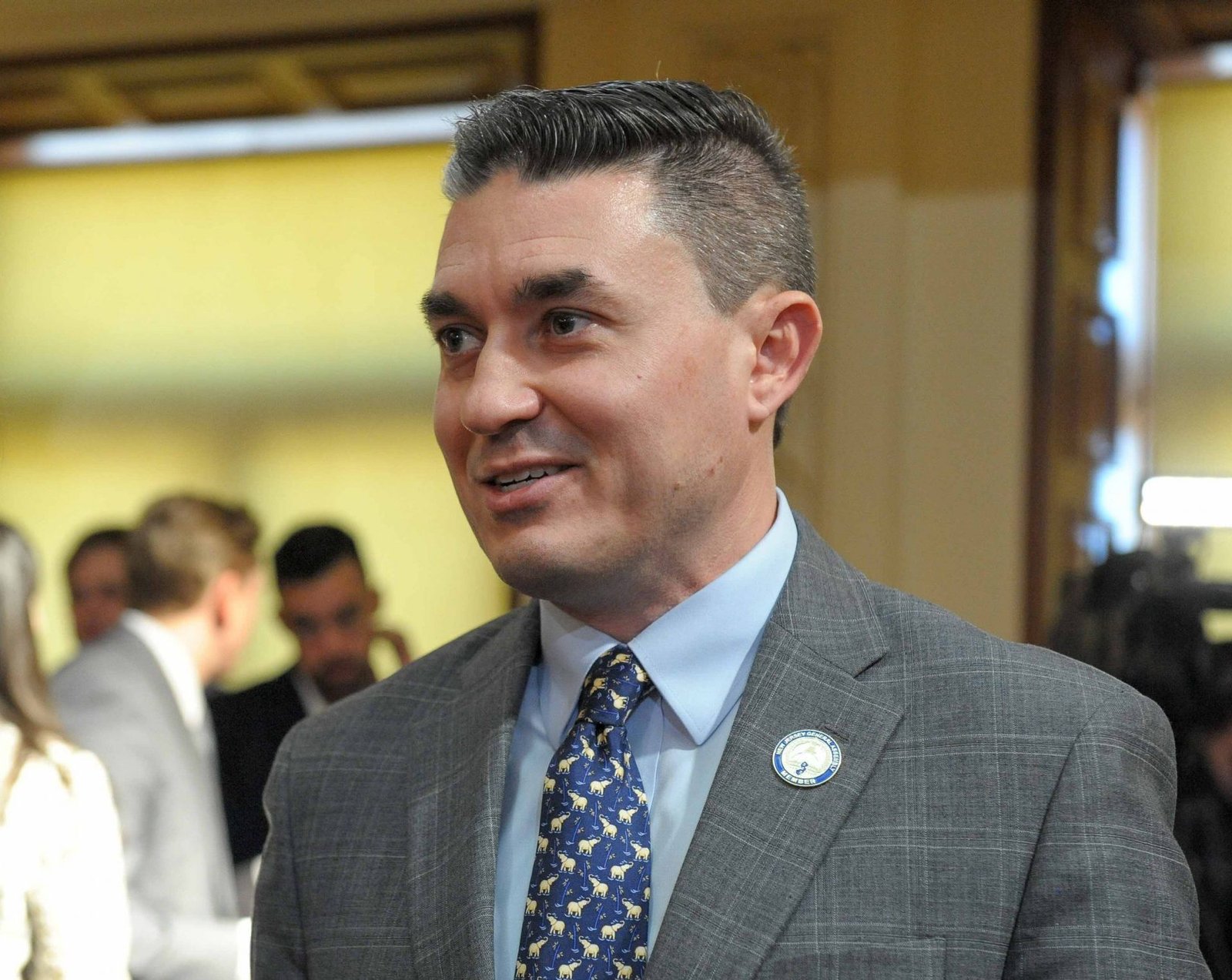
The New Jersey Globe is continuing its series of legislator Q&As this week with Mike Inganamort. Prior installments include Luanne Peterpaul, Dave Bailey Jr., Doug Steinhardt, Al Abdelaziz, and Andrew Zwicker.
Assemblyman Mike Inganamort (R-Chester Township) is a consultant and was first elected to represent the 24th legislative district in 2023. He was a member of the Chester Township Council from 2018 to 2023 and was the town’s mayor from 2023 to 2024.
He is a member of the Budget, Environment and Solid Waste, and Transportation and Independent Authorities committees.
A list of Inganamort’s floor and committee votes this session can be found here.
Click here to view a list of bills that Inganamort has sponsored.
The following phone interview has been edited for clarity and length.
New Jersey Globe: You’re from the Highlands, and you’ve done advocacy for the Highlands region. Could you, for the layperson, explain what the Highlands are and why it’s a region that needs advocacy?
Mike Inganamort: The Highlands is, in my opinion, the most beautiful part of our state: rolling hills, lakes, and streams. We have many state parks throughout the Highlands and my legislative district; I’m usually in one of them with my wife and kids on any given weekend. It’s a gem in a state so densely populated. So I care a lot about the health and resilience and sustainability of the Highlands region, and that’s true both environmentally and economically.
I think what has many people talking about the Highlands in 2026 — I’m sort of segueing here — I really think the defining issue of 2026 is the broken school funding formula, and one of the places where it’s harm is most obvious is in the Highlands region. These are towns and communities that cannot grow, that cannot add rateables, certainly not commercial rateables, and those are the things that you need to continue to fund your schools.
As the S2 school funding formula has changed the equation, and we’ve seen the state pull back from so many school districts, particularly in suburban and rural areas, the burden of paying for these schools shifts overwhelmingly to the local property taxpayer. It’s around 80% in West Milford, which is entirely in the Highlands. So the environment matters here, the economy matters here, and those things are tied together, and I think the state is dropping the ball.
So you would support a school funding formula that helps municipalities that have less room to grow?
Yes, I think Highlands impact aid is necessary. It’s something that the Highlands Council actually called for when it was created. So this is not a new concept. It was just forgotten about for a long time, and that is important as a short-term fix. But longer term, we very obviously need to fix the school funding formula, and so I really hope that the governor will work in a bipartisan way on that and not get pulled back by the Democratic majority that created the formula and hasn’t shown any urgency to change it.
The one change the majority put forward two years ago was to allow school districts to raise the tax levy by 9.9% without voter approval. That was something that solved a short-term math problem, but it dramatically worsened the property tax crisis in New Jersey, and two years later, we have school districts like West Milford and Jackson and Middletown closing schools. In Jefferson, which lost $45 million in state aid since S2 was adopted, they’re looking at which extracurriculars and sports to eliminate, just taking the soul out of the high school experience.
You had your segue, so I’ll add a segue. I also hear about the Highlands in terms of concerns about the ecological effects of sprawl, whether it be warehouses or the proposed Roxbury detention center, and you have spoken against the detention center. Why do you think your opposition to that project is necessary?
Well, whether it is affordable housing, a warehouse, or a detention center, the same infrastructure limitations exist. Politicians can put on their partisan jersey depending on the particular development project; I prefer to stay consistent throughout, which is focusing on the very real and intentional infrastructure limitations in the highlands. And when I say intentional, I mean mandated by the state of New Jersey. So we need to keep that front of mind, regardless of what type of project it is.
A bill you co-sponsored last year ended the state’s long practice of requiring legal public notices in newspapers. About a year later now, have you heard about how that’s been going? Do you think it’s been an effective change?
Yes, I do. I think that to continue to require municipalities and counties and other public entities like that to advertise in what has frankly become an old-fashioned form of information sharing was no longer a product of the times. More than anything, that legislation was intended to modernize the way public entities share information in a transparent way, and the easiest way to do that is to put that information on their own website and on other websites, including one created by the state.
That particular bill, which I was proud to be a part of and proud to support, is part of a philosophy I’ve brought to the Assembly — it’s actually something that compelled me to run for the Assembly in the first place. Small towns like the one where I live are having a tough time staying afloat, and the primary driver is state mandates. When I was serving in local government in Chester Township, not a week went by that my administrator wouldn’t say, “We have a new state mandate we have to comply with.” There are the big and obvious ones, like mandated developments and the school funding formula to a certain extent, but there are also the less obvious ones, like what we just discussed around public notice, like requiring every town in this state to adopt a fee ordinance for tree removal. Tell that to a family living on five acres in Long Valley: that they need permission from town hall to cut down a tree in their backyard.
My perspective is that the state of New Jersey has a punishing attitude toward small towns and the property taxpayers who foot the bill. So, whether it is modernizing our public notice laws, repealing this onerous model tree ordinance, I pulled together 20 bills intended to get the state of New Jersey off the backs of small towns, and I’m calling it the Small Town Rescue Plan, and that’s been the core of my emphasis in my first term.
We reported that you were among the finalists for Jack Ciattarelli’s lieutenant governor nomination. What was that process like, and how do you feel being among the finalists at a relatively young age in politics?
Relatively — we should talk about that. It was a thrill. It was an honor to be considered. I very strongly and proudly supported Jack last year. To be considered for lieutenant governor was totally unexpected. It was certainly not something I was angling for, and that’s why I didn’t miss a beat when my good friend Sheriff Jim Gannon was picked, because he is a terrific guy, and I was proud to support Jim. The whole campaign was exciting, not just the process of being vetted for lieutenant governor.
I think Jack raised important issues. I think the campaign, however, revealed that New Jerseyans are evaluating their choices in the voting booth based on what’s going on in Washington, D.C. I wish that weren’t the case, because we have very real and specific problems in New Jersey that I believe have been created by a 25-year entrenched Democratic majority, and every day we’re talking about Washington D.C., we’re not talking about that 25-year Democratic majority that I think is causing specific harm in our municipalities, in our school districts, and on our property tax bill.
You mentioned we should talk about the relatively young age. Do you feel young in the Legislature?
Well, I’m the youngest Republican in the legislature, and at 42, that tells me my party needs to do a better job reaching out to young people. That’s been another priority, talking with more young people about the challenges they’re facing in New Jersey.
One of my reflections after the 2025 campaign is that we as Republicans need to think about our approach and messaging on housing. We know that the top-down affordable housing mandates don’t work because they strain local resources and are literally impractical in many of the towns I represent. That message resonates with existing homeowners, but I think it falls flat with young people who are working hard, trying their best to save and achieve the dream of home ownership. But when the average age of a first-time homebuyer in New Jersey is 45, that says we’re missing a huge swath of people, and they deserve to hear Republicans’ housing agenda.
I think we need to embrace being more creative on top of existing development, whether that’s accessory dwelling units or getting serious about redeveloping our empty shopping malls. Republicans are the party of private property rights, and part of that is thinking creatively about providing adequate housing for these really hard-working New Jerseyans who want to achieve the American dream.
You’re a member of the Budget Committee — what do you think of Governor Sherrill’s budget proposal so far, especially as she says she wants to try to cut down on the structural deficit?
Well, this budget, of course, has a deficit, and it is to be seen whether the governor will, in fact, hold the line on additional Christmas tree items. You’re already seeing an emerging disagreement within the Democratic Party as to whether there should be additional spending items in the budget.
Clearly, we need to hold the line on these additional spending items, but if we’re being serious about the structural deficit and the long-term fiscal solvency of the state, we need to focus not just on these $10 million one-off parking garages, but on the structural drivers. We very much need a fix to our State Health Benefits Plan, which is hurting towns, school districts, and other public entities. We need a fix to the school funding formula. These are the big-ticket items that I wish the governor were addressing more specifically in this budget, because it’s bigger than simply debating Christmas tree items.
You were the prime sponsor of a bill that established New Jersey’s inaugural Hostage and Wrongful Detainee Day. What began your push on that bill?
It was such an honor to move that legislation, which is now law. That came from a constituent of mine, the Levinson Moriarty family, whose father, Robert Levinson, was the longest-held hostage in American history. And the federal government established May 9 as U.S. Hostage and Wrongful Detainee Day. That came into effect under Biden, continues under Trump, and New Jersey is now the first state to do the same. It’s a small but meaningful symbol that the state of New Jersey cares about Americans wherever they are, even if they are being held hostage or wrongfully detained.



