
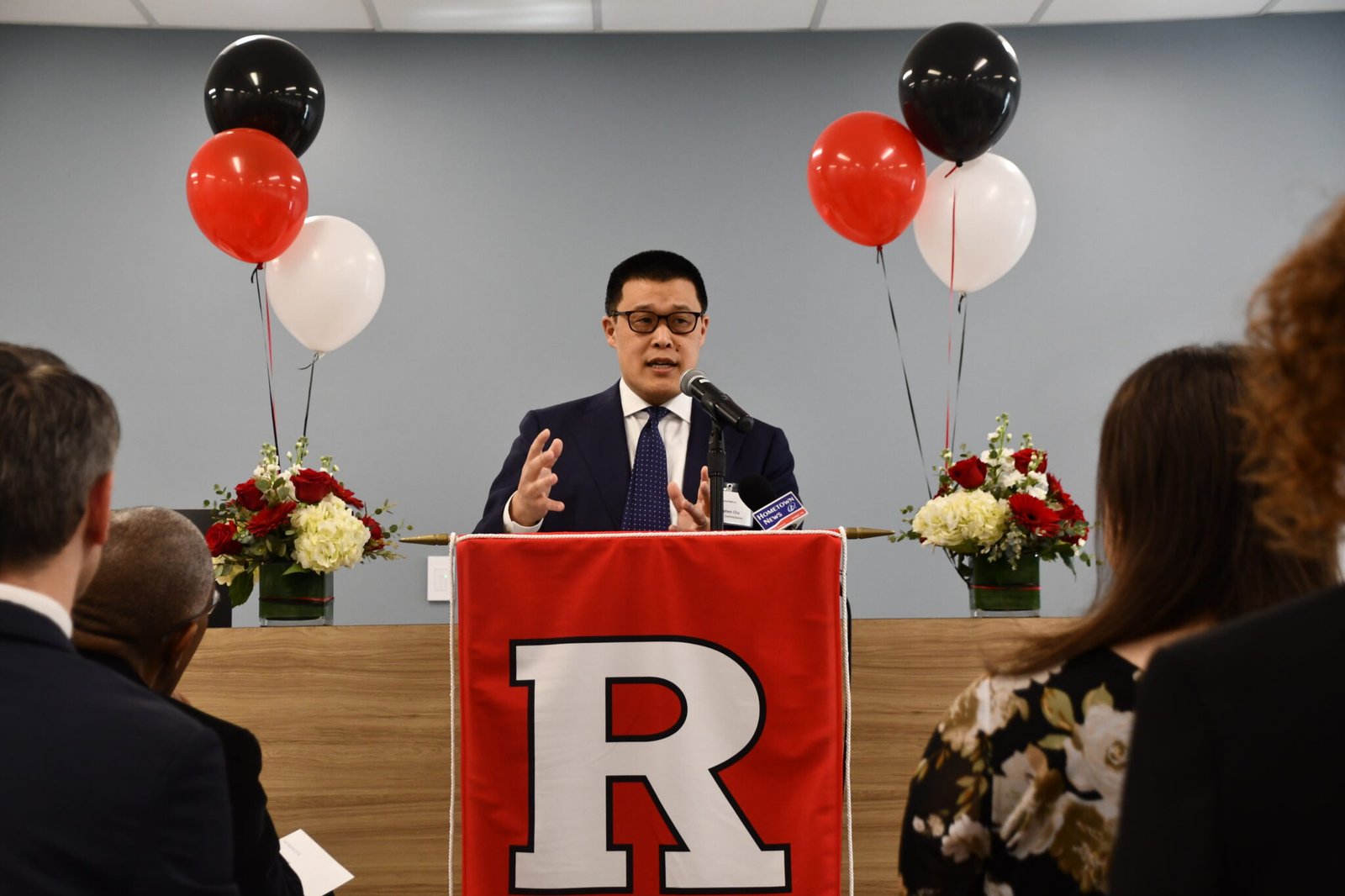
A month after state officials cut the ribbon on New Jersey’s first drop-in healthcare facility designed for people in mental health or addiction crisis, the center has yet to welcome patients, while funding concerns could delay the opening of additional sites.
New Jersey needs nearly $36 million more to fully fund, operate, and support the five planned regional “crisis stabilization centers,” facilities that are designed to be a less stressful, more effective option than the emergency room, according to a non-partisan analysis of the budget proposal for the state Department of Human Services, which oversees crisis services. The Newark site was slated to open in late April, with four others to follow in the coming months.
Human Services Commissioner Stephen Cha told members of the Assembly budget committee Monday that the end of federal pandemic relief funds has left the state with some funding gaps around the centers, which are part of a broader system that also includes the 988 mental health hotline and mobile response teams. Cha said the state is pursuing other funding options, including potential Medicaid reimbursement for these facilities, but securing any revenue will take time.
“As that funding has expired, our progress forward is challenged, just to be clear,” he said. “We may need to delay some openings of those five centers.”
Gov. Mikie Sherrill’s $60.7 billion annual budget proposal includes $35.5 million for all 988 related services, including nearly $29 million from state funds, roughly half of what it will need for this work in the coming year, the analysis shows. The state will spend more than $52 million on this suite of programs in the current fiscal year, which ends June 30.
State lawmakers must approve a final spending plan before the new fiscal year begins July 1.
“Mental health is one of those issues that remains at almost a crisis level, especially with our young adults,” said Assemblywoman Carol Murphy (D-Burlington), who asked Cha for an update on the 988 program.
New Jersey launched its 988 crisis hotline in 2022 as part of a national shift designed to make it easier for people in a mental health emergency to connect with help. New Jersey lost more than 700 people to suicide in 2025, an increase from 2024, according to state data.
Cha said new national data shows researchers believe there has been an 11% reduction in suicides following the implementation of the 988 system.
“It’s incredible to think about who is here today, but for the 988 line,” he said.
New Jersey received nearly 60,000 calls and texts to the 988 line the first year, Cha said, and that volume has since tripled to 182,000. Staff anticipates nearly 242,000 next year.
“The demand as originally projected was linear. The growth has been exponential,” he said.
All the funding is available to pay for the 988 hotline itself in the coming fiscal year, a cost of $13.8 million, budget documents show. Sherill’s proposed budget also includes the full $16 million needed to fund the mobile response teams operating in all 21 counties. But the state has only $1.7 million in place for the crisis centers and needs nearly $30 million more to operate all five facilities in the coming fiscal year, plus another $6 million-plus for support services, the documents show.
Legislation sponsored by Sen. Joe Vitale (D-Middlesex) and Sen. Vin Gopal (D-Monmouth) would provide at least $67 million for the crisis response programs annually by adding a 40-cent fee to every phone line in the state. At least a dozen states have passed similar funding measures, but the bill has received little attention in Trenton.
Cha was among the dignitaries who visited the Newark crisis center to celebrate its pending opening on April 1. The facility is set to offer medication and other clinical care, connections to other health care services, and a place where people in crisis can rest and recover for 24 hours.
The Newark center is located on the same campus as University Hospital and would be operated by Rutgers University Behavioral Health Center. According to budget documents, it is still awaiting certification of some form. Additional information was not available Monday.
Other crisis stabilization facilities are being created in Bergen, Camden, Monmouth, and Morris counties.
In all, Sherrill’s proposal calls for funding for the Department of Human Services, the state’s largest department, with more than 6,000 employees, to increase 5.7%, from $35.1 billion this year to $37.1 billion in the budget year beginning July 1. Of that, $21.1 billion is to come from the federal government, $11.4 billion from state taxpayers, and $5.6 billion from other sources.
GET THE MORNING HEADLINES.



