
Quantum Computing’s Quiet Revolution: Why Datacenters, Costs, Memory Usage and the Tech Power Map Are About to Change
Srivax News | Technology & Markets
For decades, the economics of computing have been straightforward: more demand required more servers, more energy, and more physical space. Hyperscale datacenters—sprawling facilities packed with tens of thousands of machines—became the backbone of the digital economy.
Quantum computing threatens to rewrite that equation.
While still in its early stages, the technology is advancing quickly enough that industry leaders—from startups to Big Tech—are positioning for a future in which fewer machines perform exponentially more work. If that transition materializes, the implications will extend well beyond performance gains. It could reshape how datacenters are built, how much they cost to operate, and which companies ultimately dominate the next era of computing.
🏢 The $1 Billion Datacenter—And Why It May Not Stay That Way
A modern hyperscale datacenter typically costs around $1 billion to build and operate over its lifecycle. That investment is spread across:
- Large-scale real estate and infrastructure
- Massive fleets of servers and GPUs
- Continuous energy consumption
- Advanced cooling systems
- Staffing and operations
This model has scaled effectively—but it is fundamentally resource-intensive.
Quantum computing introduces a different approach.
Instead of relying on brute-force calculations across thousands of machines, quantum systems exploit properties such as superposition and entanglement to evaluate many possibilities simultaneously. In practice, this means certain complex problems—particularly in optimization, simulation, and cryptography—could be solved with far fewer computational resources.
Industry analysts increasingly envision a hybrid datacenter model, where classical systems handle general workloads while quantum processors tackle the most demanding calculations.
📉 A New Cost Structure Emerges
In such a hybrid model, a datacenter originally costing $1 billion could see its effective cost drop to roughly $600 million to $700 million over time.
The savings would come from:
- Reduced hardware requirements
- Lower overall energy consumption per completed task
- Smaller physical infrastructure needs
These gains are partially offset by new costs, particularly the specialized cooling systems required to operate quantum hardware at extremely low temperatures. Even so, the net effect is expected to be a 30%–40% reduction in total cost for certain workloads.
The shift is not uniform across all computing tasks, but for industries dependent on high-complexity calculations, the economics could change dramatically.
⚡ Energy: Less Total Consumption, More Intensity
Datacenters currently account for an estimated 2%–3% of global electricity usage, a figure that is rising rapidly with the growth of artificial intelligence.
Quantum computing presents a paradox.
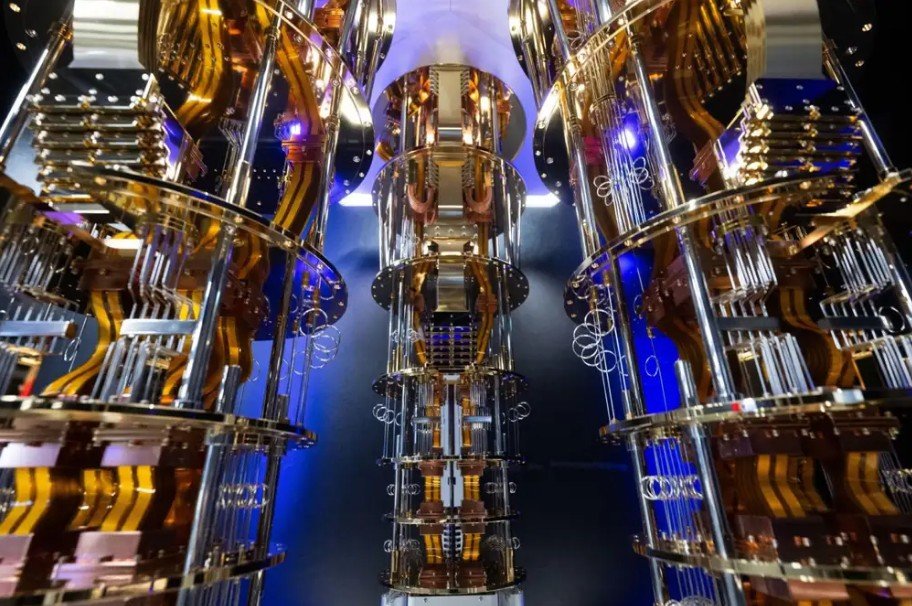
On one hand, it can dramatically reduce the number of computational cycles required to solve a problem—meaning less total energy consumption. On the other, individual quantum systems demand extreme cooling environments, often near absolute zero, making them energy-intensive on a per-machine basis.
The result is a shift from widespread energy usage across thousands of servers to highly concentrated energy use in fewer, specialized systems.
💾 Memory and Storage: From Volume to Precision
Classical computing relies heavily on large-scale data storage, with systems designed to store and replicate vast datasets.
Quantum computing alters that dynamic. Instead of storing every possible state, it can evaluate multiple states simultaneously, reducing the need for brute-force data storage in certain applications.
This does not eliminate the need for memory, but it changes its role:
- Less emphasis on volume
- Greater emphasis on precision and specialized architectures
⏱️ Time: The Most Disruptive Variable
Perhaps the most significant impact of quantum computing lies in time compression.
Problems that currently require years of processing—such as molecular simulations in drug discovery or complex financial modeling—could potentially be solved in weeks or even days.
For industries where time is directly tied to cost and competitiveness, this shift could be transformative.
📱 The Consumer Effect: Invisible but Profound
Quantum computing will not appear directly in consumer devices like smartphones. Instead, its influence will be felt through cloud-based services.
Applications powered by quantum-enhanced systems could deliver:
- Faster and more accurate AI responses
- Real-time optimization in logistics and finance
- Highly personalized digital experiences
To the end user, the change may seem incremental. Behind the scenes, however, the computational engine driving those services would be fundamentally different.
🏢 Real Estate and Infrastructure: A Subtle Rebalancing
The rise of quantum computing may also reshape the physical footprint of the tech industry.
Today’s hyperscale datacenters require vast amounts of land and infrastructure. As quantum systems reduce the need for large server farms, demand for massive facilities could stabilize or even decline.
At the same time, new demand will emerge for specialized quantum facilities, which require precision environments rather than sheer scale.

🏆 The Companies Positioning for a Quantum Future
The race to commercialize quantum computing is already underway, involving both specialized startups and established technology giants.
🔬 Pure-Play Quantum Firms
- IONQ
Focuses on trapped-ion systems, offering quantum computing through cloud platforms.
Partners include major cloud providers such as Amazon, Microsoft, and Google. - RGTI
Develops superconducting quantum processors and hybrid computing systems.
Works closely with cloud ecosystems and hardware partners. - QBTS
Specializes in quantum annealing, already used for optimization problems in logistics and industry. - QUBT
Explores photonic quantum systems that operate without extreme cooling requirements.
🏢 Big Tech: The Infrastructure Layer
- IBM
Offers quantum computing through its cloud platform and enterprise network. - Alphabet
Invests heavily in quantum research and has demonstrated early breakthroughs. - Microsoft
Provides Azure Quantum, positioning itself as a platform provider for quantum services. - NVIDIA
Plays a critical role in hybrid computing, bridging classical AI and quantum systems. - Intel Focuses on silicon-based quantum hardware research.

🔗 An Ecosystem, Not a Single Winner
Unlike previous computing revolutions, quantum computing is unlikely to produce a single dominant company.
Instead, it is forming a layered ecosystem:
- Hardware developers
- Cloud platforms
- Software providers
- Integration partners
The companies that succeed will be those that can connect these layers effectively, rather than operate in isolation.
⚠️ A Measured Timeline
Despite rapid progress, quantum computing is not yet ready for widespread deployment.
- 0–5 years: Experimental and niche applications
- 5–10 years: Early hybrid datacenters
- 10–20 years: Broader commercial impact
For now, the technology remains a long-term investment thesis rather than a short-term certainty.
🧭 The Bottom Line
Quantum computing will not replace classical systems—but it will reshape their role.
The implications are significant:
- Datacenters become smaller and more efficient
- Costs decline for high-complexity workloads
- Energy usage shifts from distributed to concentrated
- Entire industries gain faster access to solutions
In the process, the competitive landscape could shift as well.
The next phase of computing may not be defined by how much infrastructure companies build—but by how efficiently they can use it. -Cxo BankStadt Govt Service



