
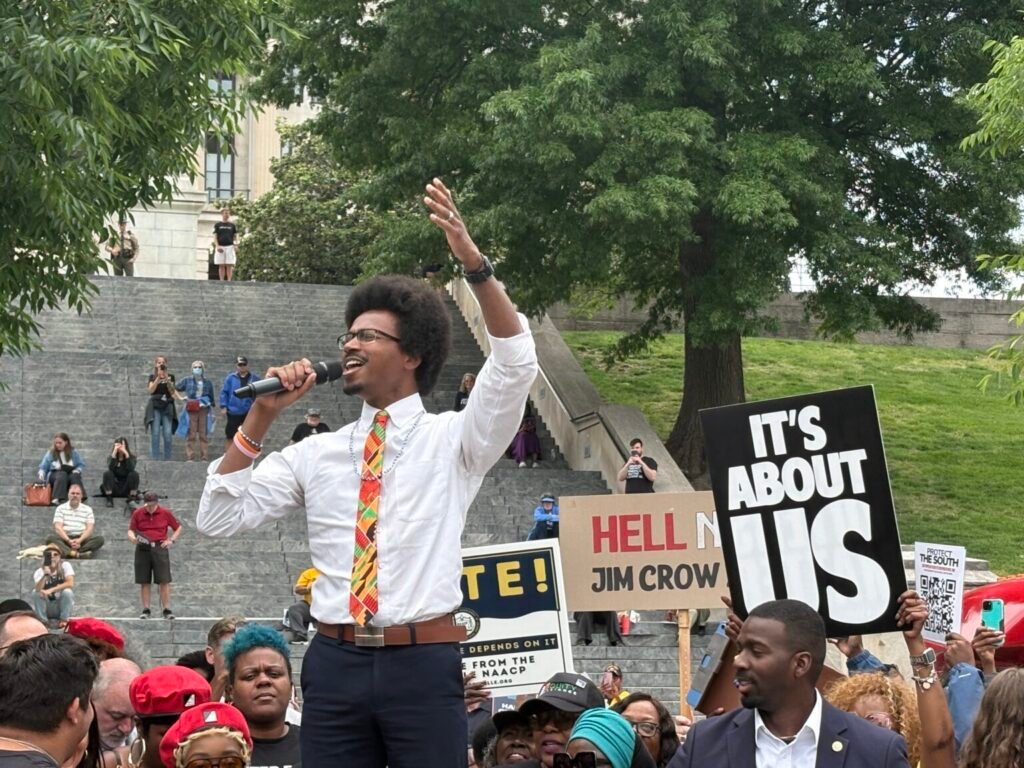
Tennessee State Rep. Justin Pearson, a Memphis Democrat, speaks to a crowd of protesters on May 5, 2026, the first day of a special legislative session called by Republican Gov. Bill Lee to redraw Tennessee’s congressional districts. (Photo by Cassandra Stephenson/Tennessee Lookout)
The day after the U.S. Supreme Court crippled the federal Voting Rights Act, NAACP President and CEO Derrick Johnson addressed a virtual gathering for the group’s members and supporters where he ranked the landmark decision alongside the court’s most infamous cases.
Dred Scott excluded Black people from American citizenship ahead of the Civil War. Plessy blessed policies of racial segregation in 1896. And now there was Callais.
The opinion will “probably go down in the history book as one of three of the worst Supreme Court decisions in the history of this nation,” Johnson said.
The Supreme Court’s 6-3 ruling in Louisiana vs. Callais on April 29 cleared states to split apart, for political gain, congressional districts where a majority of residents belong to minority groups. The court’s conservative majority said Louisiana lawmakers acted unconstitutionally when they intentionally created the state’s second majority-Black district, which the justices found unnecessary.
A week after its release, the decision is roiling politics across the South as states move at a rapid pace to recast the political landscape that has taken progressives by surprise.
Republicans, triumphant over their victory at the court, are rushing fresh gerrymanders through Southern statehouses in time for the November midterm elections in an effort to strengthen their party’s control over the region’s U.S. House delegations. They’re acting at lightning speed, over loud protests, and have nullified votes by suspending ongoing elections.
Democrats, especially Black residents, are furious with both the court and GOP politicians, who they believe are poised to wipe away decades of Black political progress in the region. The new maps that seek to oust Black members of Congress and prevent the election of Democrats in the future recall a Jim Crow past of literacy tests and poll taxes, they say.
“We refuse to let you kill us by killing our vote,” Eliza Jane Franklin, a resident of rural Barbour County, Alabama, told a state House hearing Tuesday.

Decision kicked off legislative efforts
The Alabama Legislature is moving to authorize a special primary election using a congressional map currently blocked in federal court, if a district court or, ultimately, the Supreme Court allows the state to move forward. At least one of the state’s two Black members of the U.S. House would be vulnerable.
In Louisiana, the governor has suspended the state’s primary elections for the U.S. House, setting aside some 42,000 votes that were already cast. Republican lawmakers will begin advancing a new gerrymander in a matter of days, aiming to force out at least one of the state’s two Black House members.
Florida Republican Gov. Ron DeSantis signed a new map into law Monday that aims to hand his party up to four additional U.S. House seats. State lawmakers approved the map hours after the Supreme Court’s decision. The map has already drawn multiple legal challenges.
The South Carolina Legislature is weighing whether to redraw maps. And Tennessee lawmakers want to gerrymander a Memphis district currently held by U.S. Rep. Steve Cohen, a white Democrat who represents the state’s only majority-Black district.
“The Supreme Court has opined that redistricting, like the judicial system, should be color-blind,” Tennessee House Speaker Cameron Sexton, a Republican, said in a statement Thursday unveiling a plan to divide the Memphis area among three congressional seats.
More states, in the South and elsewhere, are expected to pursue new maps over the next two years. Georgia Republican Gov. Brian Kemp ruled out a special session this year, for example, but supports redistricting before the 2028 election.
The current moment represents an extraordinary time in America, said Rebekah Caruthers, president and CEO of Fair Elections Center, a nonpartisan voting rights group. But she also called it a reversion “back to America.”
Many thought the presence of Black, Hispanic and Asian American elected officials somehow meant racial discrimination no longer existed, she said.
“And unfortunately, that is a misread of American history,” Caruthers said. “And perhaps it is a retelling of American history for those who want to gloss over America’s very sordid past, especially when it comes to voting rights.”
Midterms impact
The scramble by a handful of Southern states to redraw districts comes as Republicans grasp for any scintilla of advantage ahead of the midterm elections in November.
A U.S. House under Democratic control would spell the end of much of President Donald Trump’s legislative agenda, produce a wave of investigations into his administration and potentially lead to a vote to impeach him in the House, though the Senate would almost certainly acquit him.
“This is all about Donald Trump wanting to avoid hard questions and oversight hearings about his actions,” Cohen said at a news conference in Memphis.
Seth McKee, a political science professor at Oklahoma State University who has studied Southern politics, said Republicans are attempting to “staunch the bleeding” ahead of unfavorable midterm elections.
“The desperation of this Republican Party, it’s off the charts,” McKee said.
Redistricting push supercharged
Prior to Callais, Trump had already urged Republicans to redraw congressional maps for partisan advantage — a process that typically occurs once a decade after the census.
Missouri, North Carolina, Ohio and Texas enacted more GOP-friendly maps, while Democrats struck back in California and Virginia. In Utah, Republicans want to block a court-ordered map that’s more favorable to Democrats.
Republican primary voters have given their approval to that approach. On Tuesday, five Trump-endorsed state legislative candidates in Indiana defeated GOP incumbents who had defied the president to block a gerrymander in the state last year.
But until now the Voting Rights Act limited how far that gerrymandering push could extend.
For decades, Section 2 of the 1965 Voting Rights Act helped protect majority-minority districts from gerrymandering and ensured voters could elect Black candidates to Congress in Southern states following the end of state laws that blocked Black citizens from voting. The Callais opinion guts Section 2 by curtailing the consideration of race when drawing legislative maps.
Republicans have praised the decision and many have been clear that they believe the opinion opens up a path to securing additional GOP seats. Trump has endorsed disregarding primary elections that have already been held so that states can pass new maps — which he predicts can net Republicans an additional 20 seats this fall.
“We cannot allow there to be an Election that is conducted unconstitutionally simply for the ‘convenience’ of State Legislatures,” Trump wrote on Truth Social. “If they have to vote twice, so be it.”
Calls for GOP seats
Over the past week, some Republicans have cast majority-minority districts previously protected by the Voting Rights Act as racist because they were drawn with attention paid to the racial makeup of the map. U.S. Sen. Eric Schmitt, a Missouri Republican, wrote on X that there are “no more excuses for keeping racist maps,” for example, and called for their immediate removal.
Other GOP leaders have centered their case for quick action on political power. Like Trump, they have explicitly invoked control of the U.S. House as a reason to gerrymander. While Republicans have the House, their margin of control is razor thin: 217 to 212, with one independent and five vacancies. Even a modest Democratic wave in November will likely sweep away GOP control.
Alabama Senate President Pro Tem Garlan Gudger Jr. and House Speaker Nathaniel Ledbetter said in a joint statement that the state’s lawmakers have a responsibility to offer Alabama a “fighting chance” to elect seven Republican U.S. representatives. Two of the state’s seven districts are held by Democrats.
“Control of the U.S. House of Representatives could come down to just a handful of seats, and when the dust settles, the people of Alabama will know that their Legislature stood firm, acted decisively, and did everything within its power to fight for fair representation,” Gudger and Ledbetter said.
Alabama Republicans want to use a map passed by lawmakers in 2023 that federal courts blocked from taking effect. Alabama’s current map was drawn by a court-appointed special master.
Alabama Attorney General Steve Marshall, a Republican, asked a federal district court Tuesday for an order that would let the state move forward with the gerrymander.
In Louisiana, Republicans obtained special permission from the Supreme Court to quickly move forward on a new gerrymander after the justices struck down its current map in the Callais decision.
Absentee voting was already underway in Louisiana before Republican Gov. Jeff Landry suspended congressional primary elections set for May 16. Votes already cast for U.S. House candidates won’t count, Republican Secretary of State Nancy Landry, no relation, has said.
Louisiana state lawmakers are set to begin work on a new map this month that will likely break apart a New Orleans district held by U.S. Rep. Troy Carter, a Black Democrat who has fought with the governor.
“The Court’s decision in these cases has spawned chaos in the State of Louisiana,” Justice Ketanji Brown Jackson, one of the Supreme Court’s three liberal justices, wrote in a dissent of the decision to quickly finalize Callais.
Court challenges
Still, Democrats and other opponents of the gerrymandering effort across the South are turning to the courts. Lawsuits have also been filed challenging the suspension of Louisiana’s congressional primaries and Florida’s new map also faces court challenges.
A petition filed in Louisiana state court by Elias Law Group, a major Democrat-aligned voting rights litigation firm, alleges the governor’s decision to halt the congressional primary is unlawful and unprecedented. Only the state legislature has the power to set the state’s election schedule, the petition argues.
“Governors do not get to cancel elections by executive fiat, least of all elections that are already underway, with ballots in voters’ hands and votes already cast,” Lali Madduri, a partner at Elias Law Group, said in a statement.
Regardless of how the legal challenges play out, Democrats say the Callais decision and the ongoing fallout from the decision underscore the need for massive voter turnout in the November election. A large Democratic turnout that results in a significant Democratic majority in the U.S. House would serve as a rebuke to Trump’s gerrymandering campaign, they say.
Blue state gerrymanders
U.S. Rep. James Clyburn, South Carolina’s sole congressional Democrat, said during the NAACP virtual meeting that a Democratic House could pass voting rights legislation.
“I would hope we could do that because I really think that’s our only hope legislatively,” Clyburn said.
Democrats have long called for the passage of a bill to restore preclearance, a major element of the Voting Rights Act that the Supreme Court paused in 2013, which required states and local governments with a history of racial discrimination to obtain federal permission before making voting changes.
But the measure would face a certain filibuster in the U.S. Senate. Even if Democrats broke a filibuster, Trump would likely veto it.
In effect, Democrats’ most realistic opportunity to enact major voting rights legislation relies on regaining control of the White House and Congress and ending the filibuster — a set of conditions that’s out of reach until at least 2029.
In the meantime, more Democrats are calling for aggressive gerrymandering of blue states as a way to punch back. U.S. House Minority Leader Hakeem Jeffries and Rep. Joseph Morelle, both New York Democrats, on Monday announced an initiative to encourage their state to redraw congressional districts ahead of the 2028 election.
Gerrymandering New York would be an intensive effort, likely requiring voters to repeal or suspend anti-gerrymandering provisions in the state constitution. But voters in California and Virginia have previously endorsed Democratic gerrymanders.
“This is just the beginning,” Jeffries said in a statement. “Across the nation, we will sue, we will redraw and we will win.”



