
When the Supreme Court weakened the Voting Rights Act of 1965 last week, Republicans saw new political opportunities across the South. Congressional districts that were considered strongholds for Democrats, often with majority Black populations, could be redrawn for the first time in decades.
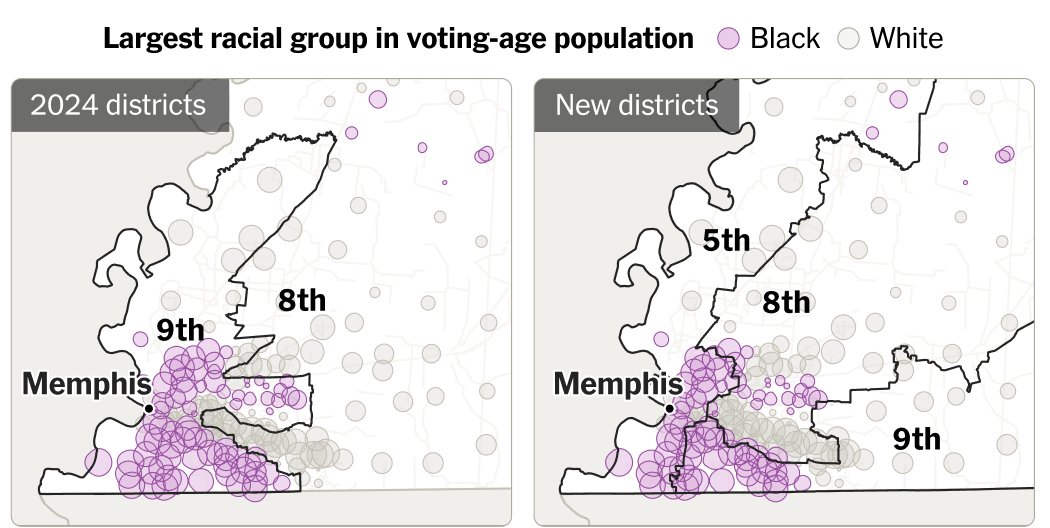
Among Southern states, Tennessee was the first to redo its map, which Gov. Bill Lee signed into law on Thursday. The new map breaks the Ninth Congressional District — a longtime Democratic base encompassing Memphis — into three Republican-leaning districts.
The new map divides areas of Memphis where most of the population is Black among three districts with overwhelmingly white populations, eliminating the state’s sole majority Black district in the process.
The decision to split up Memphis was not a question of race, the state’s Republican leaders said, but of politics — wanting the entire congressional delegation to be in Republican hands. In recent years, the Supreme Court has increasingly let partisan redistricting stand.
The Voting Rights Act had not only required some states to draw districts where minority residents made up most of the population, but offered a way for minority voters to challenge certain districts as undermining their political power. The new ruling, which said Louisiana’s congressional map was an illegal racial gerrymander, made it much harder to argue that a map illegally diluted Black voting power.
As such, Republicans in other Southern states are also making changes to their congressional maps that could swiftly upend political power and racial representation in sharply partisan ways. Democratic leaders in other states have also begun exploring changes to counter Republican efforts.
After the ruling deemed Louisiana’s map unconstitutional, the governor delayed the state’s primaries for the U.S. House of Representatives, and officials began preparing a new map that they said would strengthen Republican control. Those changes are expected to effectively carve up at least one of two majority Black districts before the midterms.
Several other states, including some led by Democrats, have already muscled through new partisan maps of their own after President Trump’s call last year to reshape Congress.
In late April, Virginia’s voters approved an aggressive new map that could hand Democrats as many as four more seats, as the national party tries to take control of the House. Days later, the Florida Legislature, led by Republicans, voted to use a new map, which was then signed into law, that they hope will deliver a similar advantage.
A closer look at Memphis
As the core of the only Democratic House district in Tennessee, Memphis was an obvious target for Republicans looking to pick up a seat through a redrawn map after the Supreme Court ruling.
The district was one of about at least a dozen nationally, most of them in the South, with a majority-Black population. Only two Black lawmakers from Tennessee have ever served in the U.S. House; both were Democrats who represented Memphis. Representative Steve Cohen, a white Democrat, has held the Ninth District seat since 2007.
The district was a successful example of Black representation, State Senator Raumesh Akbari, a Memphis Democrat, said because it assured that “a collection of Black people” could elect their preferred candidate.
The new map will indeed split apart a dense cluster of Democratic voters in the Ninth District — which supported Vice President Kamala Harris in 2024 by a wide margin — into three Republican-leaning districts. On Thursday, the N.A.A.C.P. Tennessee State Conference filed a lawsuit challenging the map. The state’s primaries are scheduled for Aug. 6.
Memphis
Cameron Sexton, speaker of the Tennessee House of Representatives, said on Wednesday that the new map was “based on population and politics,” and that “no racial data was used.”
While Tennessee voted for Mr. Trump by 64 percent in 2024, Shelby County backed Ms. Harris by nearly the same share.
Nashville as a precursor
It was not the first time in recent years that Tennessee’s Republican supermajority had weakened the voting power of a Democratic-leaning city. In 2022, the district enveloping Nashville was also broken up, its voters split among three Republican-leaning, more rural districts.
The redrawing of Nashville’s district to the advantage of Republicans was widely viewed as based on politics, not race. The district was majority white, and Black voters make up a smaller share of the population in the city than in Memphis.
Nashville
“We’ve seen exactly how problematic it can be when you lose your congressional representation,” Mayor Freddie O’Connell of Nashville, a Democrat, said.
Under the new map, Nashville remains divided among three districts. But some residents will now have a new representative, as one of the districts it had been split among no longer includes a part of the city.



