
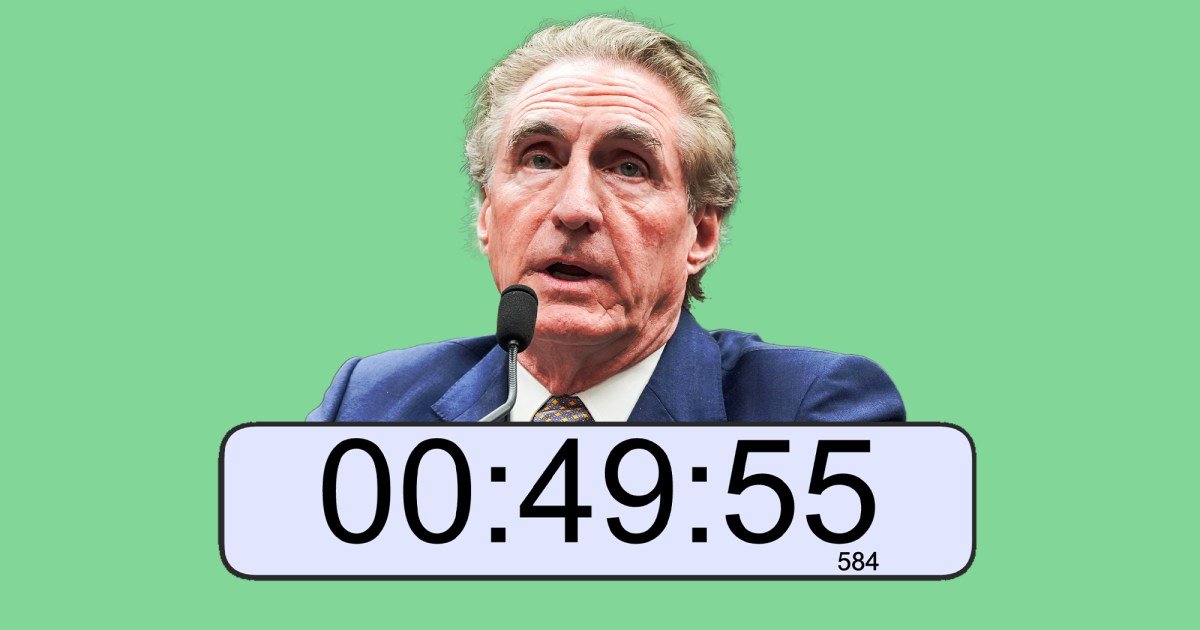
Interior Secretary Doug Burgum recently tried, unsuccessfully, to feed cinnamon Altoids to a Park Police horse. Also, Burgum enjoys artificial intelligence, in particular “AI Teddy,” a planned exhibit at a new facility scheduled to open on July 4 at Theodore Roosevelt National Park. And, it seems, he likes the band Creed.
Those are among the idiosyncratic pieces of information communicated by Burgum during an 88-minute address Wednesday at an “All-Hands” meeting held for around 70,000 Interior Department employees.
In many ways, the Interior Department seems to be struggling. The Trump administration is working to slash the budget and workforce of department components like the US Geological Survey and National Park Service.
Meanwhile the department is racing to open federal lands to mining. And Interior is hurling billions of dollars and no-bid contracts toward what critics call “vanity projects” tied to Trump’s plan for MAGA-style celebrations of America’s 250th anniversary. Those festivities will include a UFC fight at the White House on the president’s 80th birthday and an Indy Car race around the National Mall.
But Burgum on Wednesday touted the department’s “administrative efficiency.” And, in often discursive remarks wending through DOI programs, he made various calls for reducing “red tape” and “redundancies.”
I watched video of Burgum’s remarks and heard from Interior Department employees, who, on the condition of anonymity, provided fact-checking, and mockery, of the secretary’s address.
Some pointed out the irony of Burgum causing thousands of federal employees with more pressing tasks to sit through a hour-and-a-half harangue on operating efficiently. It’s not clear how many DOI employees attended event in person or virtually. The department’s press office didn’t respond when asked how many people were on the call.
Employees pointed out that the first half of Burgum’s speech—organized around slides touting the words, “Gratitude,” “Humility,” Curiosity,” and “Courage”—largely repeated remarks Burgum made about a year ago at a previous departmental all-hands meeting. One department employee said that Burgum had even repeated some of the same anecdotes from the prior year. Employees also noted that for the second year in a row, as the meeting concluded, the Creed song “Higher” played in the auditorium.
Among notable asides was Burgum’s description of his encounter with Sibbell, a US Park Police horse that eats Altoids. Burgum informed the Interior Department that he had encountered the mare during a recent event celebrating plans for the NFL to hold its 2027 draft on the National Mall. “I pull out the Altoids, my favorite…cinnamon Altoids,” he said. “And she did not even blink. It was like: ‘I could care less about your cinnamon Altoids.’”
The upshot of the anedote was that Sibbell (like many horses) prefers mint-flavored candy. But it was also part of lengthy celebration of the Park Police, one component of Interior Department that is receiving more money under Trump. Burgum said that was due to that agency helping the Interior Department to play “a massive part” in the president’s effort to “get DC safe and beautiful.”
That is a euphemistic reference to the deeply unpopular occupation of Washington, DC that Trump began last year. As part of that effort, Burgum deputized immigration agents—who are part of the Department of Homeland Security—to accompany Park Police officers patrolling National Park land in DC. The Park Police helped ICE agents by conducting traffic stops on federal roads and property in the district, in what critics charge was racial profiling.
Park Police also helped carry out Trump’s push to remove homeless encampments in DC. Burgum said Wednesday the agency had “eliminated 82 homeless camps.” And he claimed that occurred without “a front page story and barely a back page story in the Washington Post. It wasn’t even covered.”
In fact, the Post and other outlets reported extensively on the homeless camp removals in stories that noted, contrary to Burgum’s claims Wednesday, that many of the people ousted from tents on federal land did not receive services, or beds in local shelters. Large numbers remain unhoused and some appear to have returned to their former camps.
But the secretary did not tarry on on such wrinkles. In his remarks, he touted Rwanda’s and Ecuador’s park management as worthy of US emulation. “If you’re an American and you wanted to go see the gorillas in Rwanda, or you want to go to the Galapagos Islands, get ready to pay about $800 a day,” Burgum said, in a justification for new fees on foreigners at national parks that critics argue are hurting tourism.
On Burgum’s instructions, the department is removing hundreds of signs and exhibits about American history and science from federal sites to comply with a Trump order to ensure placards are “uplifting” and free of “improper ideology.” As I’ve reported, the purge includes a sign at Fort Laramie in Wyoming about a funeral the US Army held for the daughter of a Lakota chief; signs at Glacier National Park about wildfires, wolves, and the use of dams to support agriculture; and placards at Big Bend National Park about fossils and geology.
But the Park Service is planning to open a new library at an entrance to Theodore Roosevelt National Park in Burgum’s home state of North Dakota as part of the 250th anniversary celebration. And Burgum on Wednesday sounded especially jazzed that the library plans to give visitors the chance to play “that parlor game, which figure in history would you like to have dinner with?”
An “AI Teddy,” Burgum said, will answer questions using words Roosevelt wrote or spoke during his lifetime. It’s unclear whether that will include racist statements Teddy made about Black people (“inferior to the whites”) or Native Americans (“I don’t go so far as to think that the only good Indian is the dead Indian, but I believe nine out of every 10 are”).
Burgum, who last year signed a memorandum of understanding with the United Arab Emirates to collaborate on artificial intelligence, touts the technology as a way for the department to improve efficiency. “If you’re concerned about AI taking your job, then I would just say learn how to use AI and, and, and your job will get better,” he said Wednesday.
Amid the DOGE-driven firing of thousands of National Park Service employees, that agency had lost nearly a quarter of its workforce by mid-2025. Much of the department faces new proposed budget cuts. For a number of remaining employees—many of whom say they feel overworked and beset by ill-advised initiatives from the Trump administration—Burgum’s touting of “administrative efficiency” landed poorly.
Burgum “has implemented 1,700 bureaucratic hurdles on everything we do,” one DOI employee wrote. “No exhibits or social media posts without approval. No travel without approval. Credit card limits…This is the main dissonance of his entire message.”
The all-hands event included awards to department employees who had excelled at cutting “red-tape,” and a QR code for “Interior’s Innovation & Red Tape Reduction Survey.” That form allows agency employees to identify inefficiencies “in the context of mission delivery at Interior…that, if solved, could result in demonstrable improvements in your daily work life and in benefits to industry or the American public.”
The form is publicly accessible, and the Resistance Rangers, a group of current and former National Park Service employees, this week asked its followers to weigh in and send Burgum a message: “fund our parks and stop censoring science and history.”



