
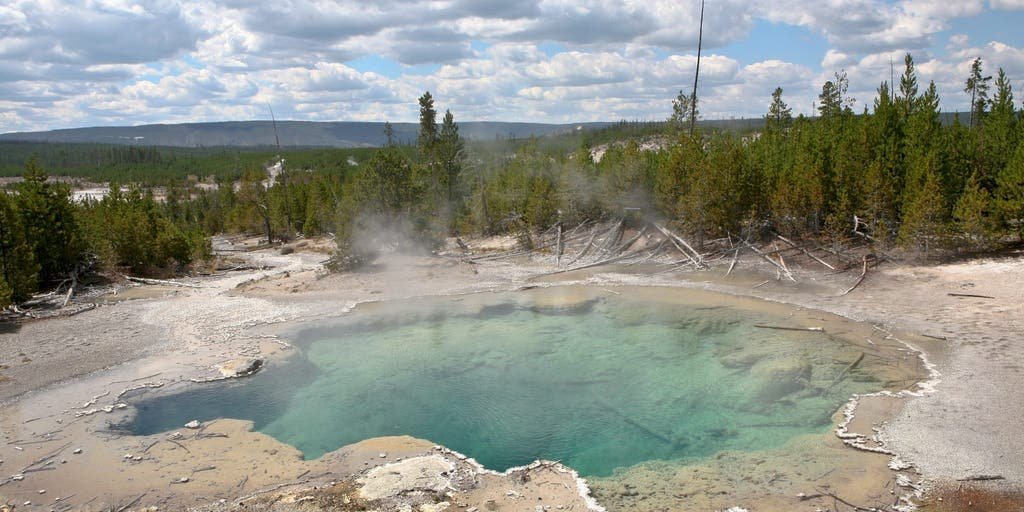
The luxurious geothermal sites are a perfect confluence of water, heat and rock, which dictate where the springs emerge and how hot they can be.
Sightseeing isn’t the only thing happening at some of America’s favorite national parks.
A new study shows that a devastating brain-eating amoeba has been detected in thermal waters at Yellowstone National Park, Grand Teton National Park and Lake Mead National Recreation Area.
The footprint of this deadly pathogen that enters the body through the nose in warm freshwater is expanding, the study finds, into some of the most iconic tourist destinations and scenic landscapes across the United States at National Parks in Wyoming, Nevada and Arizona.
Mammoth Hot Spring, Yellowstone National Park, Wyoming, USA.
(Universal Archive/Universal Images Group / Getty Images)
Researchers with the United States Geographical Survey (USGS) and Montana State University found traces of Naegleria fowleri, a free-living amoeba, that poses a dangerously serious health risk present in hot springs and thermal environment in the popular western U.S. national parks, the New York Post reported.
Colter Bay in June at Jackson Lake in Grand Teton National Park.
(NPS)
The study published in ACS Publications tested 40 thermally impacted recreational waters across five western U.S. national parks and recreation areas were studied, with widespread detection – that reached levels of infection risks – occurring at the three popular national parks.
CHILD DIES FROM SUSPECTED ‘BRAIN-EATING AMOEBA’ AFTER SWIMMING IN NEBRASKA RIVER
According to the Center for Disease Control (CDC), Naegleria fowleri thrives in warm freshwater lakes, rivers and hot springs and can infect the brain and destroy brain tissue.
While brain infections caused by the dangerous amoeba are very rare, they are nearly always fatal.
Echinus Geyser is in the Norris Geyser Basin of Yellowstone National Park. It was named because the cone resembles a sea urchin.
(Getty Images / Getty Images)
Across an eight-year period beginning in 2016, researchers collected 185 samples, detecting the deadly brain-eating amoeba in 34% of them.
HOW TO WATCH FOX WEATHER
The highest detection amounts were recorded in hot springs at the Polecat Hot Springs in Wyoming’s Grand Teton National Park – with up to roughly 116 cells per liter.
Visitors soak in the Firehole River in Yellowstone National Park.
( Bonnie Jo Mount/The Washington Post via Getty Images)
The study detected Naegleria fowleri in several well-known public recreation spots, including Yellowstone’s Boiling River and Firehole River, as well as Granite Hot Springs in the Grand Teton region.
TWO HIKERS ATTACKED BY MAMA GRIZZLY BEAR AND CUBS IN YELLOWSTONE NATIONAL PARK
The study—one of the first large-scale, multi-year surveys of Naegleria fowleri—identified previously unreported locations containing the amoeba, including Lewis Lake in Yellowstone, expanding the known geographic footprint of the devastating pathogen.
Naegleria fowleri, the brain-eating amoeba that causes primary amebic meningoencephalitis can be caught in warm water locations.
(CDC)
Naegleria fowleri typically enters a human through the nose after swimming or diving in a lake, river or other body of freshwater during the summer months, and there have been reports of traces in tap water, poorly maintained swimming pools and chlorine wave parks.
If the amoeba enters the nose and reaches the brain, it can cause a rare infection called primary amebic meningoencephalitis (PAM), an extremely deadly disease that has killed 163 of 167 patients in the United States between 1962 and 2024, according to the CDC.
A boat tows a water-skier across Boulder Basin, set against mineral-stained rocks, on July 28, 2022, in the Lake Mead National Recreation Area, Nevada. Swimming and diving are the most commonly linked activities to Naegleria fowleri infections, but other water-based recreation—including water skiing, splashing, and water festivals—has also been associated with confirmed fatalities.
(Ethan Miller/Getty Images)
While traces of the deadly amoeba have been recorded in some of the U.S.’s most coveted outdoor tourist destinations, there are several ways to mitigate the risk and protect yourself from Naegleria fowleri.
YOU CAN EAT THESE 5 INVASIVE ANIMALS TO HELP POPULATION CONTROL, US FISH & WILDLIFE SERVICE SAYS
The CDC recommends holding your nose or using a nose clip when jumping or diving into fresh water, keeping your head above water in hot springs, avoiding digging in shallow water where the amoeba is more likely to live, and using distilled or boiled tap water when rinsing your sinuses or cleansing your nasal passages.



