
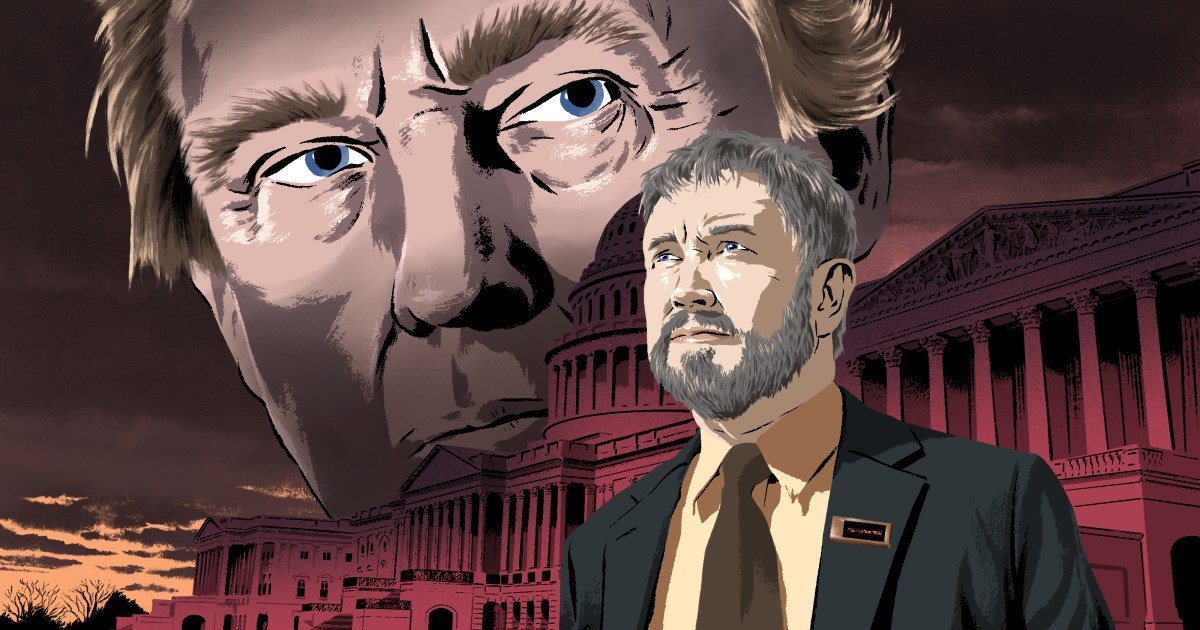
The seventh American killed in President Donald Trump’s ill-defined war on Iran was from Kentucky. Army Sergeant Benjamin N. Pennington, 26, died a week after he was injured during Iran’s March 1 missile attack on a US air base in Saudi Arabia. When his body arrived at Dover Air Force Base, Trump was not there. Two days later, the president did go to Kentucky for a rally; during the nearly two-hour event, he never mentioned the local hero.
Instead, he was there to attack a fellow Republican—a Republican who also happened to be one of the fiercest critics of the war. “Millions of Kentucky families will have more money in their pockets thanks to what we did with respect to tax cuts,” Trump claimed. “But every single Democrat in Congress voted against it…They want tax increases along with just one Republican. He is the worst person…His name is Thomas Massie.”
Massie, Trump fumed, has been “disloyal to the Republican Party. He’s disloyal to the people of Kentucky, and most importantly, he is disloyal to the United States of America. And he’s got to be voted out of office as soon as possible.” Trump urged voters to support his hand-picked challenger, former Navy SEAL Ed Gallrein, who jumped on stage to pump Trump’s hand and lead cheers of “USA! USA!”
What had the seven-term congressman done to become “the worst person”? First and foremost, he worked with Democrats to force the Justice Department to make good on Trump’s campaign promise to release the Epstein files— documents that exposed Jeffrey Epstein’s ties to some of the world’s ultrarich, notably Trump himself.
But that’s only part of it. Over the past year, the MIT-educated engineer has been the lone Republican in Congress willing to challenge a vengeful president. Now he’s locked in a nasty and expensive primary that has been framed as a referendum on Trump’s sinking popularity. But the results on May 19 may have as much to do with the conflict between Massie and his state’s Republican establishment. “He’s at the front lines of trying to define what kind of party it’s going to be,” said Stephen Voss, a political science professor at the University of Kentucky.
For decades, Kentucky politics was dominated by retiring Sen. Mitch McConnell, a traditional pork-barrel conservative who ruled Congress as the Senate’s top Republican, including a long stint as majority leader, for more than 15 years. Massie has worked to break McConnell’s machine and replace it with his libertarian acolytes, an enterprise that has bruised egos, deposed powerful state legislators, and left the losers fuming—but it has also earned him unlikely bipartisan fans.
That internecine battle over the future of the state GOP is now taking on new relevance with Trump’s involvement in the 4th District primary. “If Massie does pull this off,” said Trey Grayson, a former secretary of state and 2010 Republican Senate candidate in Kentucky, “I think we’re going to see a lot more Republicans standing up to Donald Trump.”
Thomas Massie has always been a pain in the ass.
Even as a child, he had that engineer’s directness, an innate distrust of authority, and the gifted kid’s impatience with lesser mortals. “I was simultaneously the teacher’s pet and the teacher’s worst nightmare,” Massie, now 55, told me in one of several interviews over the past few months. “I would like to think I’ve become a lot more tactful, but I still won’t tolerate a wrong answer.”
He grew up in the foothills of Appalachia, what he calls Kentucky’s “hillbilly region.” The state’s public schools fully banned corporal punishment only in 2023, and Massie’s long history with it finally ended when he was in ninth grade. In an early lesson on the dangers of unchecked authority, his physics teacher was upset when he stood up to get a pencil out of his pocket. “A verbal tit-for-tat ensued,” he explained, “and she decided to have me paddled by the principal.”
“I would like to think I’ve become a lot more tactful, but I still won’t tolerate a wrong answer.”
On the far eastern edge of the state, Lewis County is the poorest of the 21 counties in the 4th Congressional District, which has a population of about 776,000 spread out across nearly 5,000 square miles. Its county seat is Massie’s hometown of Vanceburg, population 1,500. Situated near the banks of the Ohio River, Vanceburg is 30 miles from the closest Walmart. The nearest major airport is at least an hour-and-a-half drive away outside Cincinnati.
Alongside the railroad tracks that bisect Vanceburg’s small downtown is the old Denham Distributing Co., a now-abandoned red brick building where Massie’s maternal grandfather once ran the local icehouse before switching to a beer distribution business that Massie’s father eventually took over. A precocious kid, Massie spent his time taking things apart and putting them back together. Even in high school, Dennis Brown, publisher of the Lewis County Herald, told me, “he stood out early for his aptitude in engineering and problem-solving.”

At 15, he built a robotic arm, declared himself the winner of his school’s (nonexistent) science fair, and advanced to the regional fair. His victory there led to the International Science Fair, where he won an award from NASA, propelling him to MIT. Once there, the former high school valedictorian earned two degrees, in electrical and mechanical engineering. He developed a virtual reality technology that allowed users to “feel” what they could see on a computer screen, which he patented with a professor—the first of two dozen patents he would eventually hold.
In 1993, Massie married his high school sweetheart, Rhonda Howard, a mechanical engineer who was two years behind him at MIT. Together, they started a successful company called SensAble to market the technology he’d created in college. It eventually employed some 70 people.
For about a decade, they lived in the “Live Free or Die” state, but even New Hampshire was not free enough for Massie. In 2003, when the eldest of their four children was in first grade, the couple sold their company and moved back to “the Shire,” as Massie calls their 1,200-acre farm in Garrison. About 10 miles outside Vanceburg, the farm had been in Rhonda’s family since the 1950s, and she’d grown up there.
Massie bought a sawmill, a backhoe, and a bulldozer and, using timber from their property, spent two years framing what would become a 4,400-square-foot house, held together with old-fashioned wooden pegs. He installed solar panels and later connected them to a battery he harvested from a crashed Tesla. The only utility bill he’s paid in 20 years has been for Starlink internet. They planted 15 varieties of peach trees and raised chickens and cattle. He planned, as he often says, to “farm until the money runs out.” But December 2011 found a ruddy-cheeked Massie, then 40, standing at a podium inside a barn at a meeting of the Lawrenceburg Tea Party, explaining how someone who had returned to the country because he wanted to be left alone went into politics.
The Tea Party movement was in full swing, with angry grassroots activists warning about the growing budget deficit and excessive government spending and ready to toss out the old guard of the GOP. Massie was their kind of guy. A few years after he’d returned to Kentucky, Massie said, he learned that the county commission was planning to impose a tax to support the construction of a federal research facility. With his 12-year-old daughter, Massie met with the judge executive, the county’s chief administrative officer, and told him, “I’m gonna fight this.”
In a letter to the editor opposing the tax, Massie invited county residents to attend the next commission meeting. Much to his surprise, he said, many did, and the commission eventually abandoned the plan. Soon, he was encouraged to run for office, and in 2010, he was elected Lewis County judge executive, a position that is responsible for managing county budgets and daily operations. He spent his first days in office demanding to know such things as: Why was the county paying 14 different electric bills, like $50 a month to power an old bank sign that had been torn down six years earlier? Eventually, he found enough savings to cover his own salary.
“Every time, I’ve done what I thought was right, even though I thought it might cost me my job. I end up keeping the job.”
Massie’s constituents might have appreciated his investigations, but his elected colleagues didn’t. Especially after he dug into the county contracts, discovered officials who had been profiting off sweetheart deals, then aired all the dirty laundry. The resulting uproar could have meant a single term, he told the Lawrenceburg audience. Instead, those Tea Partiers helped catapult him into Congress a year later. “Every time, I’ve done what I thought was right, even though I thought it might cost me my job,” he told me. “I end up keeping the job.”
In Congress, Massie became known as “Mr. No” for his opposition to most government spending bills. But he wasn’t just a budget hawk. He pushed a libertarian agenda and worked with civil liberties groups to fight government surveillance of Americans under the Patriot Act. Fiercely antiwar, he opposed all foreign aid, including to Israel, and refused to take campaign money from AIPAC, the pro-Israel lobby—one reason why pro-Israel donors have poured money into defeating him. The Republican Jewish Coalition Victory Fund spent $3 million on the race just in the first three months of this year.
Massie’s libertarian bent initially relegated him to the congressional backbench. But then Trump got elected. In 2020, when the pandemic broke out, Massie made national headlines for slowing down the passage of the Trump-backed $2 trillion coronavirus stimulus bill by forcing Congress to vote in person during the lockdowns. The same pain-in-the-ass approach that got him paddled in school drew bipartisan criticism. Trump declared him a “third-rate grandstander” and called for Republicans to boot him from the party. Former Sen. John Kerry (D-Mass.) tweeted, “Breaking news: Congressman Massie has tested positive for being an asshole.”
The dustup between Trump and Massie blew over, and in 2022, Trump endorsed him for reelection—and in 2024, Massie endorsed Trump for president in the general election. Meanwhile, Massie inspired a bit of a cult following, particularly among young men who were attracted to his quirky politics. In 2023, Charlie Kirk, the Turning Point USA founder who was assassinated in Utah last year, declared Massie “one of my favorite members of Congress. He loves the Constitution, he loves liberty. He’s honest and he’s tough…Thomas Massie [is] just terrific.” That same year, then–Ohio Sen. JD Vance told the New York Times, “I absolutely love Massie.”
His life off the grid appeals to right-wing preppers, MAHA anti-vaxxers, and crunchy environmentalists, and his nerd cred remains intact. He invented the smart badge he wears on his lapel that shows the growing US debt in real time. He built a solar-powered robotic chicken coop, dubbed the “Clucks Capacitor,” to tend to his flock when he leaves the Shire for the “Mordor” of DC.
During an interview last June with podcaster Theo Von, Massie described spending two years living in a congressional parking lot in a camper he installed on the back of his F-250. In the summer, it got “hotter than the hinges of hell,” he said, so he ran a 50-foot extension cord to an electric car charger to power AC. “I gotta mix my medical margaritas and keep my raw milk cold,” Massie told a delighted Von. Eventually, he covered the truck’s roof with solar panels and put in a mini-split. This is not because Massie cares about climate change—his Tesla sports a “Friends of Coal” license plate. Living off the grid liberates him from utility bills and political pressures.
“I’d be perfectly happy going back to my farm,” he told me. “If I were to lose, my blood pressure would go down, and my quality of life would go up, so I’m okay with that fate. I think so many of my colleagues just so desperately want the job that they couldn’t imagine doing a single thing that would endanger having the job.”

In September, Massie joined Reps. Ro Khanna (D-Calif.) and Marjorie Taylor Greene (R-Ga.) and victims of the late sex offender Jeffrey Epstein for a press conference at the US Capitol. Despite his campaign promise, Trump had refused to open the government’s investigative files on his old friend and disparaged the scandal as a “Democrat hoax.”
At the event, Massie insisted: “This is not a hoax…There are real victims to this criminal enterprise, and the perpetrators are being protected because they’re rich and powerful and political donors to the establishment here in Washington, DC.”
He urged members of Congress to sign the discharge petition he’d engineered to force a House vote on the Epstein Files Transparency Act—a legislative maneuver that can circumvent House leadership’s effort to prevent a vote but almost always fails. But guided by someone who’d served on the House Rules Committee, this time, it succeeded, and Trump was forced to save face by signing the bill. The Justice Department eventually released 3 million records that included shocking revelations about Epstein’s connections to the world’s rich and powerful, including the president. The documents, for instance, showed that Trump was lying when he said in a 2024 social media post that he “was never on Epstein’s Plane.” In fact, according to flight records cited by prosecutors in the files, Trump had flown on Epstein’s private jet at least eight times in the 1990s.
The Epstein victory that so embarrassed Trump made Massie a household name. In fact, the brief truce between Trump and the rogue Republican had ended long before. Trump was only two months into his second term when he first threatened to have Massie primaried. “I will lead the charge against him,” Trump pledged on Truth Social after the congressman had refused to vote for a short-term spending bill. Massie didn’t seem too worried. “He’s going after Canada and me today,” he told reporters. “The difference is Canada will eventually cave.” Massie went on to be one of only two House Republicans to vote against the president’s signature legislation, the One Big Beautiful Bill, calling it a “debt bomb.”
For Trump, the final straw came in June last year, when Massie worked with Khanna to try to block the president from attacking Iran without congressional approval. When Trump joined the Israeli assault on Iran’s nuclear facilities, Massie criticized Trump directly. “I feel a bit misled,” Massie told Fox News Digital. “I didn’t think he would let neocons determine his foreign policy and drag us into another war.”
Trump was furious. “MAGA should drop this pathetic LOSER, Tom Massie, like the plague!” Trump fumed. Shortly afterward, he deployed his best campaign operatives to try to unseat the Kentucky Republican. Chris LaCivita, Trump’s 2024 co-campaign manager, set up MAGA KY PAC to fund a primary challenge, underwritten almost solely by three pro-Israel billionaires: Miriam Adelson, widow of the casino magnate Sheldon Adelson, and hedge fund titans Paul Singer and John Paulson. Together or through their PACs, they contributed $2.975 million to unseat Massie.
Ads attacking Massie on Kentucky TV started appearing in July. All that was missing was a candidate. Several people the Trump team approached declined to challenge Massie. Finally, in October, Trump announced he would be endorsing Gallrein, a 67-year-old former Navy SEAL, fifth-generation farmer, and one-time state Senate candidate who hadn’t even filed the paperwork yet.
Gallrein has never won an election and has no appreciable platform aside from his fealty to Trump. Fundraising emails from “Team Gallrein” often don’t even mention the candidate. “Confirm your Trump Approval Record,” one suggested. Others warned that if Gallrein loses by “<1%,” Trump could be impeached. And the candidate was not ready for primetime. When he appeared with Trump, he earned a healthy dose of online mockery when his voice cracked in his brief comments. He refused to debate Massie and ducked out of public appearances where he might have to field questions. Gallrein’s campaign did not respond to requests for comment, but he told a local media outlet Thursday that “I’m debating him every day. Please look at the social media.”
But LaCivita has a strong track record of ousting Republicans who are insufficiently loyal to Trump. If Massie’s race were a “lost cause,” LaCivita told me in January, “we wouldn’t be spending money.” He made his name in politics almost two decades ago when his infamous Swift Boat Veterans campaign tanked Sen. John Kerry’s presidential aspirations by attacking his military record. “He is a brass-knuckle brawler who understands what moves voters better than almost any operative I have ever known on either side of the aisle,” his friend Mo Elleithee, a former Democratic operative who directs Georgetown University’s Institute of Politics and Public Service, told me in 2024. “And he pulls no punches.”
LaCivita’s dark arts emerged in full force shortly after the Kentucky Derby earlier this month, when the MAGA KY PAC put out a deep fake ad that claimed Massie was “caught in a throuple.” It used AI-generated images of Massie holding hands with Democratic Reps. Ilhan Omar and Alexandria Ocasio-Cortez and checking into a hotel, as the narrator accuses Massie of voting with “the Squad” against border wall funding and other parts of Trump’s agenda. “It’s a complete and total betrayal of President Trump and Kentucky conservatives,” the narrator says.
Massie responded on social media, calling the ad “defamatory.”
“It reeks of desperation,” he wrote, “but they’re hoping the older generation won’t realize it’s an AI generated lie.”
Trump’s right-wing media sycophants have also launched an underappreciated stealth campaign against Massie that helps explain why GOP members of Congress so fear the president. As one of the most conservative members of Congress, Massie was a frequent guest on Fox News. According to data tabulated for Mother Jones by the nonprofit group Media Matters, he appeared on the network more than two dozen times between January 2021 and the end of 2023; 13 of those were friendly spots on Laura Ingraham’s show.
Things changed after he endorsed Florida Gov. Ron DeSantis for president in the GOP primary. And then in early February this year, after Massie helped gum up an effort by House Speaker Mike Johnson to block future votes on Trump’s tariffs, Ingraham tweeted: “It’s obvious: Massie’s only goal in Congress is hurting the President…Massie needs to go.”
He hasn’t been a guest on Fox since March 2025, when Trump first threatened to primary him. Massie acknowledged that the media blackout has been damaging. “Fox is the biggest source of information about this race,” Massie said, “given the viewing habits of people in my district.” (A Fox spokesperson did not respond to a request for comment.)
Still, Trump’s campaign against him seems to have only emboldened Massie. In February, he became one of six House Republicans to vote to end Trump’s tariffs on Canada, which also hurt Kentucky’s bourbon industry. His insubordination has helped his fundraising. In early March, Massie reported on social media that “the President’s trip to Kentucky generated a fundraising record—we received $109,388 online in just 2 days!”
A super-PAC funded by libertarian billionaire Jeff Yass has bolstered Massie’s campaign. And his loyal donors seem to be sticking with him. For years, Massie’s biggest individual contributor has been Chris Rufer, founder of a California tomato processing company. A lifelong libertarian, he’s given Massie’s campaign $7,000 this cycle. “Thomas is standing up for what he believes in,” he told me. There’s a big difference between Massie and most Republicans, Rufer said: “If he’s not a congressman, he can make a living.”
Massie’s confrontations with Trump also earned him support from another unlikely quarter: blue-state liberals. Massie’s donors include people like Rory Gates, son of Microsoft founder Bill Gates, who gave more than $900,000 to Kamala Harris’ campaign in 2024. He gave $7,000 to Massie this cycle.
“I think these people just don’t know who Thomas Massie is,” Western Kentucky University political science professor Jeff Budziak marveled about Massie’s liberal donors. “He wants to cut Social Security.”
That’s not all. Massie has pushed to abolish the federal Department of Education and withdraw the US from NATO. In 2024, he co-sponsored a bill to attempt to deny citizenship to people born to undocumented immigrants. For Christmas in 2021, he posted a photo of his family in front of their tree holding guns, with the caption: “Merry Christmas! ps. Santa, please bring ammo.”
He’s also a bit of a conspiracy theorist. Long before the Epstein files—a real scandal wrapped in an array of implausible conspiracy theories—he called the investigation into Russian influence in the 2016 election a “hoax.” Last year, Massie co-sponsored then-Rep. Marjorie Taylor Greene’s bill to ban supposed weather modifications like “chemtrails.” More recently, he has promoted the debunked theory that a US Capitol Police turned CIA officer planted two pipe bombs in DC the night before the January 6 attack on the US Capitol. (In December, the FBI arrested Brian J. Cole Jr., who confessed to planting the bombs, but Massie thinks they got the wrong guy.)
“I vote with Republicans 91 percent of the time. And the 9 percent I don’t, they’re taking up for pedophiles, starting another war, or bankrupting our country.”
Normally, someone like Massie would be toxic to Democrats. But these aren’t normal times. “The US Congress would be a much better place if the Republican caucus were made up of just Thomas Massies,” Rep. Jamie Raskin (D-Md.) told me. “Most of the Republicans are just behaving like sheep and responding to whatever Donald Trump asks them to do.”
He compares Massie to people like former Rep. Liz Cheney (R-Wyo.), an arch-conservative hawk who was one of only two Republicans to join the House committee that investigated the January 6 riot. Of course, Cheney lost her seat to a Trump-endorsed primary challenger. Progressives, Raskin said, “don’t agree with a lot of the substance of their politics but support them for their fidelity to the Constitution.”
As liberals have come to his aid, some MAGA supporters have peeled off. In early March, the Turning Point USA PAC posted a clip from Trump’s Kentucky rally calling Charlie Kirk’s favorite congressman a “RINO.” “Trump haters are on notice,” it warned.
Massie insists he is not a Trump hater. “I’ve never attacked the president,” Massie said. “I’m supporting the platform he campaigned on. He’s the one who deviated from that.” And while he’s worked with Democrats, that doesn’t mean he is one. “I vote with Republicans 91 percent of the time,” he told a minion of online provocateur Laura Loomer, who had ambushed him at the Capitol to question his party loyalties. “And the 9 percent I don’t, they’re taking up for pedophiles, starting another war, or bankrupting our country.”

On a frigid Friday night in February, Kentucky political candidates gathered in a local community center for the Oldham County Republican Party’s annual Lincoln Day dinner. On the far western edge of Massie’s district, Oldham is Kentucky’s richest county and a stronghold for Sen. Mitch McConnell’s establishment Republicans. Massie had invited me to meet him there for an interview.
When I walked in, Massie was grip-and-grinning, so I looked for Gallrein. Tall and commanding, he was flanked by a long line of admirers. At the back of the line, I encountered Jerry Smith, a good-natured financial planner with a highball glass in his hand who said his wife had “drugged him here.”
Smith can’t stand Massie. “I don’t give a shit about Epstein,” he volunteered. “I do every damn thing I can to get him out.” The one thing he can’t do, however, is vote against him. Smith lives in Louisville, outside Massie’s district. Smith’s situation epitomizes a key feature of Massie’s nationalized race: Many people have strong feelings about it, but most can only throw rocks or roses from the sidelines.
Denise Graham had already gotten her face time with Gallrein and was happy to gush about him. She is the first vice president of the Oldham County Republican Women’s Club, where Gallrein had appeared in January. “Overall, I was extremely impressed with the man,” she said, calling him “very humble.” Massie, who doesn’t come to her meetings, has “been a thorn in Trump’s side,” she said. “There’s a lot of us in the club who are just over him.”
Does she care about the Epstein files? “Not really,” she confessed. “We have so many other important things going on,” like “the border and girls’ sports.” She thinks there should be justice for the victims, but “should it be the focus, preoccupation of voters for this primary? No.”
She steered me through the crowd to meet the club’s president, Deborah Graham, who immediately radiated hostility from her white pinstriped power suit. Despite having “ridden in his Tesla,” she intensely dislikes Massie and demanded that I leave. When I said that Massie had invited me, she retorted, “He’s not in charge of this dinner.” I needed to buy a ticket, she added. But when I got out my wallet, she got flustered and told me to wait while she consulted the party chair.
The private event was sold out, Graham said when she returned. She declared that I had to go—and that I couldn’t write about it. “I’ll be watching,” she warned. When I told her that I would absolutely write about the event, she lunged forward and tried to grab my notebook. I held onto it but agreed to leave. (Deborah Graham did not respond to a request for comment.) While I waited to retrieve my coat, I asked some of the young Massie volunteers in the lobby to let the candidate know I’d been booted. One who had witnessed the scene shook his head. “Wow,” he said, “they almost make you want to become a liberal.”
As it turned out, I wasn’t the only person manhandled by a party official that night.
After a long list of speakers, Massie took the podium. He recounted his recent accomplishments in Congress, including a bill to ban transgender athletes from women’s sports that had recently passed out of committee. He then detoured to a personal issue that has dogged him throughout the campaign.
In June 2024, Massie announced on social media that his wife, Rhonda, “the smartest, kindest woman I ever knew,” had died unexpectedly at 51. But he didn’t explain the cause. Into that vacuum bloomed the conspiracy theories: that AIPAC was involved, the Mossad killed her, she died from the Covid vaccine. In response to the ghoulish chatter, Massie posted, “The only credible conspiracy I can offer is a gorgeous girl who was a literal genius conspired to make a congressman, who would be steerable by no one but her, out of an awkward nerd.”
Spurred by grief and concerns for his own health, over the next year, the “awkward nerd” quietly underwent another transformation. He took up running and lost 25 pounds in four months. In the glow-up, the glasses disappeared, and a new beard covered his cherubic dimples. In November 2025, Massie, then 54, announced he had married Carolyn Grace Moffa, a 36-year-old former staffer for fellow Kentucky libertarian Sen. Rand Paul.
“Fun facts about our wedding,” Massie wrote on social media. “Of course we served raw milk with the wedding cake and margaritas made with frozen peaches from our farm!” In the post, Massie said that he’d known Moffa for a decade and that she’d even visited him and Rhonda at the farm. Internet trolls seized on the disclosure.
“How did @RepThomasMassie’s wife die?” Loomer posted on X in response to the wedding news. “Why is this such a mystery?…I find it to be so bizarre, and I always have. Now there’s a much younger woman in the picture.”
Rhonda Massie’s tragic death wasn’t a mystery. Massie simply wanted to respect his wife’s privacy. According to a coroner’s report, she had suffered from multiple autoimmune disorders for nearly two decades. One week, she and her family were touring Mount Rainier, and a week later, she was gone. Officially, she died of respiratory complications from chronic autoimmune myopathy.
In February, as more shocking revelations from the Epstein files continued to dog him, Trump turned his fury on Massie again, this time with a new target. Moffa, he suggested, was a “Radical Left ‘flamethrower’” who might be the reason Massie “became a Liberal.”
After generally ignoring such comments, Massie chose to address them at the Lincoln Day dinner because Gallrein had recently retweeted Trump’s attack. “I feel like a woman needs defending,” Massie told the audience, “and I’m going to defend her here tonight.”
He ran through Moffa’s résumé, from her volunteer work as a teenager for Republican candidates to her five years on staff for Paul. “Does that sound like a flame-throwing lefty?” Massie asked. As he was trying to finish his comments—having run over the five-minute limit—Kentucky House Speaker David Osborne stepped in and yanked the mic away from him. “I work for you!” Massie yelled as he was ushered off the stage.
The next morning, Massie called me from a Cracker Barrel, where he was meeting with one of “his mayors.” Far from being upset, he dubbed the now-viral video of the event “the best eight minutes money can buy.” He explained that the House speaker “is upset with me” because he had backed primary challenges against several powerful GOP incumbents. “They were reliable soldiers for him in the state legislature. Now they’re gone, and now they have more people like Thomas Massie and Rand Paul.”
For the past four years, Massie has backed an upstart crop of “liberty Republicans” who are known around the state as Massie’s Nasties. Among the most prominent is Kentucky state Rep. T.J. Roberts, who was a plaintiff in a 2020 lawsuit against Kentucky’s Democratic Gov. Andy Beshear, successfully challenging his ban on in-person worship services during the pandemic. With Massie’s endorsement, at 26, Roberts became one of the youngest people ever elected to the Kentucky legislature in 2024.
Roberts, who last year proposed naming a Kentucky highway after Trump, has said he considers Massie a mentor and shares many of his political stances. But as with many conservative young men, he is also a shitposter who has allegedly flirted with antisemites and white nationalists, including once meeting with neo-Nazi Richard Spencer. In November, a woman emailed Roberts opposing a bill he’d proposed to allow local law enforcement to work with ICE. He responded by sending her an AI-generated video that superimposed his face over Trump’s in a clip of the president telling a female reporter, “Quiet, piggy.” Teri Carter, a liberal opinion columnist for several Kentucky newspapers, wrote a piece calling out Roberts’ sexism. Roberts responded by announcing that he’d bought a new gun and named it after her. (He did not respond to requests for comment.)
Carter told me that while she doesn’t often agree with Massie, she respects him because he doesn’t “blow with the wind” and she finds him “to be genial and pleasant.” His acolytes? “I’m kind of shocked by their extremism.”
While the primary may test Trump’s power over the GOP, it will also test whether Massie’s Nasties have enough juice to help him survive Trump’s attacks. Their informal organization, the KY Liberty Movement, told me in a statement that they have expanded Massie’s base and successfully delivered turnout for him in previous races. Labeling them “extreme,” they said, “is a tired establishment talking point that contradicts the reality of election results.”
But 2026 may present new challenges.
“Thomas Massie has put himself on such an island politically,” noted state Rep. Matthew Lehman, a Democrat who ran against Massie in 2022. He said traditional GOP-aligned groups like the Farm Bureau and Chamber of Commerce have been at odds with Massie for a long time. “He’s been a frustrating representative to have,” he said. People tend to expect their member of Congress to focus on things like “infrastructure, education funding, making sure your district is getting its fair share of federal resources,” Lehman noted, “and that’s just not what he’s interested in doing.”
Plus, Massie refuses to meet with any people affiliated with companies that have a vaccine mandate, effectively ruling out anyone in healthcare, where employees are often required to be inoculated against hepatitis and other infectious diseases. “When somebody asks to meet with my office,” Massie explained, “there’s really only two types of rejections: That’s if you’re a foreign lobbyist or if you have a vaccine mandate on your employees.”
“His very first vote in Congress, he voted against [GOP Rep. John] Boehner for speaker. The man doesn’t understand or care about loyalty.”
Adam Koenig spent 16 years in the state legislature until he became one of three Northern Kentucky committee chairmen successfully targeted by Massie’s operation. “His very first vote in Congress, he voted against [GOP Rep. John] Boehner for speaker,” Koenig told me. “The man doesn’t understand or care about loyalty.”
He recounts the now-legendary story of how Massie emerged from a seven-way GOP primary to first get elected to Congress in 2012. He got an improbable boost from a 21-year-old college student who’d seeded a libertarian PAC with nearly $900,000 he had inherited from his grandfather. The PAC poured $542,600 into ads backing Massie. “No one else was able to raise that kind of money,” Koenig said. Massie was “the only person on TV and he won. He hasn’t had a legitimate primary challenge since then.”
As far as Koenig is concerned, Massie’s current moment in the spotlight nationally belies his popularity at home. “His support is not even a mile wide and no more than an inch deep,” he said.
Massie may not spend a lot of time hobnobbing with the horsey set in Oldham County, but he did help Larry Pancake get elected. Pancake is a singer and songwriter from the far eastern part of Massie’s district that has produced country-western stars like Loretta Lynn and Billy Ray Cyrus. In 2022, the former Greenup County deputy sheriff challenged the incumbent county jailer in the GOP primary. Massie anted up $500 for Pancake’s winning campaign—a decent sum in a state where few people ever make political contributions.
“It’s kind of a libertarian idea that if you’re going to put people in cages, that person should be responsible to the public,” Massie explained, noting that Kentucky is the only state that elects its jailers. But his donation to Pancake wasn’t an outlier. Since entering Congress, Massie has liberally supported local candidates, and they form the backbone of his support. “I’ve given to sheriffs, jailers, commissioners, judges, county executives, state representatives, even state judges,” he said. “I’ve given about a quarter of a million dollars because I felt it was more effective than giving to the Mitch McConnell–dominated state party.”
That’s one reason why local officials who’ve worked with Massie paint a different picture of a politician so unpopular with the Chamber of Commerce crowd. Jessica Fette is the Republican mayor of Erlanger and owner of a local restaurant called The Hive. “He’s always been extraordinarily responsive to me,” she said of Massie. “He even came to my restaurant on opening day.”
The largest city in Massie’s district is the Democratic stronghold of Covington, with a population of about 40,000. Joe Meyer, a former state legislator, retired as the mayor in 2024. “None of the Republicans around here send me Christmas cards,” he told me, but he has a “very close working relationship” with Massie.
After Meyer first ran for mayor, a veteran who’d run in the primary died by suicide. Meyer organized a suicide awareness event and invited Massie. “I still remember him talking about the nation’s venture into foreign wars,” he recalled. “I thought, ‘This guy is a hell of a lot more antiwar than I am.’” The former mayor said Massie has a good rapport with his constituents. “He goes down and sits with the guys around a potbelly stove and plays a banjo,” Meyer said.
And despite his reputation as a deficit hawk, Massie has brought home some bacon. Meyer told me that after Massie voted to uphold the results of the 2020 election, Democrats rewarded him with “a significant sum of money he could allocate in his district.” He earmarked a few million dollars of it to convert a couple of Covington’s one-way streets back to two-way. But later, Meyer said, “a guy from Kentucky, I think his name was McConnell, helped pull all the earmarks out of that budget, including the one for Covington.” Undeterred, Massie turned around and successfully lobbied the state for funding, and the road was completed last year. “He has been doing a terrific job for the city of Covington.”

One day in February, I walked past fake camels grazing in the snow-covered grass in rural Williamstown, as Noah’s Ark appeared on the horizon. The $100 million Ark Encounter is supposedly an exact replica of the original—depending on how you define the biblical measurement of a “cubit.” As I entered, sounds of a thunderstorm roared from speakers overhead. Exhibits described how Noah and his family tended to more than 7,000 animals during the great flood.
Lifelike automatons lounging on rugs or working on ladders gave the impression that the ark was a pretty chill place, aside from the dinosaurs. They may have died out millions of years before humans evolved, but “up to 85 kinds of dinosaurs were on the ark,” a sign explained. Midship cages held fearsome-looking replicas.
A popular tourist attraction in Massie’s district, the ark was created by Australian Christian fundamentalist Ken Ham as a companion to his Creation Museum in the western Cincinnati suburbs. Massie visited shortly after it opened in 2016, declaring it “amazing,” Ham wrote in a blog post. The day before the ark was scheduled to open its live animal exhibit, Massie described calling “some bureaucrat in Georgia to shake the paperwork loose” to secure the USDA permit his constituents needed to bring in real camels.


The ark’s version of history may conflict with what Massie learned in school—he grew up digging for fossils—but as a Christian and a libertarian, he’s respectful of other perspectives. “I don’t judge anybody for having a religion or a lack of it,” he told me.
The Ark Encounter also helps explain Massie’s political survival. The MIT-trained tech entrepreneur/libertarian/anti-vax conspiracy theorist/banjo-playing gentleman farmer almost perfectly embodies the wildly diverse constituencies that make up his idiosyncratic district, where the ark and Boone County Distilling peacefully coexist within 30 miles of each other. “If there’s any place a rogue Republican with a liberty message could hold out against the president’s wrath,” posited the University of Kentucky’s Stephen Voss, “Massie’s district would be a great candidate.”
“If there’s any place a rogue Republican with a liberty message could hold out against the president’s wrath, Massie’s district would be a great candidate.”
Home to the Cincinnati airport, Kentucky’s northern “bump” is the fastest-growing part of the state and a hub of national commerce along the Ohio River. It includes two railroads, three locks and dams, and three major interstates that funnel $1 billion worth of goods a day from Michigan to Miami. DHL, Amazon, and UPS all have a big presence in Massie’s district—one reason Massie has made sure to secure a spot on the House Transportation and Infrastructure Committee. “That I-71 corridor is like a day’s drive from half of America,” said Trey Grayson, the former secretary of state.
And yet, the district’s biggest population center suffers from chronically low voter turnout. “A whole lot of people moved into Northern Kentucky from Cincinnati because it’s cheaper,” Grayson explained. “They’re not as clued in to Kentucky politics.”
In 2024, just over 50,000 people—about 15 percent of registered Republicans— voted in the 4th District GOP primary. “If you go to the Walmart and ask people about the race, you’re going to have to talk to 12 people before you find one who’s even going to vote,” Massie told me. “The race is about reaching those 50,000 people.”
Some of the more motivated voters in the district are Catholics who became Republicans because of abortion politics. And now, Grayson said, a lot of ultraconservative Catholics have been migrating to the area because of the Our Lady of the Assumption Church in Walton, about 20 miles north of the Ark Encounter.
The church’s sanctuary, built in 2010, holds more than 400 people. It was packed when I arrived for high Mass one Sunday. Nuns in habits filled the pews, along with women wearing mantillas. A flock of altar boys with closely cropped hair waved incense burners. The church, which conducts traditional Latin Mass, is part of the Society of St. Pius X, which opposes the liberalizing reforms of Vatican II. From the pulpit, a young priest promised to continue the fight against a Catholic Church going soft on such sins as “self-abuse,” adultery, and the blessing of homosexual unions.
The church and its school are part of the fiefdom of local solid waste magnate Jim Brueggemann. Brueggemann has donated $3,500 to Massie’s campaign, and his Bavarian Waste landfill down the road from the church proudly displays a Massie campaign sign at the entrance. Some of Massie’s staunchest supporters worship at Assumption, including Bill Kunkel, who in 2019 sued the state after it banned his unvaccinated son from playing basketball during a chickenpox outbreak at the church’s school.
Kunkel, known in Northern Kentucky as the “sign guy” for conservative candidates, has put up campaign signs for Massie in every election since 2012. He put up 160 this cycle before his wife got sick. Kunkel told me that he voted for Trump all three times and had a Trump sign on his truck, but now, “all I can do is apologize.” He is deeply unhappy with Trump’s second term, both because of the Iran war and his attack on Massie. “He’s trying to tear down the last great representative that we have.”
After Mass, I went to a nearby Starbucks and ran into a family I’d seen at church. Scott Velarde, the father, asked how I’d liked the service. I asked him about the election. He was a Massie supporter. “I feel he’s got a lot of values that align with mine,” especially his fiscal conservatism, antiwar positions, and opposition to abortion. (Massie isn’t Catholic, but like Rand Paul and his famous father, Ron, he hails from the anti-abortion wing of libertarianism.)
Velarde, who works at a nearby Toyota plant, said that while people loved Trump “for his maverick element,” they aren’t just blindly following him in the Kentucky primary. “I support Massie, and I also support Trump. I’d wish they’d stop fighting.”
At the end of April, the US Supreme Court heard arguments in a case that could result in near-immunity for pesticide manufacturers from 100,000 lawsuits filed by people who may have been sickened by their chemicals. Massie was outside, addressing a crowd of Make America Healthy Again protesters fighting the chemical companies—and the Trump administration. “They want ‘get out of court free’ cards,” he told them. “We’re not going to give it to them.”
In February, Trump issued an executive order to protect the manufacturing of the potentially carcinogenic chemical glyphosate, better known as the weed killer Roundup. Massie has introduced legislation with Rep. Chellie Pingree (D-Maine) that would block the order. He also teamed up with Pingree to strip language from the farm bill the House passed in late April that would have immunized pesticide makers from lawsuits. He plans to continue this work if he survives his primary, using some of the strategies he learned in freeing the Epstein files.
But his victory is anything but assured. Recent polling puts him ahead by only single digits. Looking at betting markets that put his victory odds at 70–30, he said, “there’s a 1 in 3 chance I’m gonna lose.”
The results will all depend on turnout. Massie said he’s blowing Gallrein “out of the water” in every age group except the 65-and-older crowd, but they are the likeliest voters. Regardless of the outcome, Massie thinks Trump’s primary challenge against him that’s likely to cost $30 million may damage the party, particularly in this fall’s midterm elections.
“People are already starting to question the wisdom of this cleansing effort,” Massie told me. “By the time we get to November, we’re going to have a hell of a problem when they realize they’ve alienated a third of the people who got [Trump] elected—MAHA, libertarians, young people.” But if he prevails, “it will be very easy for me to be a gracious winner,” he said. “I haven’t resorted to personal attacks, ever. When [Trump] called me a moron at the prayer breakfast, I told people I was glad I was in his prayers. All of my disagreements have been on policy, not personality. I don’t have anything to apologize for.”



