
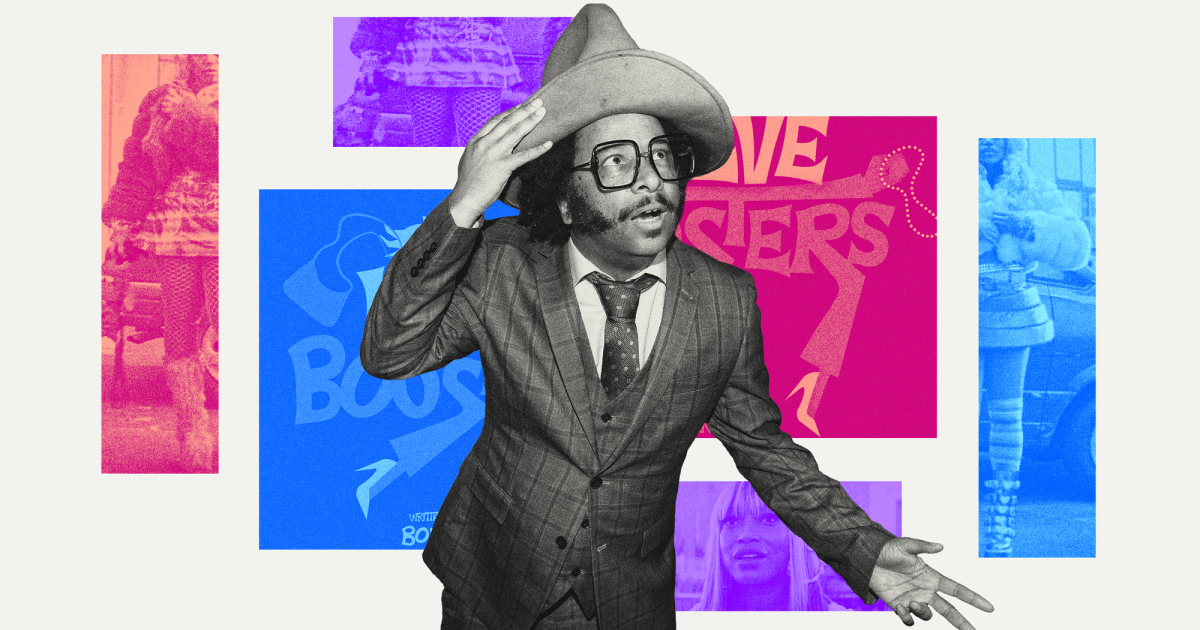
In typical Boots Riley fashion, I Love Boosters is jam-packed with surreal, science-fictional, and even supernatural elements.Mother Jones illustration; Courtesy NEON; Mat Hayward/Getty
A few days before May Day—International Worker’s Day—I traveled to Oakland’s Grand Lake Theatre for the West Coast premiere of activist-writer-director Boots Riley’s sophomore film, I Love Boosters. The 100-year-old movie palace—which was one of many businesses across the country closed on May Day in support of workers’ rights—seemed a fitting place for Riley’s star-studded satire to debut.
As the centerpiece of this year’s San Francisco International Film Festival, at which Riley also made his directorial debut in 2018 with Sorry to Bother You, it was a packed house, with a long line of prospective popcorn munchers outside the venue hoping to cop a last-minute ticket. Like Riley’s first film, Boosters—also the title of a track on Pick a Bigger Weapon, a 2006 album by Riley’s hip-hop group the Coup—is an incisive critique of capitalism set in the Bay Area.
This time, Riley turns his lens on the fashion industry, zooming out through the supply chain to reveal the layers of exploitation usually rendered invisible. The film follows Corvette (Keke Palmer) and her gaggle of stylish, shoplifting women, or boosters, feuding with an oddball designer played by Demi Moore. And in typical Boots Riley fashion, it’s jam-packed with surrealist, sci-fi, and even supernatural elements like teleportation machines and demons. Plus some good old Marxist philosophy.
“Pointing out the problem is not enough, although I might enjoy those movies…we need something that makes people want to join a movement that can win.”
After the credits rolled, Riley and cast members Eiza González, Poppy Liu, and LaKeith Stanfield took the stage, and began fielding questions from a moderator. Asked what he thought when he first read the script, and what made him excited to be a part of the project, Stanfield said that he knew Boosters would “push the art form forward” and allow him and the rest of the film crew to speak to “this social issue that I think that we’re having trouble with, which is unity.”
“We have to challenge these structures above us,” he said, “and we’re only going to be able to do it together.”
The next day, while walking through downtown San Francisco to interview Riley in person, I watched a small plane cruise above the skyscrapers, dragging a banner through the cloudless sky that read, “STOP HIRING HUMANS.” It would have fit perfectly into one of Riley’s cartoonishly dystopian worlds—which is perhaps why his films resonate so much in our late-stage capitalist hellscape. Shortly after, I sat down with the filmmaker to discuss his inspirations, his thoughts on the state of socially conscious films, and I Love Boosters, in theatres on May 22.
This conversation has been edited for length and clarity.
What was it like being back at Oakland’s Grand Lake Theatre for the premiere of your sophomore film?
Well, Grand Lake Theatre, I’ve gone to since I was kid. [I] saw so many formative movies there. And since I did Sorry to Bother You, and they did so well with it, they gave me a lifetime pass to go there. So I go there all the time. I know everybody that works there. But just showing it in Oakland as well, it’s a real treat.
That’s amazing. I know that you encountered some obstacles in producing Sorry to Bother You. I wonder, after the massive commercial success of that, what it was like this time around.
It was a lot easier. It didn’t take that much shorter [an] amount of time, but it was a lot easier to convince people that they should do it.
Last night, you described I Love Boosters as your best work yet. What about it are you most proud of?
So many aspects. One, I feel like we got amazing performances. [And there’s] just so many cinematic things that I don’t think people have seen before. The connection to the characters that people feel when they’re watching, the roller coaster ride that people take, the politics of it, the fact that people are crying at different points.
To me, it felt like it ended on a more optimistic note than Sorry to Bother You. I’m wondering if that’s how you feel about the ending as well, and sort of how you came to that conclusion.
I don’t know. I feel like Sorry to Bother You ends with the Equisapiens leading an uprising against Steve Lift [played by Armie Hammer]. There’s something optimistic about that. So I don’t feel like it is more optimistic. I think maybe I expressed it a little more clearly [in I Love Boosters].
What do you think of the rise of socially conscious or anti-capitalist films that we’ve seen in the past five years or so? Because I feel like since Sorry to Bother You, there have been more movies that sort of touch on those themes.
Which ones are you thinking of?
Like Parasite, No Other Choice, Triangle of Sadness, or The Menu, that I think all kind of get at those themes to varying degrees of success.
I haven’t seen all of those movies. I have seen Parasite, and I’ve seen some other movies that might fall into that. [The thing is,] for instance, the Coup came out at a time when there were all these other things that were supposed to be conscious music, conscious hip-hop. The difference with us is that we were putting forth the idea that we need to be involved in class struggle to overthrow the ruling class. To me, they weren’t the same kind of music at all.
Often [one] would be like, ‘Hey, you need to change what you’re doing,’ right? Or, it would be like, ‘Here’s how the world is fucked up.’ I’m glad that there are movies that are saying, ‘Here’s how the world is fucked up,’ but I think what we need is a movement that actually tries to change things, and that movement needs to be a mass, militant, radical labor movement that uses the withholding of labor as a tactic and strategy to change policy and grow more revolutionary.
“We need victories…and we need to let people know about those victories.”
Pointing out the problem is not enough, although I might enjoy those movies. I think that what we need is something that makes people want to join a movement that can win. I think a lot of these things are saying it’s all bad, it’s nihilistic. I can’t say that about Parasite, I’m forgetting how it ends. But we need films that get people to join organizations, join movements, campaigns, parties, to help make and push this movement forward and make change. I don’t see that as a similar sort of a thing.
I see those movies as maybe having a more accurate world that they paint as far as the power relationships. But I think the point is that if you don’t make stuff where it shows that someone is actually struggling to change it, even if your main characters aren’t, if there’s no class struggle, not just class conflict, but class struggle, collective struggle, if that doesn’t exist in the world, then it ends up becoming defeatist.
I’m not gonna say, ‘Make it all your characters want to be Violeta [Eiza González’s character in I Love Boosters] or Squeeze [Steve Yeun’s character in Sorry to Bother You].’ [But] I think you can have danger with Squid Game, things like that, of being like, ‘See, the world is fucked up. Told you, that’s why nothing can work.’ At first it feels like a revelation, and it is that, ‘Wow, they are pointing out what’s happening,’ and sometimes they’ll have stuff happen where someone is rebelling against it. [But] we do need people to know that there’s a movement that they can join, there are things happening.
Since you mentioned Squid Game, that makes me wonder, when you’re creating art, how do you prevent it from being co-opted? I think about how Squid Game went on to be a game show.
I think it’s connected to the end point [of] this growing radical labor movement. And if somebody decided to continue the story and have the radical labor movement even existing right now, that would be a win. So I’m not worried about that. I’ll put it like this, and this is also why I would say Sorry to Bother You being optimistic is a thing. Because between 2020 and 2024 was the largest strike wave in the U.S. since the ‘70s, thousands of strikes and work stoppages [happened], a lot of them in places that didn’t have unions before, new unions popping up, just work things happening.
“I got messages that said some version of, ‘We had everybody watch Sorry to Bother You, and then [they] voted to strike.’”
Anyway, during that time, I got dozens of messages that said some version of, “We were trying to organize a union, or we were trying to make a strike happen. We were pessimistic that it could happen.” There was pushback, different things like that, because that’s always what happens, right? And all of them had some version of, “We had everybody watch Sorry to Bother You, and then everybody voted to strike, or everybody voted to make the union.”
So yeah, you can make another movie that continues that story, but that story is already continuing on another plane. It doesn’t matter what you do, by having the story go on, it’s already in the world in a different way.
You mentioned your music career, and I read that you’ve been making music for your films since you were a student at San Francisco State. How does your music inspire your filmmaking and vice versa?
Yeah, for [I Love Boosters], I didn’t make the music. Tune-Yards made the music for my film. I made the soundtrack to Sorry to Bother You, which was different [from] the score. But my process of making music is definitely a huge part of how I make film, what I go for—as far as visceral responses, as far as how I want people to not just know a thing is happening, but feel things happening, go along with that character, and use all the techniques I can to do that.
I will often be in the studio, and I’ll be the worst musician in the room, and it might be the best guitar player in the world, and a drummer that thinks he’s the best drummer in the world, and the bass player that’s really good. But I have to know that they are experts at their instruments, but I’m the only one that’s an expert at this idea, and so I have to figure out how to communicate to them, how to get them interested and get them to see what I’m doing.
And then, on top of that, know that just because the guitar player wants a solo, and he’s the expert at guitar doesn’t mean he’s the expert at what this is so [I have to] be able to say no, or to know that when the bass player says, “Oh, I got a better idea for [the] bass line,” to be like, “That is better”—and also to just go for it, make the thing you think you want to make, and if it doesn’t work, it doesn’t work.
Switching gears a bit… I wanted to ask you about your hat. I noticed it at the premiere yesterday, and you’re wearing it today. Do you know how tall it is?
I don’t. I have a lot of hats. I’m wearing the turquoise one a lot—one, because the costume designer Shirley Kurata got it for me as a wrap gift, but two, because it connects to the character of Corvette [Keke Palmer’s character in I Love Boosters]. But these are all from Uptown Yardie. It’s a guy’s business in London, and he is kind of inspired by Jamaican Yardie culture. I don’t know how tall it is, though.
Got it. And that was actually my next question: I was gonna ask if your hat was turquoise or aquamarine. [Another nod to the film.]
[Laughs.]
How would you compare your sensibilities as a filmmaker to fellow Oakland native Ryan Coogler—and I guess I’ll make this a two part question: what would you do if you had a $100 million budget, if you wanted to even make a movie at that scale?
Well, with this $20 million budget, I made a movie that has more than a lot of $200 million budget movies have. I don’t know. I don’t go from the budget. I go from the story that I want to tell, [and] I don’t ever know what the budget for that is.
How do we build a labor movement without a teleportation machine?
You can connect without a teleporter. You can connect to other movements that are happening around the world. But you have to be organizing first. The real thing is you have to be organizing first where you are. You have to be making that exciting. You do connect, like, “Hey, this is what’s going on over there. This is what we can do here.” That sort of a thing. You just do that through conversations. And you do that through building up small actions and getting people involved.
And there’s already one. Like I said, we had that strike wave that happened, and we also had, in Minnesota, a one-day strike that was symbolic, but it was hundreds of thousands, maybe millions of people involved in a strike, a general strike that was not even just for their own immediate personal good. It was having to do with class solidarity against fascism. That’s qualitatively more radical than many things that have happened in the US in a long time.
The reason it took the form of a strike is because we’ve got this movement started and growing already, and the way that we do it is we need victories. We need some victories, and we need to let people know about those victories.
Do you have any final thoughts?
I need everybody to go see this May 22, and if you like it, tell folks about it.



