
India is planning a nationwide overhaul of its aviation backbone, rolling out its most aggressive expansion yet with up to $40 billion planned through to 2040. Airbus forecasts the commercial fleet will triple to 2,250 aircraft by 2035, even as the airport network expands from 149 to 200‑plus, backed by parallel build‑outs in maintenance-repair-operations (MRO), hangars, vertiports, air traffic control modernization and clean‑energy aviation assets.
The estimated $18-24 billion airport procurement pipeline over the next four years is shifting from mega-hubs to a wider grid of small and mid‑sized airports, opening global opportunities. Planned upgrades include terminal expansions, longer runways, larger aprons, new tech blocks and expanded city‑side assets. Greenfield sites include Parandur, Puri, Dholera, Kota, Alwar, Mandi, Raichur, Doloo, Kottayam, Sonepur and Saharsa.
Business aviation growth is triggering over 30 new terminals this decade—a $1.2–1.8 billion build‑out—while some $4-5 billion in cargo infrastructure is planned across 20–25 airports.
“India’s aviation‑infrastructure push has become far more predictable and investible, with liberalized foreign direct investment norms, stronger regulators, clearer concession frameworks and wider use of arbitration improving contractual certainty,” says Sonam Chandwani, managing partner, KS Legal & Associates.
Engineering Depth
Tata Projects Ltd. (TPL) managing director and CEO Vinayak Pai says the company is moving into deeper roles across airports, MRO complexes, renewable‑energy power bases, and cargo and logistics infrastructure.
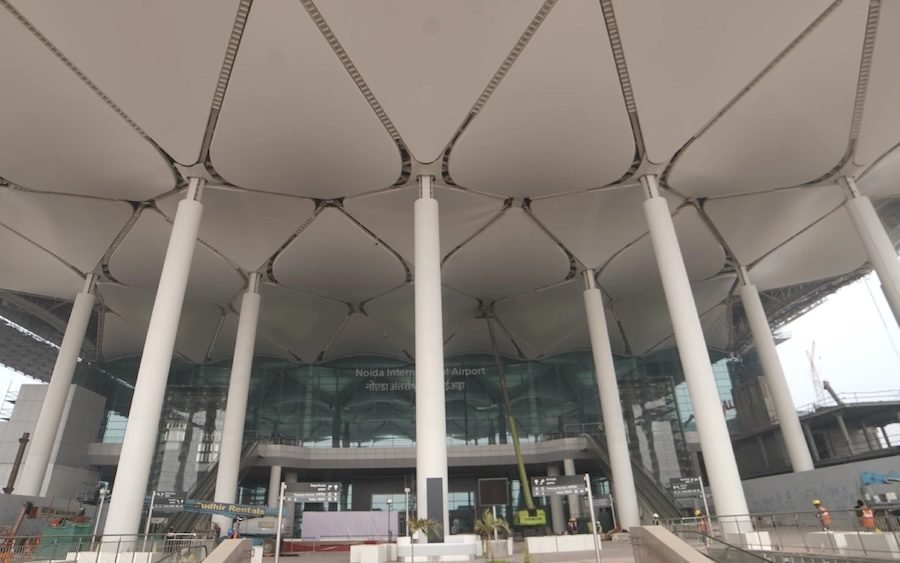
TPL’s partnership with Yamuna International Airport and Zurich Airport International for Delhi’s second international airport at Jewar is “one of our most iconic programs.” The scope includes a terminal, a 4‑km runway, airside and landside systems, utilities, cargo terminal, an air traffic control tower and ancillary facilities with a workforce exceeding 100,000, he adds.
“A runway looks simple but is extremely complex,” he notes. “You move layer by layer, integrate electrical conduits, design drainage and future‑proof the entire system.”
Looking for quick answers on construction and engineering topics?
Try Ask ENR, our new smart AI search tool.
Ask ENR →
Renewable energy systems, rainwater harvesting and sustainable materials have been integrated. Connectivity is anchored by the Yamuna Expressway, with future multimodal links planned. Designed for long‑term expansion, the airport will scale to 70 million passengers annually, two runways, expanded terminal capacity and aircraft maintenance infrastructure.
“With 200‑meter clear spans, minimal columns and dense mechanical-engineering-plumbing, terminals and rail stations are now conceived as experiential spaces,” says Pai. At Jewar, geometric complexity forced site‑measured fabrication of purlins and roof members, Pai says, a challenge of delivering such complexity in a 2.5‑year schedule.
Next‑Gen Build Surge
While BIM models, 3D camera‑based monitoring, drone mapping, robotics and software‑based enterprise resource planning platforms are now standard, digital twins remain a work in progress, Pai says, noting that a true digital twin requires item‑level cataloging, embedded sensors and predictive‑maintenance logic.
International interest in India’s MRO market is accelerating. TPL is collaborating with Singapore‑based ASI Global, which with its design center in Sydney is known for aircraft hangar design, modular steel structures and turnkey MRO facilities. Valued at approximately $245 million each, “India will need two to three new MROs every year for the next four years. We project an approximate 40 percent share,” says Pai.
Meanwhile, SP‑PLUS AG is backing a $250 -million first‑tranche investment to build a new MRO hub in Bhopal, the opening move in a wider Indo‑Swiss $5-billion aviation program spanning MROs, airports, training, defense‑tech and aviation finance, with Fly Bharathi Group.
India needs 300–350 new hangars ($2.6–3.3 billion), while 160–200 legacy hangars require retrofits, and defense airfields and ships require 100–120 new units. “[European safety standard]‑compliant, climate‑controlled hangars with doors are mandatory abroad. India will need to follow the regulations as it seeks to service European-registered and leased aircraft,” says Pratik Gandhi, senior manager at Mumbai-based Gandhi Automations.
The question today is no longer whether Electric Vertical Take-Off and Landing aircraft (eVTOLs) will fly in India, but how quickly the ecosystem can align to make them viable.
“Advanced air mobility will be defined by ecosystem collaboration, not standalone innovation,” says Clem Newton‑Brown, CEO and Founder of Australia’s Skyportz. In partnership with Vertiports India, the company plans to model 10,000–15,000 sites by 2045 to support a projected fleet of 2,500–3,500 eVTOLs. The company recently launched Aeroberm, a modular fractal vertipad that reduces downwash, noise and fire risk, enabling safer, smaller‑footprint rooftop operations in congested urban cores.
India’s Sustainable Aircraft Fuel (SAF) Transition
India’s SAF evolution is crystallzing into a $2–3 billion, decade‑long contracting cycle spanning Alcohol-To-Jet plants, Hydroprocessed Esters and Fatty Acids (HEFA) refineries using LanzaJet, UOP Honeywell and Neste technologies, biomass‑to‑jet pilots, certification labs, airport‑side infrastructure and carbon‑market systems. GPS Renewables has secured NTPC’s (the nation’s largest power utility) engineering, procurement and construction mandate for India’s first 1,800 TPA ethanol‑to‑jet ATJ plant at the Pudimadaka Green Hydrogen Hub, targeted for March 2029.
SAF tenders will be put out in the next couple of years. Alcohol-to-jet bids in Maharashtra, Uttar Pradesh and Karnataka will be followed by packages for dehydration, oligomerization and hydrogen‑supply units once licensing deals with LanzaJet, Gevo and Axens close. Under India’s April 24, 2026 SAF framework, public‑sector oil companies must commission at least one HEFA plant by 2028, triggering 2027 bids covering methanol-to-jet Honeywell/Neste licensing, used-cooking-oil/tallow logistics and refinery integration.
India’s first commercial HEFA unit has been mandated by the government of India under the April 24, 2026 SAF regulatory framework, directing public‑sector oil marketing companies to commission at least one HEFA‑route plant by 2028.
In parallel, TPL has been appointed as partner for SAF One Energy Management’s Middle East HEFA project with UOP Honeywell, a move that anchors a “design once, build many” global rollout including an India facility, giving Tata a modular, scalable execution role across pretreatment, hydroprocessing and constructability‑driven integration.
Airport‑side tenders for SAF blending terminals, segregated tanks, pipeline retrofits and book‑and‑claim digital systems at Delhi, Mumbai, Bengaluru and Hyderabad are expected next year, once upstream volumes firm up—forming India’s first coordinated, end‑to‑end SAF contracting cycle with global licensors supplying the chemistry and Indian builders delivering the facilities.
Source: www.enr.com



