
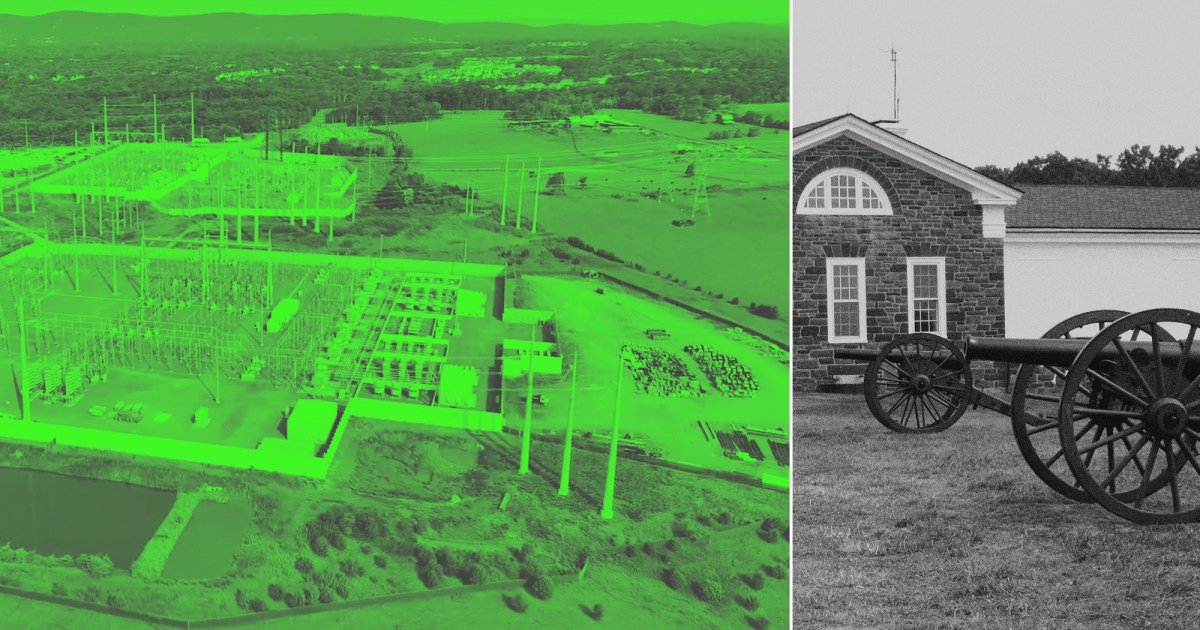
Mother Jones illustration; Hugh Kenny/PECVA; Billy Hathorn/Wikimedia
It’s hard to make a story about data centers interesting. I know this because that was the goal I gave myself recently: Report a data center story that wasn’t totally soporific. And honestly, it was a challenge. Whether I succeeded remains to be seen—breaking news, I did!—but what I learned during my reporting has been the subject of every dinner party discussion I’ve had for months.
You’ve probably heard that data centers are sprouting all over America like weeds in an empty field. You may also have heard that they are huge water hogs, sucking up more H2O than the Kardashians of Kalabasas™️. What you might not know is that their electricity guzzling has caused energy bills to spike through the ceiling all around the country. And their need for vast swaths of land has resulted in the bulldozing of natural habitats from Oregon to Florida. Basically, if you want to be dramatic about it—and I do—data center proliferation is a harbinger of humanity’s demise at the hands of our AI overlords.
But this digital gold rush isn’t just threatening open tracts of land or pristine rural watersheds. It’s infringing on residential neighborhoods right outside major US cities. In fact, developers are trying to buy whole suburban communities as sites for these moaning monoliths, these temples of technology. In exchange for thousands of acres of residential property, data center developers promise they will bring jobs, infrastructure, and much-needed municipal revenue to places like the Northern Virginia suburbs, right outside Washington, DC, where I live.
Here’s the gag, though: The jobs are temporary, the infrastructure is useless, and the revenue is diminishing and offset by monster tax breaks. The developers are counting on public ignorance about what the Brookings Institution calls the “little durable local economic upside” of data centers. They are swanning into communities like Prince William County, Virginia, where I did most of my reporting, with sackfuls of cash, offering folks a Faustian deal of sorts: We’ll give you gobs of money to scram from your property, or you can stay on your little patch of earth and we’ll build colossal data centers all around you. Not a great bargain.
For the past few years, developers in Northern Virginia have been trying to push through the world’s largest data center project to date. If built, the Prince William Digital Gateway would be roughly the size of 61 Pentagons spread over 2,100 acres. And a good chunk of that acreage abuts the Manassas National Battlefield Park. Now, if you’re not a Civil War buff and you didn’t know that this battlefield is one of the most important in the US, you’re forgiven. But it’s so important that when the legendary documentarian Ken Burns—he of the epic 11-hour Civil War miniseries—found out that some developers were trying to turn a buck by building a bajillion new data centers right outside the battlefield’s gate, he was like, Oh, hell no. And he wrote a very sternly worded letter to the county’s Board of Supervisors expressing his distress and admonition.
It wasn’t just the inimitable Kenneth Lauren (real middle name) Burns who protested the arrival of the gargantuan tech project. Neighbors also took up the mantle. When the development came up for a final vote, all kinds of folks came out to speak their minds: a man whose family had farmed the land for generations, a Civil War reenactor in a sack coat and forage cap, and a lady who sang an anti-data center ditty to the tune of Joni Mitchell’s ubiquitous “Big Yellow Taxi.” They paved paradise and put up data centers, indeed.
I won’t tell you the outcome of this David vs. Goliath cage match royale. You’ll just have to learn the fate of our collective digital future by listening to the story on Reveal.
Editor’s note: This post was not written by AI, despite how perfect and clever and 100 percent factually accurate it is. It was written by a human with seasonal allergies, an extreme aversion to stone fruits, and two breathtakingly naughty dogs.



