
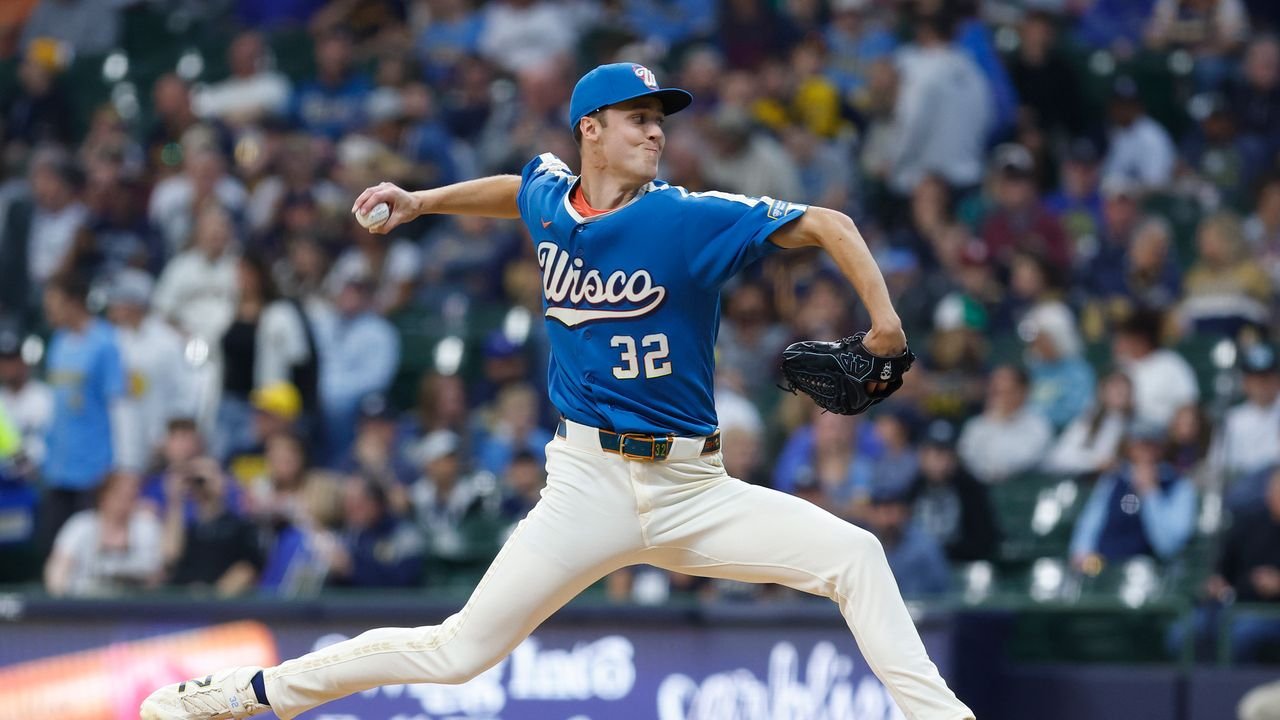
There have been power pitchers throughout the game’s history, of course: Bob Feller, Bob Gibson, Walter Johnson. Randy Johnson once accidentally exploded a bird with his fastball. Nolan Ryan threw a hundred miles per hour, on his way to a record 5,714 strikeouts. But Ryan was an outlier. No one else was doing it.
Now better training methods and new technology—in particular, camera and radar networks that can precisely measure a ball’s movement and create three-dimensional models of a pitcher’s mechanics—have helped pitchers learn to throw harder and harder. They spend their off-season at special baseball facilities training their arms—or, more often, building up their legs, which is where most of the power comes from. In 2008, there were just two hundred and fourteen pitches thrown at a hundred miles per hour or more. In 2025, there were 3,701 of them.
This has led to something of a crisis, or possibly two. For one thing, that extra speed—plus a spike in spin, which has allowed pitchers to throw harder while also making the ball swerve, dive, and kick—has given pitchers an even greater advantage over batters than before. According to Statcast, there were nearly twelve thousand fewer balls hit in play during the 2025 season than in 2008, and the lack of offense has made the game a little less exciting. More worrisome, though, is what throwing at maximum effort does to a human arm. Tendons and ligaments remain weak links, and the harder you throw, the more torque on your elbow. Consequently, the number of arm injuries has exploded. More than a third of major-league pitchers have ruptured their ulnar collateral ligament, requiring so-called Tommy John surgery, which can take more than a year to recover from. And those who haven’t had it yet can expect to. Teams basically price such injuries into their expectations for a young pitcher. They can do that because hard-throwing pitchers are becoming more and more fungible. When one goes down, there’s always another.
Misiorowski, a product of Crowder College, a junior college in Neosho, Missouri, threw forty-three pitches at a hundred miles per hour or faster during his recent outing against the Nationals. He threw another forty-one against the Yankees, including ten straight. And last week, facing the San Diego Padres, he threw forty triple-digit fastballs again. Batters can expect him to throw a four-seam fastball: he uses that pitch more than sixty per cent of the time.
That’s another thing that sets him apart from most top starters. Tarik Skubal, the two-time American League Cy Young Award winner, can throw about as hard as Misiorowski, but Skubal uses his four-seam fastball less than forty per cent of the time. Modern technology lets pitchers experiment with grips and spins to create gnarly movement and ambush batters with off-speed action. Max Fried, the Yankees’ ace, throws seven different pitches. So does Shohei Ohtani. Misiorowski throws just three pitches with any regularity, but he throws his four-seam fastball so hard that the element of surprise is hardly necessary. His fastball not only arrives faster than the blink of an eye but also comes in at a tricky angle. When Misiorowski pitches, his muscular legs take a long stride down the mound, and then his skinny right arm, which is as loose as a whip, follows. (He’s built like a centaur.) As a result, he releases the ball closer to home plate than any other pitcher. And his length lets him get low. That, along with the angle of his arm—his arm slot, in baseball terms—adds another layer of deception. His fastball comes in flatter than it looks to the batter, creating the illusion that it’s rising—a ball that appears to be at the top of the zone out of his hand might actually be a few inches above it, tempting batters to swing under. All that “makes for a tough day,” as Judge said after facing the young pitcher. Judge called Misiorowski’s fastball one of the best he’d ever seen.



