
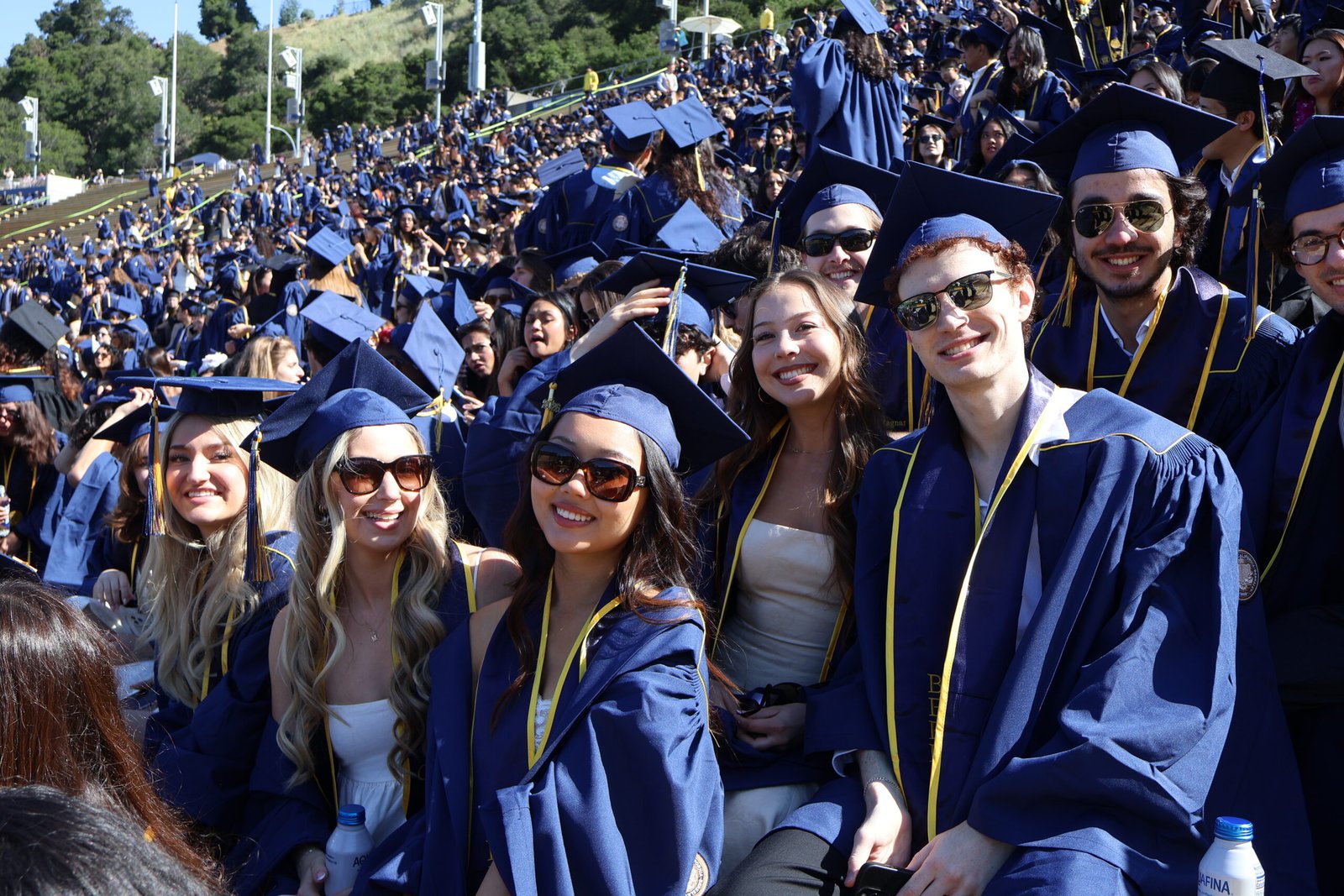
Saturday morning marked UC Berkeley’s 2026 campuswide commencement ceremony, where more than 7,000 graduating students gathered at California Memorial Stadium to hug, laugh, snap selfies and reflect on their academic achievements under a cloudless blue sky.
Throughout the morning, among students, family members and speakers, one theme stood out: the importance of connection and community as a foundation for graduates to go out and change the world.
In his address, Chancellor Richard K. Lyons encouraged graduates to use lessons from Berkeley to build bridges in what he called a “period of profound societal division.”
Keegan Houser/UC Berkeley
“You’re uniquely suited to apply all you have learned and gained to one of the highest possible purposes — to be builders of bridges across the divides that threaten to tear us apart,” Lyons said. He exhorted students to have empathy for those who view the world through lenses other than their own, and to always strive for connection over division.
Those ideas were echoed by Robert Reich, this year’s commencement speaker, who emphasized the unique power Berkeley grads hold to make positive change in the world despite enormous headwinds.
“I’m not going to minimize the challenges you face, from authoritarianism to climate change to the job market and a world in turmoil,” said Reich, a professor emeritus at the Goldman School of Public Policy and former Secretary of Labor under President Bill Clinton. “But I know that you will take what you have learned at this wonderful place and teach others what is worth doing, how to do it better, how to protect the powerless and hold accountable the powerful.”

Ellie Sahand/UC Berkeley
Reich concluded by encouraging students to be the best, most authentic versions of themselves they could be. “You are the teachers and the leaders the world needs,” he said, to which the stadium filled with cheers and applause.
This year’s University Medalist, Charles Long Jr., praised the many “organic intellectuals” in the graduating class — students who came to college not to escape their communities, but to learn how to serve them.
“I see what you carried,” Long said. “Family responsibilities and pressure. High rent and endless debt. Grief and depression. Disabilities and illness. Long shifts and late nights — and still, you made it here. You are amazing. So please, give yourselves a hand.”
A sociology and social welfare double-major who overcame incarceration, homelessness and a difficult childhood to graduate as this year’s top senior, Long underscored the importance of embracing one’s differences to forge an authentic life.

Ellie Sahand/UC Berkeley
“The world does not need us all to agree on everything. It does need us to remember that we belong to one another,” Long said. “Across our differences, we share a responsibility to leave people more free, more safe, more seen, and more loved than we found them. And when doors close around you — because some will — don’t be afraid to build your own. Then hold that door open so someone else can walk through it.”
For this year’s graduating students, those ideas reverberated as they reflected on the most memorable parts of their Berkeley journey.
Ato Aliping, a sociology major who aspires to one day practice law, reflected on the sacrifices that his parents, both immigrants from the Philippines, made to allow him to attend Berkeley. He noted that he might be the first person in his family’s tribe to graduate, and proudly wore its colors to represent the achievement.

Ellie Sahand/UC Berkeley
When asked what it meant to his family to see him here today, he didn’t mince words: “Everything. Everything,” he said. “They were looking for a better life. My dad, he was in the U.S. Navy for 30 years, and I’m here on the GI Bill with his military benefits. They sacrificed a lot for me to be here. I owe a lot to them. And I want to represent my community.”
Others reflected on personal challenges they had to overcome to make it to this joyful day. When Alicia Valenciana first arrived at Berkeley as a neurobiology major at age 17, she says she struggled. “There was a lot going on back home mentally, emotionally,” she recalled, leading to academic challenges and ultimately having to leave school for a period.
She was able to gain readmission as a sociology major a few years later, and now plans to be a school counselor. “There are so many students who don’t have support systems at home, so school psychologists are really needed,” Valenciana said.
For Jared Kazhe, club Frisbee became much more than a sport he loved; the people he met through it, including fellow graduates Kyle Kim and Kainoa Huttendorf, ended up becoming family. “It’s my strongest community by far,” he said.
Kazhe, who is Mescalero Apache, wore regalia to honor his Native identity and community at commencement. His uncle beaded his mortarboard, he said, and he wore a beaded medallion that his grandmother made for him with his tribal seal stitched onto his stole.

Marissa Gutierrez/UC Berkeley
He also wore an eagle feather symbolizing strength and power. “You get it out in times of great accomplishment,” Kazhe said.
Na Lee Her, a film and media studies major, says the network of support and sense of belonging she found at Berkeley made her college journey meaningful. “Being able to meet new people — and also find out more about myself — that’s one of the best things,” she said.
Her, who is Hmong, wore a stole with intricate blue and white embroidery called Paj Ntaub. She noted that few Hmong students attend Berkeley, and that the stole was a way to celebrate her roots.
After graduation, Her plans to stay on campus to build up experience in film production. “I do plan on going to New York someday,” she said. “I really like being able to be on site and to do everything that the people are doing to make a movie go.”
Her advice to incoming students? Don’t give up, even if things seem challenging in the moment. “One bad thing is not going to ruin your entire day,” she said. “Feel it and let it pass and do your best.”
As the ceremony concluded, the former students rose to receive their degrees, moving tassels from the right to the left. The space rang with cheers and applause. Berkeley’s newest alumni left the stadium with encouragement to go out and make a difference in the world. They seemed ready.



